| | |

Tulip Mania

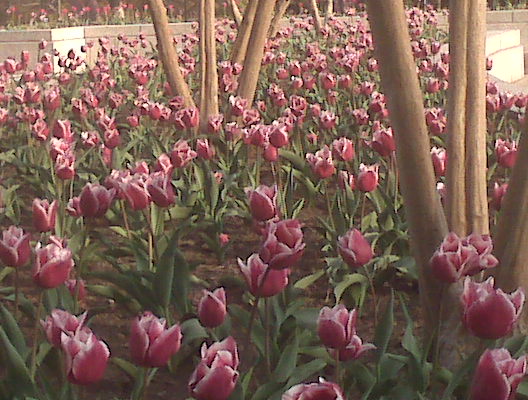
Whenever I see extensive plantings of tulips, it brings to mind the tulip mania of the 17th century Dutch. At the height of the mania, single bulbs could sell for several times the annual income of a skilled worker.

Now, the tulip is just another beautiful flower. How could it ever have been the focus of such outrageous extremes of lust, gambing, greed, and social mania?

It is a great contemplation to examine what leads us to desire and seek and value particular things–either individually or collectively. Do the desires bring us to a place of greater good and true fulfillment or is the desire just fueling the unhappy dance of craving and loss?

The tantric philosophers point out that desire itself is not bad. After all, it is what gets us out of bed in the morning and can turn us to the good. But if it is driven by external opinion and emptiness of self, then it yields suffering–the suffering from which yoga seeks to free us.

Peace and light, E — Posted with WordPress for BlackBerry.

Similar Posts

  • |

    Parama Shiva Tattva (playlist from class)

    Per Pam’s request, here’s the Shiva-themed (with a little Ganesha {son of Shiva} and Bhuvaneshwari {Adi Parashakti inseparable from Shiva} included)  playlist from Saturday’s class:

    • Om Shiva, Chloe Goodchild, from Sura
    • Hey Shiva Shankara, Dave Stringer, from Japa
    • Shiva Shambo, Bhagavan Das, from Now
    • Son of Shiva, MC Yogi, from Elephant Power
    • Om Mata, Ragani, from Best of Both Worlds
    • Dancing with the Goddess, Atman, from Eternal Dance
    • Namah Shivayah, Krishna Das, from Live on Earth
    • Hara Shiva Shankara, Jai Uttal, from Spirit Room

    Enjoy.  Practice.  Dance.  Sing.

  • | | |

    Harvesting and Replanting

    This weekend’s work in the garden continues on removing summer plants that are no longer productive to make way for cold weather planting (various greens and root vegetables).

    The cherry tomatoes and a couple of the hot peppers are still flowering in addition to fruiting. Those I will leave in place as long as they are producing or until a frost, whichever comes first.

    I ruthlessly pulled up all of the other pepper plants, gleaning the last of that cycle of the harvest (some years there are lots of peppers to pickle and roast and enjoy into winter, but not with this summer’s weeks of blasting, arid heat followed by the flooding storms).

    With the limited space in my tiny garden, frittering away time or space from sentimentality, attachment, neglect, or lack of knowledge, has a significant impact on the possibility of flourishing. Sometimes I relish my ability to be ruthless in the garden–to tear things up that do not serve, let them go, and invite in new and more nourishing and productive things.

    When thought about in relationship to the vastness of possibility, my life is not unlike a tiny and limited garden, the limits being space and time and the particular and peculiar collection of quirks, challenges, and talents that came in this incarnation. Oh to be as ruthless in discarding what does not serve in this life as I can be in the garden.

    Peace and light, E — Posted with WordPress for BlackBerry.

  • Would My Life Have Been Different?

    The other day I found myself wondering how and whether my life would have been different if at 20 I had been introduced to the writings of Abhinavagupta instead of those of Derrida

    It is always interesting to contemplate “what might have beens,” as long as it does not invite regret or disappointment.  I might have continued as a philosopher instead of shifting to law or have practiced yoga with greater intensity earlier on if I had been reading Abhinavagupta instead of Derrida, but who is to know what really could or would have happened if things had been different.  We need to act as though we can shift and change, but we must at the same time accept that we are ultimately not in charge.

  • | | |

    “Who Goes On A Diet to Lose Three Pounds?” (and the Carbon Footprint of Orange Juice)

    The other night after yoga class, a group of us went out to celebrate a friend’s 39th birthday.  During the ambling course of the conversation, I said that I was turning 50 later this year.  I added that I would grow my hair another couple of inches longer and lose three pounds, and 50 would be just fine (let’s leave aside for now all the societal conditioning that goes along with feeling that such an age marker wouldn’t feel too old as long as my hair was long and my body at a youthful weight).

    “Who goes on a diet to lose three pounds?” asked one of my friends.  I find that people sometimes look at me and are shocked that I pay attention to my weight.  They have an idea that someone who stays slim is just lucky rather than consistently mindful.  My grandmother who was 4’11” in her high-heeled slippers was the one who taught me to be mindful in this way.  Once or twice a year, she would moderate her diet to lose the two pounds that crept on after one too many desserts over the course of a few months without any other change in her modest, healthful for those days diet.

    Going on a diet to lose three pounds means never having to lose 10 or 20 pounds or more.  It means returning to mindfully eating a little extra less for a couple of weeks after a couple of months of having eaten a little more than what is perfectly sustaining rather than having to go through a major lifestyle change.  In my middle age, I pay attention to my diet not as much for how I look in my clothes and feel about my body, but more for whether what I am eating is healthy for me and the planet.  One of the best and easiest ways to be at an optimal weight, feel healthier, and have less impact on the planet is simply to eat less (though this is a new announcement by the government, any one with even an ounce of common sense knew that, no matter how much exotic, novel, or challenging diets seemed more appealing).

    Part of eating the right amount for your ideal fit with your body and its relationship to the planet and society is having food that is not necessary for a healthy body only on special occasions (which is different than rigidly forbidding it to yourself).  In reviewing what is sustaining for me and the planet while still enjoying a delicious diet, I periodically take a look at what I am eating and think about what is really fulfilling.  One of the things I enjoy, but have known really should be a treat is orange juice (which I stopped drinking on other than an occasional basis several months ago and truly have not missed).

    If you are eating multiple servings of vegetables and a piece or two of fruit a day, orange juice processed, packaged, and shipped outside of a grower state provides little more benefit to your diet than does a can of soda.  If you kept everything else in your diet consistent and aren’t already eating enough to be gaining weight, eliminating the unnecessary glass of juice would not only diminish your carbon footprint (and if it is not organic, your chemicals into the drinking water footprint as well as your carbon footprint), but you also would be eliminating the number of calories it takes to gain a pound over the course of a month.  And if you live in one of those states covered in snow and ice and are yearning to eat something from the land of sunshine, eat an orange or some other tropical fruit–organic if you can get it — and skip the processing, the cooking (pasteurizing), and some of the packaging that goes into it being shipped to your grocery store as juice.

  • | |

    A Favorite Sculpture (and the missing mentor)

    I have been walking past this sculpture regularly ever since I was a judicial clerk in 1987-1988.  It is in the plaza between the Federal and DC court houses.  It is dated in the subject matter.  The partner-associate relationship has shifted over the years, both from the inclusion of women in the law place and the changing economics.  The shift in economics to assume that most associates will not be partners because the firm simply does not have the space for more partners and because the associates feel freer to move around and for a whole host of other reasons, some more benign than others, has left new workers bereft of the support of a mentor.  In the disruption of the continuity of the workplace, those who stay are less motivated to serve as mentors and lose the delight and strength that comes from the action of mentoring.  Those who come into a workplace without a mentor never learn the way they could.  Although some of the changes are good, the missing mentor is indeed a loss.

    Though the sculpture reminds me of something lost, I love this sculpture, especially where it is set.  It is absolutely suited to its location and was made with great skill and love.

Leave a Reply

Your email address will not be published. Required fields are marked *

This site uses Akismet to reduce spam. Learn how your comment data is processed.