| | | |

Outrageous Light (and Sadhana)

I just spent a week looking at the celestial realms — inner and outer.  Fifty of us spent a week meditating and studying with Paul Muller-Ortega at a retreat center in Sedona.  It might seem from these pictures that there was not a moment when we weren’t exclaiming in awe over magnificent visions.  The truth is that many times of the day, the sky was not spectacular, but I was always looking and always had my camera in my pocket, whether the sky was dull or flat when I left my room or whether it was engaged in some outrageous display of light.  The photographs below are in chronological order to show the pulsation of night and day, the progression of the moon from almost full to full, the shift in mood from day to day.  But, the images show a completely edited view.  There were the views for which I did not take out my camera at all.  Those were the majority, but I was still looking.  There were the views I photographed, but deleted from the camera memory, choosing not even to save them.  There are the photographs that I downloaded onto my computer, but did not even enlarge to get a better view.  There are photographs I enlarged, but decided not to edit.  Then there were the photographs I chose to edit by making decisions about cropping, brightness, contrast, hue, and saturation.  The photos below are a subset of the last group.

If I were doing a show where I printed and framed the work, I would have worked from at least ten times as many images and would have done multiple prints of each image before choosing what to display.  In this persistency and discrimination, photography teaches much about meditation practice.  To show what is seen in a way that shifts the soul of the viewer, the photographer has to look over and over again.  For example, Robert Frank took over 20,000 images for “The Americans.”

Anyone (especially these days with the technology available) can take an extraordinary picture or two if in the right place at the right time with the camera.  But to have a body of work takes consistent devotion, work, and presence.  So too, with our meditation practice.  Some days exquisite visions arise.  Sometimes we are pulsing with extraordinary energy that fills us with a sense of the very fullness of being.  Other times, old issues or the to do list or even feeling trapped by sitting still is what comes.  If we sit consistently over a long period of time, though, we will witness — just as the camera did — the extraordinary.  We will know from being consistent that it is our very consistency that reveals bliss.

Similar Posts

  • |

    Louise Bourgeois at the Hirshhorn

    The other day, I went to see the Louise Bourgeois retrospective at the Hirshhorn.  The works are a combination of exquisite technique and in-your-face, challenging emotions.  I had a friend who raged at me once because I had created a piece that was radically, polemically feminist.  “That’s not art; art is only meant to be beautiful and aesthetic, not to be political,” said my friend.  Although he could not have questioned Bourgeois as an artist — her technique is too good — he might still have raged at it.  (The high school group being shown art on a field trip, while I was at the exhibit, was scurried through a room or two, much to my amusement).

    Seeing the exhibit led me to think of the purported purpose of left-handed tantric practices, which are meant to challenge us, turn us upside-down and inside out, and question what we recognize as the divine.

  • More Thoughts on Consent

    I’m pretty sure that I am not alone in wishing that I would be assisted or touched–in yoga class or elsewhere–exactly when and how suits me without my having to say a word. But permeable/bridgeable boundaries require clear and steady awareness and communication.

    I’m in the middle of a weekend workshop at Sun and Moon Yoga out in Fairfax (a whole different place from where I live and spend my time in the DMV, but that’s another story) with Dianne Bondy (check her out on social media or get her book) on making yoga more inclusive and accessible to all.

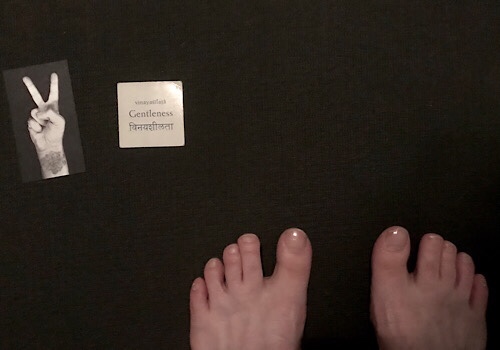
    One of the many things discussed was consent. Since I wrote about my reaction to having to say yes or no to physical assists by hand raising, I’ve also been at a studio with cards that one takes and puts on one’s mat to say “no; please don’t touch me.” What if the card ends up under a prop? What if you don’t want other students to see that you don’t want (or want) assists? What if you change your mind?

    The solution Dianne has seems the best I’ve seen. Every body gets a card (she uses playing cards from the dollar store). Face up means I am open to the possibility of an assist. Face down means leave me completely alone. Students can change which side is up throughout the practice.

    If the card is face up, it’s just agreeing to further the conversation. Seeing that level of consent, Dianne said (as I was taught in my Anusara teacher trainings), if she thought there was something beneficial to offer, she then would ask while approaching if it was ok to offer an assist. If the answer was “yes,” then she would give a verbal assist. Only if the verbal assist was insufficient, would she ask if she could offer a physical assist and would say where she would touch the student to give the assist BEFORE doing so. The student would then have another opportunity to say “no” or provide limits on the permission.

    Of course, in a big public class, this all gets done quite quickly, but I think this really is the only thing that works. I’m also sure, from my personal teaching experience, that there might be an occasional moment, like catching a student about to fall and maybe take down another student, that an urgent intervention must be done regardless of prior permission for assists generally–but those should be rare indeed.

  • | |

    Flying Carpet Yoga

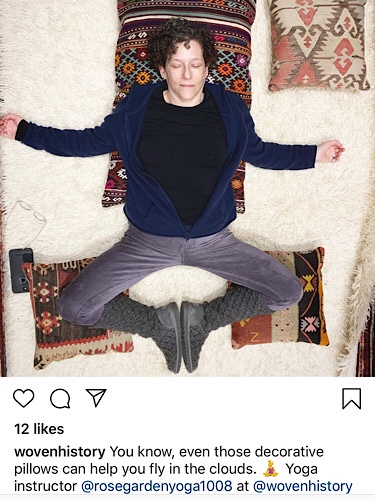
    I have been talking idly with the family at Woven History about having a yoga benefit for members of either local community or where Woven History trades who are in need. On a winter evening after closing hours, using the cushions and carpets for props. Here’s one pose I have in mind. You can also do this with bed pillows in a hotel or guest bedroom.

  • | |

    In Honor of Tzaddik RGB

    Although, having been raised as a Quaker and continued to practice as such in adulthood, I do not observe most of the Jewish rituals and holidays. This year I was certain that I at least wanted to bake something traditional for Rosh Hashanah, and I felt engaged with wanting some part of ritual observance.

    Thus in recognition of RGB leaving this embodiment into that of a tzaddik, I have a honey-glazed, sourdough, apple challah–baked round for the cycle and fullness of the year.

One Comment

Leave a Reply

Your email address will not be published. Required fields are marked *

This site uses Akismet to reduce spam. Learn how your comment data is processed.