More Thoughts on Consent

I’m pretty sure that I am not alone in wishing that I would be assisted or touched–in yoga class or elsewhere–exactly when and how suits me without my having to say a word. But permeable/bridgeable boundaries require clear and steady awareness and communication.

I’m in the middle of a weekend workshop at Sun and Moon Yoga out in Fairfax (a whole different place from where I live and spend my time in the DMV, but that’s another story) with Dianne Bondy (check her out on social media or get her book) on making yoga more inclusive and accessible to all.

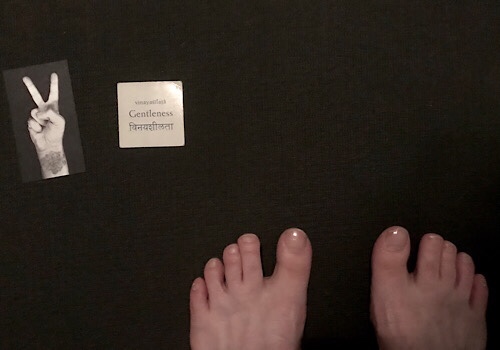
One of the many things discussed was consent. Since I wrote about my reaction to having to say yes or no to physical assists by hand raising, I’ve also been at a studio with cards that one takes and puts on one’s mat to say “no; please don’t touch me.” What if the card ends up under a prop? What if you don’t want other students to see that you don’t want (or want) assists? What if you change your mind?

The solution Dianne has seems the best I’ve seen. Every body gets a card (she uses playing cards from the dollar store). Face up means I am open to the possibility of an assist. Face down means leave me completely alone. Students can change which side is up throughout the practice.

If the card is face up, it’s just agreeing to further the conversation. Seeing that level of consent, Dianne said (as I was taught in my Anusara teacher trainings), if she thought there was something beneficial to offer, she then would ask while approaching if it was ok to offer an assist. If the answer was “yes,” then she would give a verbal assist. Only if the verbal assist was insufficient, would she ask if she could offer a physical assist and would say where she would touch the student to give the assist BEFORE doing so. The student would then have another opportunity to say “no” or provide limits on the permission.

Of course, in a big public class, this all gets done quite quickly, but I think this really is the only thing that works. I’m also sure, from my personal teaching experience, that there might be an occasional moment, like catching a student about to fall and maybe take down another student, that an urgent intervention must be done regardless of prior permission for assists generally–but those should be rare indeed.
Similar Posts

  • How I Injured My Wrist (a Reminder)

    About a month ago, I strained the top of my hand near my wrist as I was moving from uttanasana–standing forward fold to adho mukha svanasana–downward facing dog. I was certain that I had placed my hand properly. I always place fingerpads down first and then ground my metacarpals, with the emphasis on the index finger metacarpal. My fingers were evenly spaced. It felt like perhaps I had jammed the bones or slightly dislocated them–the wrist/hand version of a sacrum “going out.”

    My initial reaction was to work harder, but it was not feeling any better. I resorted to resting for a few days and then concentrating on forearm balance instead of handstand.

    When I was at the weekend workshop in New Jersey last month, one of my friends suggested that I was working too hard. That was definitely on the right track. Once my hand was in place, though, what felt best was to work very strongly. During the first intermediate/advanced workshop, I was fortunate enough to be able to spend a few minutes with John Friend, who gave me an adjustment that rearranged the bones. This cleared most of the pain, but my hand was still extra sensitive.

    I found myself placing leaving my hands soft and placing them with great delicacy. Before going into weight-bearing I added the actions of clawing the fingerpads and drawing the thumb and index finger together, while making sure my metacarpals were firmly rooted. No pain.

    I went through this sequence of events with my Wednesday night group practice students yesterday. I showed them the difference between engaging strongly as the starting point of the hand alignment and sweetly touching, immediately followed by full engagement.

    “What principle of alignment had I been leaving out?” I asked. Without hesitation, they chorused in unison, “opening to grace.” Exactly right. Sometimes practicing the Anusara principle of “opening to grace” is subtle, but it always comes first and, in my experience over the past decade of study and practice, is always essential to have the most life-expanding and holistic of practices.

    Peace and light, E — Posted with WordPress for BlackBerry.

  • | | | |

    Asteya and Juneteenth

    Asteya in Sanskrit means non-stealing and is the third yama of the yamas and niyamas set forth in Patanjali’s Yoga Sutras as a critical part of the path of yoga. White people giving themselves a holiday created by Black people for themselves without both taking action against current injustice and inequity is a classic example of what would be stealing.

    Could you give extra support to a Black business today? Donate to a Black-run organization working to fight for civil rights or voting rights or equal access to health care, education, and support services or against police brutality? Give mutual aid? Write to your elected officials about said issues?

    We don’t have to do everything every day, but it is not ok to do nothing.

    Chalk drawing on stairs says:  1865, we are not free until all are free; Black Lives Matter, voting rights, climate justice, make reparations, support Black business, seek justice, don’t be a hypocrite, Juneteenth—not just a Federal holiday
  • | |

    Mahashivratri

    On this mahashivratri , the darkest moon of winter, the night to delve into our dreams, into the rhythms of the wild dance of existence, experiencing the fullest emptiness . On this night, too, the goddess Uma (aka Parvati) incarnate as feline WHO IS NOT SUPPOSED TO BE ON THE BED appears to have been reunited with Siva Nataraja.

  • |

    Uncertainty

    Like the financial markets, I historically do not respond well to uncertainty, even when nothing bad has yet happened. To have the government shutdown looming (and all the preparations to be forced off the work place next week) in the midst of the escalation of war, chaos following natural disasters, and looming threats to the environment and most of what I hold dear socio-politically is pushing my buttons.

    This morning, as I rose from my morning meditation, refreshed and ready for the day, I reminded myself of the absolute certainty that as long as I am conscious, I can meditate. And as long as I can meditate, I have a space of peace, beauty, vibrancy available to me. That is a wonderful certainty indeed in these uncertain times.

    Peace and light, E — Posted with WordPress for BlackBerry.

Leave a Reply

Your email address will not be published. Required fields are marked *

This site uses Akismet to reduce spam. Learn how your comment data is processed.