Advaita Vedanta?


Martin Luther King, Jr. said: “A true revolution of values will lay hand on the world order and say of war, “This way of settling differences is not just. …A nation that continues year after year to spend more money on military defense than on programs of social uplift is approaching spiritual death.” Still, the Pentagon suggests that Martin Luther King “might” have supported the war in Afghanistan. Not sure on what basis.
Last night at the Willow Street Book Club, where we were reading Ram Dass’s Paths to God–Living the Bhagavad Gita, one of my fellows raised the question of how we could read as a spiritual guide a book whose context is war. Another asked a similar question from the perspective of a feminist. It was a fabulous, engaged, lively discussion, and I hope to see more next month.
It would be an injustice to the text and the historical context to read entirely out of the Bhagavad Gita the duty of a warrior to kill, a wife to practice suttee, and persons born into each caste to accept their lot in life in a society structured on the caste system. There is much richness in the text, though, that can provide guidance for a feminist, pacifist, who believes that “all men are created equal.”
We have reread “men” in the Declaration of Independence to include women and those of all races (though we cannot manage to rewrite the Constitution to explicitly state that women are equal, but that’s a thought for another day). Similarly, without doing injustice to the text, we can see that the ultimate teachings about living in accordance with duty (svadharma), love, devotion, and sacrifice in the Gita, like the concepts of “life, liberty, and the pursuit of happiness,” provide guidance and force for social action and spiritual devotion beyond a historical context that oppressed and bound on the worldly plane the very persons who are now seeking the deeper meanings in the text. In fact, I believe that we can use the essential intent of the text to teach and transform the oppressors, to use the very text to show why the violence and oppression of the historical context is injust and needs to be changed so that the spiritual intent can be expanded and spread beyond the privileged.
We have a choice. We can emphasize what we don’t think enhances life (for example, an over-sized, gas-guzzling, suburban SUV with city plates) or we can focus on an exquisite reflection of beauty. That we see what optimally would better be changed or shifted to be more fully aligned with nature or that we speak of it does not mean that we are not seeing beauty or embracing the whole of life with love.
My chosen reading for the train journey to New York and New Jersey to visit with friends and to attend a weekend workshop at Dig Yoga with Paul Muller-Ortega and Sianna Sherman is Mariana Caplan’s Eyes Wide Open.
I have my reasons to have reservations about some of what she says and advocates. I am finding the book interesting and not untimely reading, though, and fully agree with her caution: “To approach spiritual paths and practices with intelligent skepticism is advisable.” I would add to this statement that the discerning, questioning approach should not just be at first experience, but should be cultivated continuously and progressively more insightfully as explorations and relationships deepen.
Peace and light, E — Posted with WordPress for BlackBerry.
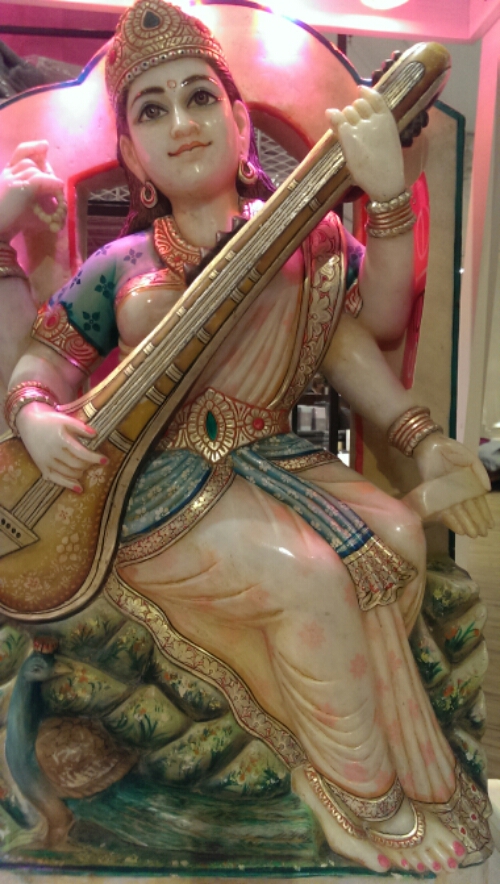
Every time I walk past this sculpture, I wonder whose idea it was to repaint it. For a long time it the gilding was chipped and faded. For me it had much more charm showing its age.
So too, I think, with humans. It is great to feel and look youthful naturally because of proper care of health, and quite another to disfigure ourselves and our looks with surgery and treatment seeking always to look like we have not fully lived out some life.
By all means, seek to remain vibrant and supple, but do please also honor the signs of experience.
Peace and light, E — Posted with WordPress for BlackBerry.