| | |

Quote for the Day

My chosen reading for the train journey to New York and New Jersey to visit with friends and to attend a weekend workshop at Dig Yoga with Paul Muller-Ortega and Sianna Sherman is Mariana Caplan’s Eyes Wide Open.

I have my reasons to have reservations about some of what she says and advocates. I am finding the book interesting and not untimely reading, though, and fully agree with her caution: “To approach spiritual paths and practices with intelligent skepticism is advisable.” I would add to this statement that the discerning, questioning approach should not just be at first experience, but should be cultivated continuously and progressively more insightfully as explorations and relationships deepen.

Peace and light, E — Posted with WordPress for BlackBerry.

Similar Posts

  • | | | |

    Teaching Less to Practice More

    This morning is the last Saturday in the foreseeable future when, even waking up before dawn, I have to cut short my morning practice to get on the metro to go teach. I have a strong memory of a relatively novice teacher telling me, before I started teaching, that she was going to stop teaching indefinitely because she needed more time for her own practice. At times over the years, when my other job was at its most demanding, I would think about that statement. Mostly, though, I have circumscribed other activities to fit in time for work, teaching, and a full practice.

    It came time to admit, though, after nearly two years of steady study with 0Paul Muller-Ortega, which expanded my meditation practice from 25-30 minutes a day, in addition to asana practice and studying, to an hour a day plus additional practices and more studying, that there are not enough hours in a day for all I want to do.

    I have been teaching on Saturday mornings for a number of years now. I love my Saturday morning students and have embraced the discipline of getting to class to teach.

    The energies have shifted. I will still teach my noon class on Saturday and my weeknight classes, but I will have more time for a full practice and perhaps some extra garden time from this shift. I expect that this time to deeper into my own path will bring new energy and light to my teaching. I hope trust I will see my Saturday morning students at other classes and workshops, both when I am teaching and taking class together at Willow Street.

  • |

    The Triangle Player

    Yesterday, while watching the Capitol City Symphony and Capitol Hill Chorale’s joint performance of Beethoven’s 9th Symphony at the Atlas Theater, I noticed with some amusement the cymbol player reading a novel in the wings through the first three movements.  (The triangle player appeared just in time for the fourth movement).

    This reminded me of an anecdote John Friend told at the Anusara Certified Teachers’ Gathering in Denver the other week to illustrate the importance of every person and element to the whole.  He spoke of the triangle player.  What do you say to him after the show, John asked, “great job man;  I love the way you came in right when you were supposed to?”  Even if showing up and playing one beat at the right time is the triangle player’s only job, the triangle player still is an integral part of the composition, though perhaps not as evidently crucial as the first violinist.

    We may not know how we are essential or how we will shift things, but we should always revere and recognize each and every being, including ourselves, as part of the web of existence.

  • |

    Different Ways of Turning Your World Upside Down

    Yesterday at the William Penn House class, we were emphasizing strong working of our tailbones.  One of the regular students came to class even though she was still exhausted from recent and sudden major loss and upheaval in her life.  She wanted to be with the spirit of the class even if she would not be able to do everything.

    When we went to the wall to work on half and full arm balance, I advised her to give it a try if she felt up to it and then said to do legs up the wall if she knew trying to hold the arm balance would be too much.  After all, I pointed out, legs up the wall (vipariti karani) is just half handstand upside down.  And what is awesome about both the poses is that the both turn us upside down (albeit in energetically different ways) and can thus help give us a fresh perspective on how we are in our bodies and minds.

  • | | |

    Thoughts on Attribution and Lineage

    What do we mean, exactly, when we say a thing is “by” someone? Yes, we are attributing the thing’s creation to that someone. But how is something just by us when it is based on all the input and teachings to which we have been exposed or immersed? How do we give credit when it is due? How do we honor and acknowledge what has influenced us? When is attribution called for?

    The yoga sages speak of the parampara, the lineage of teachings. For some the lineage is just that: a linear chain passed on from one generation of teachings to the next, and the attribution is clear. Those in such lineages or who would lead one of their own making often teach that one should pick one path (one style of yoga/meditation) and stick with that form or teacher to succeed (with the mythic goal of enlightenment).

    From my unattained perspective, I question who is to say how “enlightenment,” assuming it is indeed something that can be achieved, would or could or should be attained by anyone else? Practice tips for enhancing the experience of human embodiment (is that not the real path?) are nice, though.

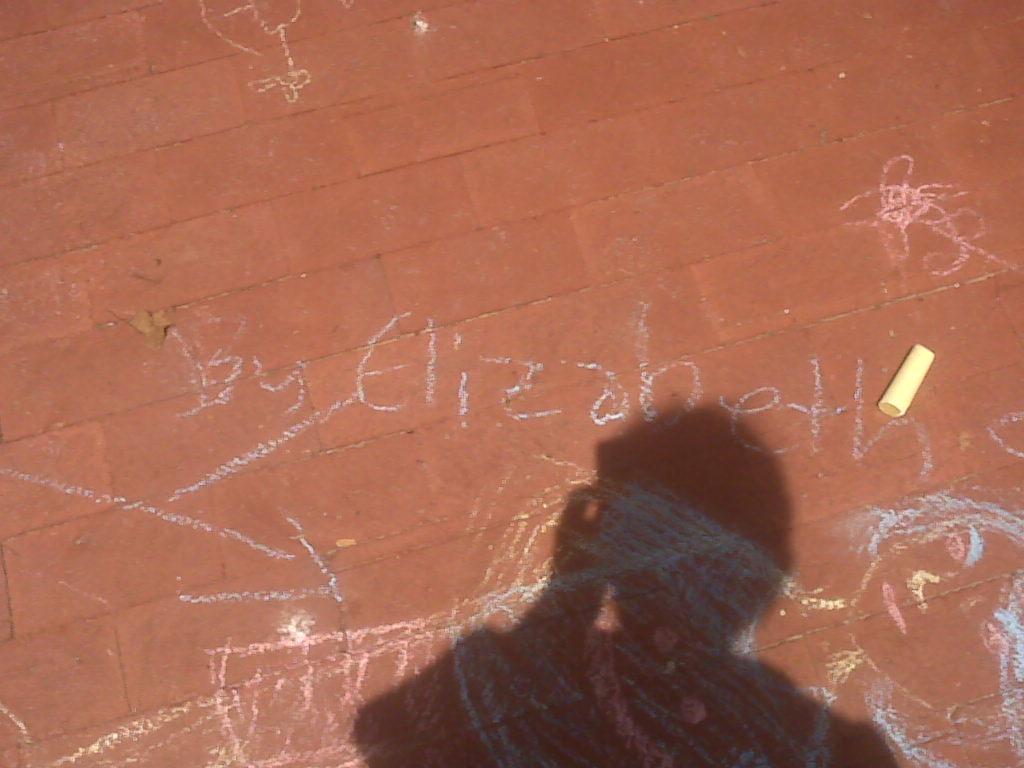
    I do not know the Elizabeth who drew on the sidewalk. She is quite possibly about the age I would have been when I first read (not saw the movie) Mary Poppins and dreamed of entering another world through a chalk drawing on the sidewalk.

    Peace and light, E — Posted with WordPress for BlackBerry.

Leave a Reply

Your email address will not be published. Required fields are marked *

This site uses Akismet to reduce spam. Learn how your comment data is processed.