yoga sutras

  • | |

    Knowing Your Garden (and svadyaya)

    This will be my 20th season in my garden.  I know that my back garden — where I grow my herbs, flowers, and vegetables —  is easily 4-5 weeks earlier than the gardens of my friends’ in Potomac and Silver Spring and the outer suburbs.  It is even almost that much earlier than my front garden.  I have a brilliantly sunny, south-facing, protected back garden with a brick patio that is against an unpainted brick house and a densely shaded, north-facing front garden.  Not only is the back garden sheltered from the wind by the house on one side and the fence on three sides, but the bricks retain enough heat to change the temperature by a a couple of degrees.  I have a special micro-climate.  My climbing rosebush (pictured in the header) is already in leaf.

    What does this mean?  While my friends in the suburbs or those with east/west facing houses are starting seedlings for kale and spinach indoors, I can put seeds into outdoor containers in the next week or two without compunction.  The seedlings I would need to start (if I don’t instead choose to purchase them from the organic farmers at the market) are peppers and tomatoes for planting in mid-April.  If I start with strong 8″-12″ plants in mid to late-April (depending on the 15-day forecast), I can have and have had for at least 10 of the past 20 years, cherry tomatoes in May and peppers in early June.  My greens, obviously, bolt earlier.  I’ve figured out that certain varieties of chard do better in these conditions, and that spinach and lettuce do better sheltered by the fence where they get afternoon shade, so that I can have them farther into the season.

    This kind of knowing by combining general book and teaching knowledge with personal observation of my little space, is much like the yoga practice of svadyaya (self-knowledge), which is the fourth niyama of Patanjali’s yoga sutras.  Svadyaya is literally study of the self through the scriptures.  Implicit in that is the guidance of a teacher or guru.  Ultimately, though, self-knowledge or awareness must be experiential.  We make the effort to study and we listen to our teacher, but then we practice.  We soften and open to who we (or our garden) truly are — another way of practicing and experiencing the Anusara principle of opening to grace — and then in the context of the teachings, accept who we are.  As gardeners, that means accepting what zone we are in, how much shade, water, space, and sun we have.  As yogins, it means accepting our strengths and our limitations.  We can shift our zone by treating certain plants as indoor/outdoor or as annuals rather than perennials; we can enhance our water flow by storing it in rain barrels, but that is merely expanding the edge rather than making a complete change.  We can expand the edge of our practice, but still need to accept the bodies with which we were born.
  • |

    Home (and sauca)

    It was wonderful to visit another city, to enjoy a change in climate and scenery, to see friends, and to study.  I am happy to be home, though, even with the responsibilities and obligations.  That I am always happy to come home from a trip away (even when I have gone to places perhaps more spectacular or interesting than where I live and met people who are able to do things that are outside of my reach) is one of the things that reminds me that my unassuming life suits me well enough.  Part of this delight in coming home is my having for the past decade steadily practiced the principle of sauca or contentment.

    I remember having a talk with a friend a number of years ago about practicing sauca.  She expressed surprise that contentment could be a practice.  She said she had always thought that happiness was something that just came to you.  Happiness may come more easily to some than others, just as some are born with physical beauty or material comfort and others are not.  It is my experience, though, assuming our basic needs are met, that by practicing sauca, we will be happier both with what we have chosen and what we have been given.

  • | |

    Kleshas (and the absence of helicopters)

    Last night when we walked out of William Penn House from the Tuesday night yoga class onto East Capitol Street, we could see a convocation of police cars in front of the Capitol — presumably in preparation for the President’s speech.  Karen asked, “where are the helicopters?”  “Maybe, Obama doesn’t need them,” I replied, “maybe he is choosing not to live in fear.”  There weren’t any army or police helicopters all night.  This was the first Presidential speech in eight years where helicopters did not relentlessly drone overhead, calling people to be afraid and to act from a place of fear.

    Patanjali’s yoga sutra II.3, says:  avidyha asmita raga dvesa abhinivesah klesah.  BKS Iyengar translates this sutra as follows:  “The five afflictions which disturb the equilibrium of consciousness are:  ignorance or lack of wisdom, ego, pride of the ego or the sense of ‘I’, attachment to pleasure, aversion to pain, fear of death and clinging to life.”

    The world is far scarier now than it has been for most of the past eight years.  In some ways, though, at least in my neighborhood, it feels less frightening because the signs of being afraid are not being emblazoned everywhere to call all to share in the fear.

    We can practice choosing to turn to a place of strength rather than fear on our yoga mats.  When we choose to do the difficult poses that are at our edge that bring up fear and aversion, we can notice the fear and aversion, but not become fully engaged in it.  By using the Anusara principle of opening to grace, we can accept fear and aversion as part of human being, but then soften and open to the full range of being, and not just cling to the fear.  Instead of avoiding the poses or beating ourselves up for being afraid, we can choose to use the yoga principles we know to invite a full experience of the moment and the possible poses.  Remaining open to witnessing the full range of our being through the pose, we next engage muscular energy (strengthening by embracing the muscles to the bone, hugging into our center [midline], and drawing from the periphery into our core).  Having found our strength, we expand more fully (expanding/inner spiral).  We then have space to draw more deeply into our core power (contracting/outer spiral).  With this balance of embrace and expansion of ourselves, we then can fully embody strength by reaching outward (organic energy) and making offering.  This pulsation of principles in poses has led me to discover physical and energetic abilities in my middle age I had not dreamed possible.

    Off the mat, the same principles can lead us to move from love and strength instead of fear and clinging.  As I got into bed with the peace of the night uninterrupted, I pondered how these principles can manifest and gave a profound thanks to whomever decided the harbingers of fear — the helicopters — were unnecessary.

  • |

    Take a Moment (and be in it)

    On unexpectedly beautiful days like yesterday, I make sure that I get out during the workday.  I’ll ask a co-worker, “did you go out?”  Often the response is, “I couldn’t go out; if I went out, I wouldn’t have wanted to come back in.”  This is not an uncommon response.  I so treasure the spaces of delight in the midst of any day, that it is hard for me to appreciate that response on an emotional or visceral level.

    But what my co-worker is saying is that she will get so caught up in longing (pain) that pleasure for a short time is not worth the pain.  Thinking about it in that way, I understand.  Patanjali cautions us not to get caught up in the “pairs of opposites,” pleasure and pain.  Both the longing for pleasure and the avoidance of pain take us out of the moment and make it hard for us to connect to the essence of being.  If we are always yearning and avoiding, we cannot rest in the bliss of being.

    When we take a walk outside, or stop to eat a nourishing lunch, or pause for five minutes to meditate during the work day, it will only have fleeting benefits if we do it just for the pleasure.  If we can consciously bring ourselves into the moment and simply rest in our own being, then it will help us just be (in the state which is free from pleasure and pain/longing and avoidance) while we are in the whirlwind of activity and challenges of our day.

  • |

    Agni (the fire element)

    Agni or fire is the third of the mahabhutas. Fire does not just give us warmth and light.  It also transforms.  Just think of what happens to the humble ingredients of flour, water, yeast, and salt when they are baked. When working with agni in our asana practice, using the Anusara principles of alignment, I have drawn on the intersection of pelvic loop and kidney loop (which together create the action of uddiyana bandha, using these principles as I understand them to activate and strengthen my core.

    One of the niyamas of Patanjali’s eight-fold path is tapas, which means heat or austerity.  We are exhorted to bring fire or fervor to our practice to experience bliss, to know true consciousness.

    Fire without balance, without a sense of detachment or surrender, though, will burn us up.  We must be careful how we work with agni as the element.

    Note:  Agni is also the name of the god of fire.  Not only do we need to be careful how we draw on the fire element — this town’s culture places perhaps too much value on “fire in the belly,” but we should be wary of how we invoke the gods:  India’s nuclear missile program is named “Agni.” Of that invocation of the gods and of fire, I am afraid.

  • | |

    Yoga of Housekeeping

    Last week Orie suggested that as I have a “Yoga for Gardeners” workshop, I should also do a “Yoga of Housekeeping” workshop.  A blog post isn’t a workshop, but here are a few preliminary thoughts on yoga and housekeeping.

    From an alignment perspective, I have found that the Anusara principles of alignment make safe everything I do off the mat, as well as on.  Overwhelmed by all that needs to be done? Doing heavy lifting?  Bending and stooping?  Reaching for something way up high?

    First, soften (open to grace).  Appreciate that you have a home and things to clean.  Honor each item in the house.  Things have energy, too., and they like to be touched and cleaned.  If you have anything that you do not appreciate or does not fit in the house, give it a new life in a new home (freecycledc is a great way to pass things forward).

    Use muscular energy, drawing the muscles to the bone, hugging into the mid-line, and drawing energy into the focal point (for most housecleaning activities, this will be the pelvis).  Using muscle energy will definitely help to keep you from tweaking a muscle or straining the low back or shoulders. When you are reaching, keep the arm bones integrated by hugging the shoulder blades onto the back and then reach from the waist, though each rib to extend the length of your torso (organic energy).

    Especially for bending and lifting, after you bend your knees, hug your shins in (muscular energy), take your inner thighs back and apart (inner spiral) and then tuck your tailbone (outer spiral).  If you just bend from the knees but hunch your back, your low back will still be vulnerable.

    Switch sides for activities like sweeping, vaccuuming, and scrubbing.  Yes, it can be difficult and awkward, but it’s worth it to shift sides.  Imagine doing all of your yoga practice only on one side.  How much imbalance would you be encouraging?

    The first niyama of Patanjali’s Yoga Sutras is sauca, which means cleanliness or purity.  It is easier to think and live and be hospitable in a clean home.

    The first yama is ahimsa, or non-harming.  Do your best to use safe, biodegradable cleaning products.  Your skin and respiratory system will be grateful.  So will the earth.  Try to make cleaning your own space and act of honoring your self, your home, and the greater home of the earth.

    Fully absorb yourself in the task of cleaning.  Make it a meditation.  Integrate fully the act of cleaning, the item being cleaned, and you as the cleaner.

    Finally, be playful.

  • | |

    Hard Freeze Forecast (Heyam Dukham Anagatam)

    My favorite sutra in Patanjali’s Yoga Sutra’s is, II.16, “heyam dukham anagatam.”  This translates roughly as “the pain that is yet to come can be avoided.”  What does this have to do with a forecast of a hard freeze?

    My chard, beets, and turnip greens are still flourishing.  They can manage with a night or two in a row in the high 20sF, and that is all we have had so far.  The forecast for later in the week, though, is for the first true cold snap since 1994 (you may remember that as the year when lots of people’s pipes froze).  My winter garden (which does not have a cold frame due to lack of space — maybe I’ll get more creative next year, and I’ll try an experiement with plastic bags on Thursday night) cannot survive lows in the low teens highs in the twenties.

    I could suffer today by bemoaning the coming cold, worrying about the garden, and remembering that I don’t like cold.  That would be present suffering in anticipation of potential future suffering.  I certainly can avoid that.  I can also do what I did yesterday, which was harvest lots of the chard and most of the beets, put the beets into cold storage (vegetable bin in the refrigerator) and make pasta with sauteed garlic and chard.  Between now and Wednesday night, I’ll harvest most of the remaining greens.  I’ll make a big vegetable soup with the beets and the chard, maybe make chard pie or calzones (truly delicious), and eat the rest over the following days.  I’ll feel grateful that in the bitter cold, I can be eating fresh garden greens.  I’ll be even more grateful that I can just shop at the grocery store or the farmers’ market and don’t need to rely on my garden feeding me year round.  I’ll also be happy for the hard frost.  Part of the reason the aphids and the mosquitoes have been so bad is the absence of a hard frost in winter.

    Some bitter cold in winter in a temperate zone is inevitable, as are sickness and death.  We can avoid suffering by not just getting anxious and unhappy and suffering in the present, but not taking action to alleviate potential suffering.  With preparation and practice, we can avoid some suffering.  Just has preparing for winter in the garden can allow it to be productive for greater parts of the year, so too, with a steady practice of asana, pranayama, and meditation we can avoid some physical and emotional pain and suffering.  Most important, with steady preparation (preparing for the potential for difficulties in the future is not the same as being anxious about it), when the inevitable comes, we will likely suffer less, at least in our hearts, if not in our bodies.

  • Sauca (and the blanket)

    There are lots of ways to clean out a closet.  Partly, it depends on what is in the closet.   Per my earlier post about freecycle, I think that part of the practice of sauca or cleanliness, is making sure that the hidden parts of our homes are not overfilled with stuff we do not use.  Cleaning out the closet, does not mean throwing everything out.  It can mean creatively rethinking where things should be and how we should use them.  It also means for every artist, cook, crafts person, periodically making use of all those things you picked up or saved because they would be of use in something.

    I was raised to save things that possibly could be used later, and to try and make every scrap usable.  I was taught this because my father was born in 1929 and my mother in 1936 of Jewish peasant immigrants.  Now, we are re-learning how to maximize the use of objects and minimize waste for ecological, rather than financial reasons, though the two are inextricably intertwined.  As the recession progresses, it will be interesting to see whether financial constriction will foster more environmentally conscious living.

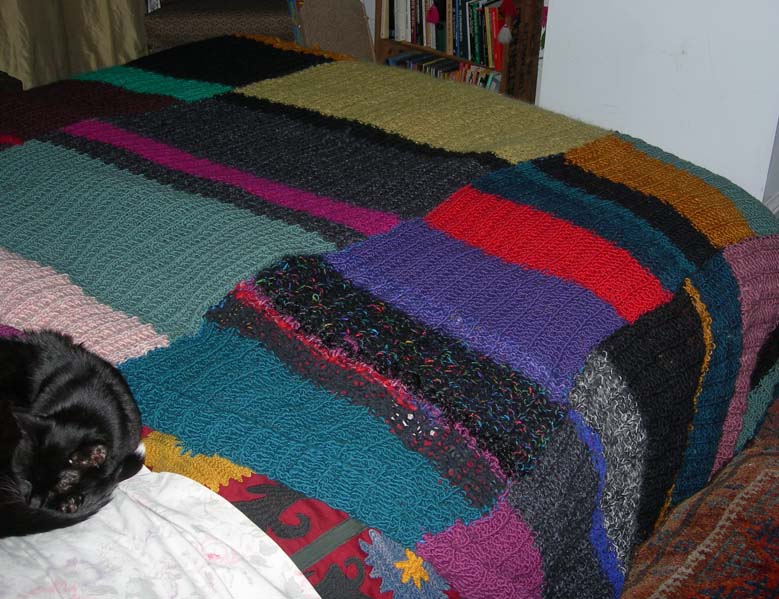
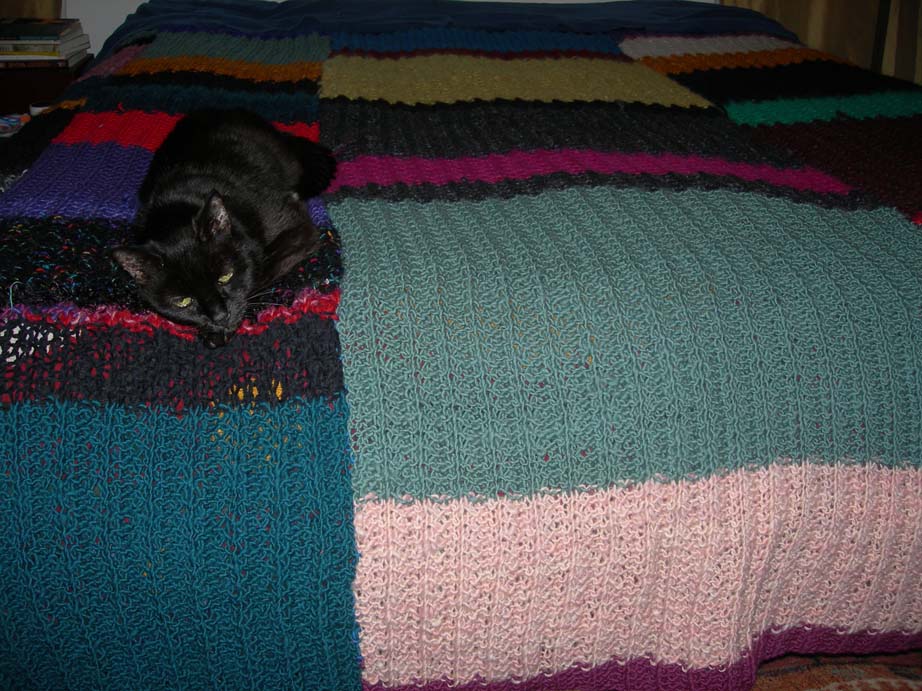
    About four years ago, when I was engaged in a periodic review of what was in the hall closet, I came upon my big box of leftover yarn.  In the late eighties and early nineties, I traveled extensively for business, and spent many hours in airports and evenings in hotels.  I found it comforting to have a lapful of mohair, homespun, or other delicious to touch yarn.  Airport security was less invasive, and it was possible to knit in the airport and take knitting needles on board the airplane.    As I love working with multiple colors, that resulted in a leftover skeins from each project.  Over a 10-15 year period, even with only a couple of aborted projects and no yarn bought for imagined future projects (unlike a really serious knitter), I ended up with enough yarn for a queen-sized blanket (shocking, really).  As you can see, I designed it like a crazy quilt.  It took an educated sense of color and line — imagine this as a painting or pastel and you can see the influence of the Washington Color School, but it did not require much in the way of knitting skills (the whole blanket knit in panels of “mistake rib” — (k2, p2), end k2, p1 — about 50,000 times).  The patch of fire engine red and the grape juice purple next to it, came from my friend Sara, who is a fabulously talented knitter.  I felt the need for those colors, so we swapped for some of the teal and green that I had.

    The blanket took almost four years to knit because I only did it in fits and starts.  Finally, last year, I decided that I needed to finish it in time for Becky be able to curl up on it.  As you can see, she thinks it is great.  Now my closet is not stuffed with a big box of yarn, I have an extra warm blanket that helps me keep the house just a little cooler, I made a thing of beauty where I might have been tempted to go out and buy something new, and Becky has a new happy spot.

  • Sauca (and freecycle)

    The first of the niyamas or ethical restraints set forth by Patanjali in his Yoga Sutras is sauca, which means cleanliness or purification.  BKS Iyengar in his Light on the Yoga Sutras of Patanjali says that sauca is both internal and external and that mastery of yoga is unrealizable without observance of the ethical principles of the yamas and niyamas [non-harming, truthfulness, non-stealing, aligning with the good, greedlessness, cleanliness, contentment, fire for practice, self-study, and acceptance — my definitions] is not possible.
    What does cleanliness mean in this time in our society?  Scrubbing the kitchen and bath with toxic cleaners and slathering ourselves with chemical products and taking long showers may make our house and body look and feel clean, but it is soiling the earth.  It is definitely easier to practice in a neat room than a messy one, but we need to learn how to be clean also keeps the earth’s environment clean as well.
    Earlier this week, I started cleaning out the “art closet.”  I have always created visual art, and before I shifted to teaching yoga, I spent a number of years creating at a wild pace (partly at the encouragement of a live-in partner), using a room in my house as a studio, and exhibiting and selling my work.  One side effect of that intense period of creation (and one of the key reasons I shifted away from it), was that it created a lot of stuff — for every painting or photograph I sold or gave as a gift, another five or eight accumulated in the house.  When I entered yoga teacher training, I turned the art studio into a yoga studio.  I was unable at that time to make a decision as to what to keep and what to discard.  Thus paralyzed, I put it all in a closet — art works and extra supplies alike.
    Having a closet full of stuff long untouched and only some of which was wanted makes a house energetically stale.  Finally, this week, I cleaned out most of the painting materials.  I even decided not to keep images that I did not want to sell or exhibit again.  It was tempting just to break everything up and put it out on the curb for trash.  But the stretchers for the canvas are completely reusable by a working artist.  So I took the paintings apart and and then did a posting on “freecycle dc” offering the art supplies.  If you are not familiar with freecycle, it is pretty simple.  You join the group in your area and let people know what you have to give away.  Nothing is for sale.  Nothing is bartered.  The point is to transfer something you no longer want to someone who wants/needs it.  The recipient is local, so only limited fossil fuels are used to transfer the goods.  What you no longer want is saved from the landfill.
    I’ve cleaned my closet.  Another artist will be creating new art with old materials instead of new.  Less goes into the landfill.  That’s a great example of sauca.