Art and Culture

  • | | |

    Nataraja (and dancing blissfully in life)

    A work colleague of mine graciously said to me that he did not know how I got through certain meetings without yelling, he did not know if he could do it.  I replied that lots of yoga helped.  “Maybe I should get back to transcendental meditation,” he said, “but I found it did not really help; I should find something, though.”

    I said that I tried to think of the challenges at work as just part of the dance that yields such rich abundance for me.  The discussion carried on, and we not only resolved the minor problem that had led to the phone call, but also felt a deeper connection that will make it easier in the future to resolve work issues that we mutually encounter.

    What I like best about the myth of Nataraja is that the dance is not for the purpose of creating the world or with any particular design, but for the sheer bliss of dancing — anantatandava.  The dance makes possible both destruction and creation, but it is not its reason.  When we engage in the dance of our own lives, yoga invites us just to dance fully with wonder at the rich diversity of experience.  We make choices and seek to be more aligned, but ultimately we are just dancing.

  • | |

    Ways to Eat Day Old Bread (Is that “fresh” food?)

    Ayurveda says one should only eat “fresh” food.  What does that mean?  How does that translate into having delicious food making the best use of every bit of it without waste and without having all of our time being devoted to creating it (from start to finish).  Is making a fresh dish from a food item from yesterday’s meal “stale” food?  I don’t think so, but then, I am not an ayurvedic practitioner.  I am fairly certain it is less “stale” than “fast” or packaged food.  And I am too much the New York grandchild of peasant immigrants to forego making the most optimal and complete use of all the food that enters my kitchen.  Also, the simple efficiency of leftovers are too important a component of having the most personally and lovingly prepared food I can with my life style.

    Here are some of my favorite ways to eat bread the day after it was a fresh accompaniment to a salad, sandwich, or larger, festive meal.  (Obviously, this is not for all of those who cannot or do not like to eat bread, which I think of as indeed the staff of life.)   Here are some of my favorites, not in any particular order:

    Crostini/Bruschetta (topped with tapenade, salsa, chopped tomatoes and cucumbers, etc.)

    Bread salad (with the best of the summer tomatoes and fresh basil)

    Croutons (for salad or soup, my favorite is rubbed with a little garlic)

    Red pepper spread with pomegranate molasses and walnuts (bread is the thickener)

    Skordalia (also can be made with potatoes or a mix of bread and potatoes)

    Stuffing for squash

    Bread crumbs for a whole variety of things

    Savory bread pudding

  • | | | | |

    Observing Another Storm Pass without Raining (and a moment of truth)

    The third front in a row.  It is starting to be a long while not to rain in the summer.  It is a tough gardening year:  extreme drought conditions all winter, overly cool and wet spring, now no rain again.

    Watching how the erratic weather patterns are impacting my garden, I am reminded that I am not a purist about gardening or food or my impact on the earth.   As much as I enjoy tending my garden and eating its fruits, there is no hesitation in my mind that if my garden does not produce, I will buy more food at the farmers’ market.  If the pickings are slim at the farmers’ market because of local conditions, I am in no doubt that I will buy food from whatever source, even if I try to make sure it is first local, then humanely picked, then organic.

    When I write about gardening and eating and yoga, I am sharing what I enjoy, what makes me feel healthy.  I do not think of myself as trying to set an example.  In some senses, my yoga practice is similarly about what works for me personally and no more.  The yoga teachings are fairly clear that the design and purpose of aligning with the subtle energies, including living in a more peaceful, less destructive way, is for the enlightenment of the individual practitioner and not for “making the world a better place.”  If by seeking to live in a healthier, more aligned, more peaceful and compassionate way ourselves also brings more global benefits, that is a bonus.

    Looking at our lives from this perspective could cause discouragement.  I hear this question all the time:  “why should I change what I am doing [consuming/eating/driving]?  My behavior is not going to change the world when there are all of those billions not changing.”  In some senses, looking at shifting our behavior from a completely selfish perspective makes it more accessible and meaningful.  If we see our choices having the possibility of making ourselves healthier, happier, and more at peace with ourselves and the world around us, why would we not want to try to live more consciously?

  • | | | |

    Shiva — By Almost Any Name (Summer Session Theme)

    This summer, we will be exploring a very few of the names of Shiva and how they can draw us to a better understanding of ourselves on and off the mat.

    According to the sources, Shiva has either 108 names or 1,000.  Each name has a different meaning.  All of the meanings point to aspects of our own being that are worthy of contemplation.  Some aspects will resonate more deeply for us.  Some less so.

    For me, besides my almost childlike delight in of lists, words, and myths, contemplating the various aspects is of deep usefulness in exploring my understanding of myself on and off the mat.  The various names describe different aspects  human nature and how we relate to others and the earth.

    The multiplicity of the names also highlights that each of us names and experiences spirituality in a unique way and should have the freedom to do so.  (As an aside, I think this multiplicity of forms of worship could be seen as a kind of rebellion within a rigid system of religious laws, but that is a whole other set of thoughts).

    In using these forms of meditation as part of our yoga practice or otherwise, whether we meditate on highly abstract notion of “Shiva” representing the auspicious nature of all beings or on one of the names that points to individual aspects of personality, contemplation on any aspect or name can be used to deepen our relation to our best self so that we can be more aligned with our world inside and out.

    For class this summer, we obviously cannot get to more than a very few.  Feel free to send to me your suggestions about names to highlight.

  • | | |

    Personal History (and Samskara and Opening to Grace)

    A samskara is generally defined as an impression left in us by a past action or experience.  I found myself thinking about the process of samskara yesterday, when I went with long time friends of my family to watch their son taking class at the summer program at the Kirov Academy of Ballet.

    I have not watched a ballet class (except on the occasional film) since I was actively studying ballet as a teenager and young adult.  I have long been conscious of how ballet imprinted my body image and way of looking at myself, but have not found a space before where I was able to look at this aspect of my history with fresh eyes.

    What was different yesterday, was that I was observing with openness.  I was sitting with people I have known all my life, sharing their warmth, love, and parental pride for their son, rather than concentrating on my own history.  It brought back memories, but not in the same way that sitting by myself or with a girlfriend, watching a documentary has done.

    In this open state of reflection, I witnessed something that I knew at some level, but had not given much thought to before:  how much having taken thousands of hours of ballet class has informed the way I teach.  My tendency in my own practice and in my teaching to see the details of  alignment and to try asanas repeatedly until it seems that I or my students have experienced the alignment in the most optimal way for the day is straight out of my experience in ballet class.

    Softening and witnessing instead of feeling or judging from past experience gives the possibility of shifting from samskaras, even ones that are very deeply etched into body and mind.  Being with my friends yesterday, of course, gave me the joy of seeing the spectacular dancing of these young men and the delight of connection.  It also gave me the unexpected gift of a moment of understanding how the Anusara principle of “opening to grace” allows us to shift.  When we are open, nonjudging witness consciousness  (an aspect of “opening to grace”), that is when we have the possibility with each thing we repeat, to experience it new without being bound by our samskaras.

  • |

    Independence Day in the Neighborhood

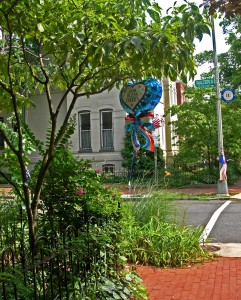
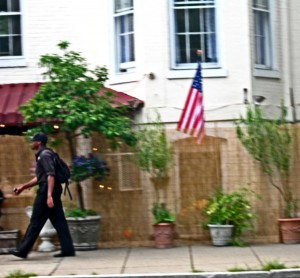
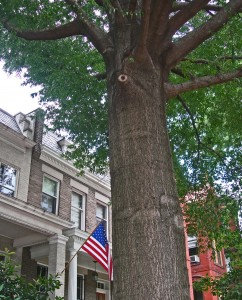
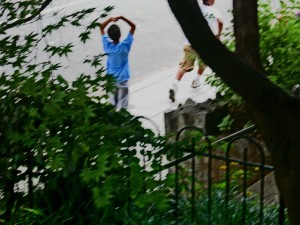
    uncle-sam-iuncle-sam-iihanging-flag-1hanging-flag-2god-bless-americasurroundingsstars-and-stripestree-and-flagkids-next-door

    The boy in the blue shirt and his friend stopped me as I was going into my yard, “happy 4th of July,” they said.  “Happy holiday to you,” I responded.

    “Do you like fireworks?” the boy in blue asked.   “I like the pretty ones on the Mall,” I replied, “but I don’t like the loud, smoky ones on the street.  I find them too noisy, and too much of a fire hazard.”  “Oh,” he said, and ran off down the street.

    Tonight, if previous years are a reliable indicator, he and his friends and family will light dozens upon dozens of illegal fireworks on my street, pausing only to let the bus go by.  They will scream with delight every time they startle themselves with a big one.  I will water the front to help prevent fire, marvel at human inventiveness, and ponder the nature of freedom.

  • | | | | |

    Choices, A Cardinal in the Grapes, and Viveka

    This morning while I was out in the garden, I heard a chirping right above my head.  Within arm’s reach was a bright red male cardinal perched among the grapes effusively talking.  (I planted a tiny red, concord grape vine about six years ago, and it has flourished beyond my wildest dreams).

    There were enough ripe grapes for me to pick a handful for myself.  I have bird netting, but I have not put it over the grapes.  They did not do so well this year, many turning brown prematurely because, I think, of the drought-ridden winter followed by the extra wet and cool spring.  I am grateful that I will not be dependent on these grapes as food for myself to survive through next winter (I’m pretty sure; if not, I have bigger things to worry about).

    For the joy of having the birds come visit so fearlessly and delightedly, and because the grapes are not fantastic to eat, I leave all, but those I get by the small handful a couple of mornings a week for a few weeks, to the birds.  Maybe next year I will net the grapes, but then I’ll have to have a canning party to make jam.  In the meantime, I’ll marvel that every bird in DC seems to know when my grapes ripen.

    We make decisions like this all the time.  With how we shop, what we eat, what work we choose, how we travel, we are making decisions about habitat and environment for ourselves and hosts of other beings.

    In yoga, the process of ever refining our understanding so that we can be more in touch with how we act impacts our life force and our relationship with all around us, is viveka, or discrimination.   Just as the more we practice on the mat, the more we develop awareness of what leads us to feel more in tune and more celebratory of life, so too, we want to use that yoga refinement and discrimination to inform our acts off the mat.

  • | | | |

    Slowing Down (and vinyasa krama)

    I wanted to share this article on “ecotherapy,” a term I had not heard before.  I found the article interesting because for years now, I have gradually practiced all the elements listed in the article as treatment for depression, not because I had been told by a therapist to do so, but because, despite my feeling the repercussions of going against the grain, I felt happier and healthier settling in one place, traveling more slowly, connecting with my pets, and tending a small patch of nature.

    These shifts in lifestyle simply feel to me more in alignment with my own nature and that of the earth.  I found, incidentally, it gave me much more time overall to do things.  People ask me how I do so much (usually referring to the day job, the yoga teaching, the gardening and cooking, the volunteer work).  Thinking of the way they live, and what they do, they ask when do I rest?  I say that my life is in fact rather slow and restful.  I rest when I meditate.  I rest when I am taking the time to make a home-cooked meal — every day when I am in town, often two or three times a day.  I rest when I am tending the garden.  I do not think of cooking and gardening as chores, but as ways to nurture myself.

    I rest when I am commuting because it is on foot or sitting on the bus or metro (note:  instead of getting anxious or angry when metro is slow, think of it as an opportunity to draw into yourself and meditate, contemplate, or read).

    Not having moved or changed jobs in years, even though there have been serious challenges with both where I live and my job, I had the time, money, and energy that would have been used up in a major upheaval, to engage in the study and practice to become a certified Anusara yoga instructor, and before that, to study  drawing and photography and to exhibit my art.  Staying in place, I continue to have time to study and to read (not watching TV helps alot, too, for finding time).  The choices are different with children in the house, but it is still possible to make choices that require less racing around for the family.

    This, to me, is a larger aspect of vinyasa krama, the art of sequencing.  When we sequence how we move in space and time in a holistic, sensitive way that honors the rhythms and cycles of our bodies and the earth’s, then we feel less trapped or overwhelmed.  When I was trying to keep up with society, I was often sad and anxious.  Now I am much less so.  I have often attributed it to these choices.  Now, I see, society has given us a word for it —  ecotherapy.  With a word coined for it and put in the press, will people feel more comfortable practicing it?

  • | |

    Simulcast, Drama, and Perception

    Last night I went to see the National Theater UK’s  simulcast (tape-delayed) of Helen Mirren performing in Ted Hughes’ translation of Racine’s Phedre at the Shakespeare Theater.  The tragedy of Phedre is misinformation, misguided helpers, and passion that has gone beyond sweet engagement to maddened attachment.

    A stage production is intimate and designed for the small audience of those present in the theater.  When it is merely filmed (instead of being turned into a movie), it sometimes feels forced because it is watching a film of a stage production, instead of being invited in as one is when one is either at the stage production or the filming is done as a movie, which is designed to include the viewer in a manner for the film.

    What was hard about watching the filming of the stage production, was being forced to have the camera’s and director’s perspective; there was no ability to turn my head and shift which part of the stage to give my attention.  At the same time, I felt appreciative of the miraculous offerings of technology:  the filming made something that is usually limited to those who can afford theater of that extraordinary quality and who are able to be in a certain place at a certain time available to tens of thousands around the globe, including me and my friend.  In that way, the filming both took away the intimacy of being physically present, but simultaneously created a unifying experience for a much bigger group of people.

    I was inspired to think about the limitations and differences among the perceptions of the characters, of the critics (talking about the play and the film), of the smaller, elite audience (the actual theater goers’ — I’ve been at that theater in London), of the technologically broadened audience, and of mine in response to the essence of the tragedy, the story and substance of the play, the delivery of the play, and my own life as informed by the play.

    It seems an interesting lesson on many levels on how we can choose to live with our passions, how we can react to limits and changes in our ability to perceive our own selves and the world around us, and on how and what we invite in through the doors of our perception.

  • | | |

    In Watermelon Sugar (Starting Each Day Anew)

    I have in my library books in which just one phrase or just the very beginning is most resonant.  It is this time of summer, when the light seems endless, and the heat just setting in as if on a permanent basis, that my thoughts turn to watermelon in food, and again in literature.  I think of watermelon differently each summer from the perspective of having lived another year, and the same in having experienced the taste and the thoughts of the taste so many times before.  When it comes the time of year when thoughts of watermelon spontaneously arise,  I revisit these words:

    “In watermelon sugar the deeds were done and done again as my life is done in watermelon sugar.  I’ll tell you about it because I am here and you are distant.  Wherever you are, we must do the best we can.  It is so far to travel, and we have nothing here to travel, except watermelon sugar.” (R. Brautigan, In Watermelon Sugar).

    Refreshed, I put the book back on the shelf, look forward to eating watermelon from the fresh farm market, and set the intention to start each day with open, receptive, and unjaundiced eyes, ready to learn and experience the same old things as glorious new ones, and to do the best I can.