Jai Chandra
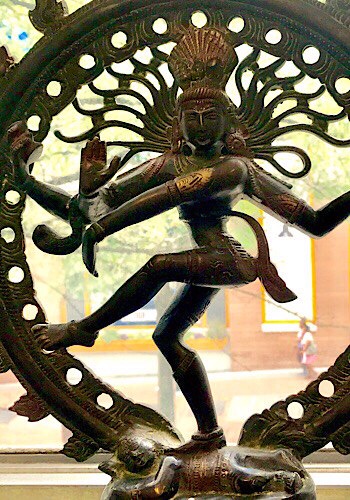
On this mahashivratri , the darkest moon of winter, the night to delve into our dreams, into the rhythms of the wild dance of existence, experiencing the fullest emptiness . On this night, too, the goddess Uma (aka Parvati) incarnate as feline WHO IS NOT SUPPOSED TO BE ON THE BED appears to have been reunited with Siva Nataraja.

Included in the asana today at Cyndi Lee’s day of workshops at Willow Street Yoga was one of my very favorites: anantasana–the serpent couch of Vishnu. Nataraja, dancing his wild dance, was watching. People outside went about their ordinary and extraordinary lives.

And all the triads.

Siva, having cleared
Space, Brahma creates anew.
Vishnu hangs around.
In which I encounter some more of the 330 million gods (mas o menos).
(Notes: (1) Hindu philosophy speaks of 330 million gods, i.e. a bigger number than we can actually get our minds around, one for every person, giving room for a complete diversity of belief. While I don’t believe in “God,” I have no problem with the idea of 330 million gods, none more exclusive or correct than any other, with no permission to use of the concept of “God” as justification for murder, physical harm, repression, or suppression of expression because of societal or family of origin privileging any particular belief. (2) “Maya,” which in Sanskrit not Spanish, literally means to measure, is the tattva that is the bridge between the universal and the manifest. The “universal” is immeasurable; what we think of as manifest is always measured in space and time. The distinction between how the tantrikas and other yoga philosophies interpret the concept of maya is for your own research or another day. (3) The number 108 refers to Shiva.)








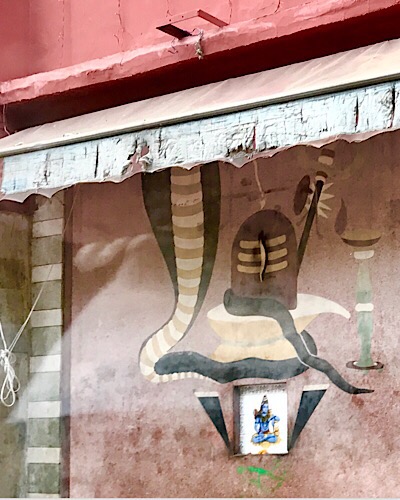
The Hindu pantheon has a trinity in which Brahma is the creator, Vishnu is the preserver, and Shiva is the destroyer. Have you ever wondered why it is Shiva, the destroyer, and not Brahma, the creator, who is represented by the lingam–symbol of the progenitor?

Peace and light, E — Posted with WordPress for BlackBerry.
The other day, it was announced that following a controlled forest fire, a rare hybrid orchid that hasn’t been seen in the wild in Maryland for the past 70 years has emerged. This, I think, is such a wonderful example of the privileging of the destructive energy of of Shiva in the context of the triad of Brahma (creator), Vishnu (sustainer), and Shiva (destroyer).
Shiva in this context does not so much destroy for the sake of destroying, but is part of the inevitable and necessary part of life that strips away, dissolves, razes, eliminates, so that new life can emerge and be sustained.
Ruda, who is both the ancestor of Shiva and another name for Shiva, is known as the howler. Rudra is wild and fierce. Rudra rages. I heard Paul Muller-Ortega recently describe Rudra. He said Rudra rages, but offered that there are lots of things against which to rage, such as injustice and inflicted suffering.
The idea of Shiva/Rudra raging has filled my contemplations for the last week. The questions that arise for me is “what is divinely inspired rage?” “When is fierceness or rage serving to expand love and compassion rather than just destroying the self or others?”
When are rage and destruction necessary to optimize the flow of energy? I think of Rosa Parks, Nelson Mandela, Gandhi. I think of a surgeon removing a tumor. When I think of the ongoing war in Iraq; the newest reports of torture; the potential that corporate interests, ignorance, and bigotry may completely undermine this country’s coming to agreement on providing basic health care for all, I think that living a quiet life is not fully engaging a life of the spirit. How do I find a place of non-attached, but fierce action? How do I find Rudra and not get distracted by personal desires for outcome (and personal desires for simple peace and quiet)? When should I howl, to whom should I howl, and what?
This rage, this fierceness, must come from a grounding in the heart with the discrimination of study and practice. If I cannot find it myself, can I at least support those with the courage and wisdom to be directly engaged?