Art and Culture

  • | |

    Responding from the Highest v. Standing Up for Your Rights

    As those of you who are regular readers may recall, I have been working to use solar energy to provide most of my electric power.  The solar installation was complete in late August, and the public utility responsible for changing the meter to reflect the input of my solar energy to the grid advised on September 3rd that the meter would be changed within three to five weeks.  Week five came and went.  Week six, I wrote to the utility and asked why nothing had been done.  My tone was appropriate, and I did not let it upset me, but still I felt the need to take action.  I was advised that the metering people would be contacted, and it would be done or I would hear back within the week.  Week six passed with not a word.  Now it was week seven.  I wrote again asking why I hadn’t gotten a response.  The answer was that I deserved to be frustrated and should complain to the public service commission.

    I filed a complaint; after all, I was directed to do so by the very entity against which I had the complaint, but was advised by the public service commission that it could take 30 days to respond to my complaint.  Meanwhile, my house was continuing to be powered by mountaintop coal mining and nuclear power.  This wouldn’t do.  I contacted my solar contractor and asked for assistance.  The solar contractor had connections with the commission.  This morning I received a very apologetic call from a supervisor at the electric company.  The meter was installed later in the day (although I still need for the electric company to “authorize” “my use” of the meter–not going to try and understand that one).  The authorization is supposed to be processed tomorrow.

    Here’s where the apparent disconnect between responding “from the highest” and not being a doormat came into play in my mind.   The reason I got an immediate response was not the delay, but my documenting the foolishness of having been advised that the next step was to file a complaint instead of having been told the actions that the employee was taking to try and address my concerns.  I work for the government.  I know that is something that is wholly unacceptable, and my having used the inappropriate response to my inquiry to make sure I got a result will likely result in unpleasant repercussions for the employee.

    This situation triggered a memory of an airport episode in the days when I was still flying around the country as a litigator.  When nearly everyone else at the airport was traveling for the holidays (it was December 22nd), I was flying out of National Airport to Hartford to take a deposition the next day.  I was waiting in a long line to check-in (this was long before the days of e-ticketing), and the airline announced the flight was canceled and that they would be putting all of us on a bus to Dulles airport on a flight that left two or three hours later (it was already the end of the work day).  I was a bit cranky, I am sure.  I asked in a way that everyone could hear, keeping in mind I had a ticket that could be changed, whether there were flights on any other airlines going to Hartford from National that night.  Gosh, apparently, no one had thought of that or was hoping that no passengers would ask for such a response since it would have a cost for the airline.  Within a half hour, several of us were re-booked on a flight with another airline leaving from National.  No bus.  Hardly any delay.  A college-aged woman who ended up with the benefit of the re-booking looked at me with her eyes shining, “are you are lawyer?” she asked.  I’ve always thought I might have been responsible for changing her life by having not stood for being treated badly, who knows whether it ultimately was for good or ill.

    I often hear people saying that speaking up, taking action, refusing to suffer inappropriate, unjust, or unnecessary conduct is “bad.”  What is the difference between being passive and responding from the highest?  Where do we draw the line?

  • |

    If It Weren’t for Columbus

    I would not be walking through Lincoln Park past a sculpture of Lincoln emancipating the slaves. There might not have been any slaves to emancipate. My great grand parents might not have made the trip from Eastern Europe to Ellis Island, which might never had been a portal for millions of human beings to arrive by ship from Europe. What an extraordinary web of existence. What do I think is my purpose and what is my part/purpose in the great web–the part I can never have the vision to know because I am inevitably bound by the perspective of my embodiment?

  • | | |

    Invitation to Artistic Collaberation

    I loved this collection of ties and sign outside the Studio Gallery in Dupont Circle. It served for me as a great reminder of the tantric yoga invitation to make and share art with our very being, with each other, with the practices, and with the divine. Whatever has drawn and continues to draw us to the practices is an invitation to collaborate in the ecstatic and creative dance of life itself.

  • |

    A “Mending Party”

    A woman on a list serve I read invited others to a “mending party.”  “How delightful,” I thought.  I have a few things in my mending basket.  I usually use mending or knitting time as an opportunity to sit and think and listen to music and sometimes write down in my journal what seems like an interesting thought.  It would be a most enjoyable alternative to sit and converse with others, all of whom have at the least a shared interest in beautifully mending clothes so that they last.  And at the end of the evening, my mending would be done.  I am sure it would be quite alright to knit or crochet or embroider, if there was no mending that needed to be done.

  • |

    Carbon-Free Website

    For those of us living fully in our modern material world, as I am, it is important to think not so much about denying ourselves things or giving them up, but rather, seeing how we can make shifts to living more lightly.  One of my heavy impacts on the environment is computer usage.  Right now, I have on my work computer, my home laptop, and my Blackberry.

    All of you who are reading this blog are doing so via computer or by a personal device with web access that requires battery charging.  I’d hazard a guess that most of these portable computers are not being powered by sun and wind.  I am still waiting for Pepco to come and change the meter to hook up my newly installed rooftop solar panels to the grid, and I don’t have a solar charger for the Blackberry.

    One thing I thought I could do to help make enjoying this way of connecting have less impact on the environment would be to go carbon-neutral.  In the world of plastic, the ideal is don’t use, reuse, repurpose, recycle.  In the world of electricity, it is don’t use, use from better sources, off-set.  With respect to my blog, I am choosing to use the necessary electricity, but go solar with my house, buy electricity from a source that uses offsets (Clean Currents) for that electricity that is in excess of what the solar panels will provide, and I’m choosing to offset this blog’s impact based on readership through the Carbon Fund.

  • | | |

    Last Night I Slept At My Parents House (and akrama)

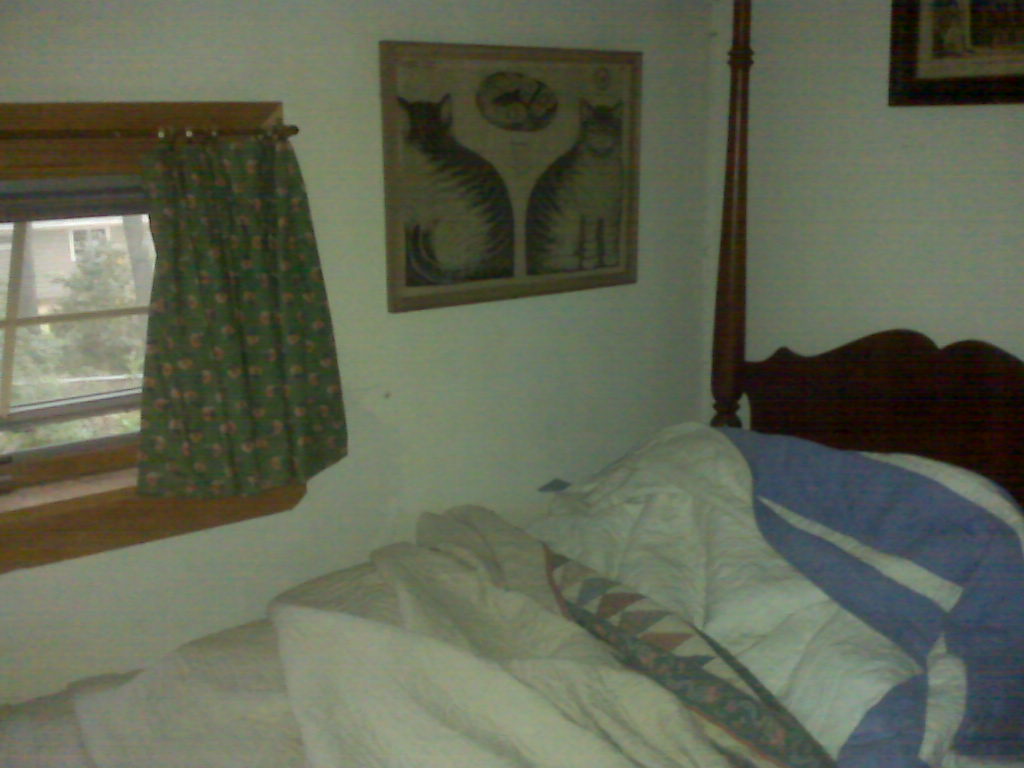
    I slept last night in the room that I slept in as a child. My mother now uses the room to store some of the vestiges of her old antiquing business. The carpet, wallpaper, and curtains from the 1960’s are gone, but the bed is the same one in which I had slept. The picture on the wall is a kit for making a stuffed animal that my Grandma Rose had bought me (probably when I was about 8) at the Brooklyn Museum of Art that my mother decided would be better as framed art than a sewing project for me.

    The neighborhood looks different–it is far more developed as is everywhere near a big city–but the bones are the same.

    It is a challenge not to feel the weight of my history and ancestry when I return. Taking the time to meditate when I woke helped me stay fully in my adult self.

    When we meditate, we ideally dissolve our individual consciousness into the luminous spaciouness of universal consciousness. In that space, where we are temporarily not experiencing ourselves as an individual, we are also not experiencing our individual self in the sequence (krama) of time. The luminous spaciousness of meditative consciousness is sequenceless (akrama) and, as universal consciousness, is the place in which the sequences of being in time and space arise.

    What I experienced this morning when I meditated was that I did not have to be flooded with the emotions of my, to try to graciously describe, emotionally challenging childhood. In the space of meditation I could bring to my day an acceptance of all of my life and be where I am at present, coming to a place of recognition that although I lived all of my history, it neither defines me nor binds me from expanding into a space of growing love and light.

  • |

    Wilmington Delaware Amtrak Station

    I witnessed this family standing on the train platform while I was listening to a teleseminar from Paul Muller-Ortega on the “four stages of the word.” That a family dressed this way was waiting for the train gave rise to much thought for me about how I seek to integrate yoga practice into my daily life in a modern Western culture. How much is compromise or disservice to the “purity” of the teachings and how much of it is a part of a pulsing, growing, changing intersection of peoples and times?