-
-
-
-
Asana, Pranayama, and Yoga Practice | Food for the Body | Food for the Mind (Yoga Philosophy, etc) | Meditation
Signs Around Town
It may be true that power that gives power over corrupts, but being empowered is liberating. The yoga, when practiced as part of an ethical life, is empowering. But beware those who claim that “enlightenment” frees one from behaving with integrity.
Peace and light, E — Posted with WordPress for BlackBerry.
-
Asana, Pranayama, and Yoga Practice | Food for the Mind (Yoga Philosophy, etc) | Meditation | Photos
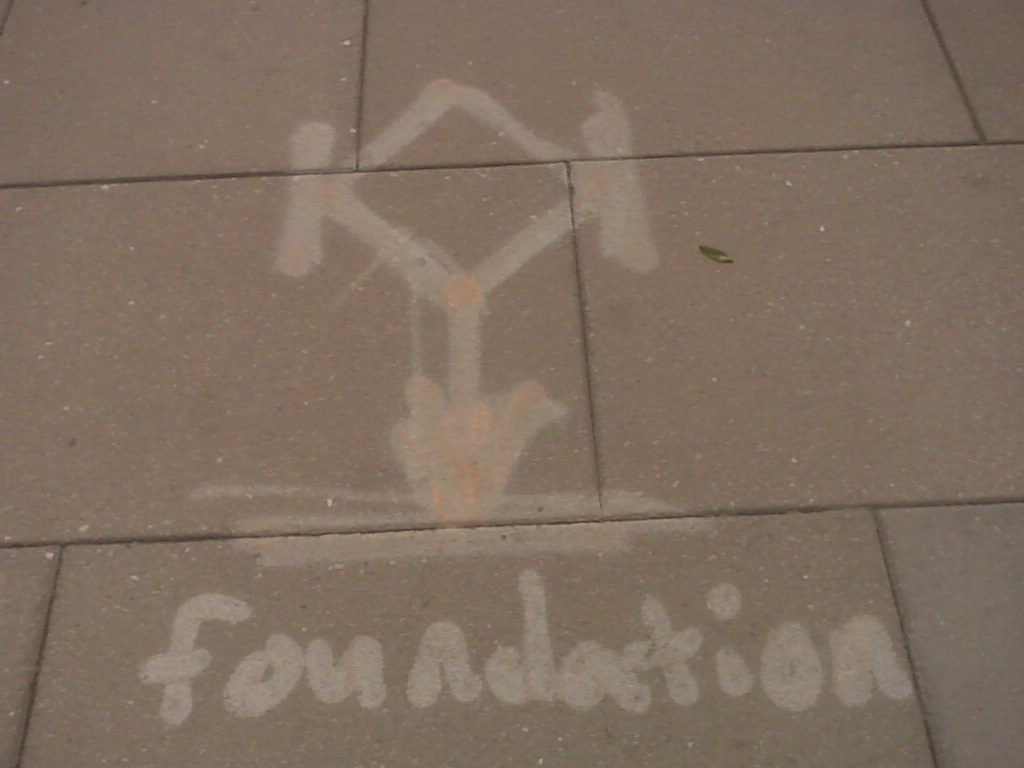
Found Exhortation
The artist who penned this exhortation here was highly unlikely to have intended it to have anything to do with “udyamo bhairava“–roughly, the upsurging of capitol “C” Consciousness. Siva Sutras I.5.
But if one were in the mood, one (not an academic, though), might suggest that the exhortation to rise up to one’s fullest potential, to refuse to be shackled by the oppressiveness of certain socioeconomic circumstances (I leave what those might be to your experience, knowledge, and education), as an example of one of the infinitude of ways Consciousness likes to upsurge itself towards itself.
Peace and light, E — Posted with WordPress for BlackBerry.
-
-
Art and Culture | Asana, Pranayama, and Yoga Practice | Community and Family | Food for the Body | Food for the Mind (Yoga Philosophy, etc) | Gardening | Meditation
Found Exhortation
By all means, wish. But then contemplate, evaluate, explore, and act. For as we know, merely wishing won’t make it so and many of our wishes are not what we really want when we think about the work to effectuate and the consequences of realizing them.
What do you truly wish for? For what are you truly willing to focus your energy and attention?
Peace and light, E — Posted with WordPress for BlackBerry.
-
Art and Culture | Asana, Pranayama, and Yoga Practice | Community and Family | Food for the Mind (Yoga Philosophy, etc) | Meditation
Sometimes, the Concern is Not the Risk Warned Of, But the Making of the Warning
For example, I am not concerned with the risk of being filled up by Satan (that’s Satan with a capital “S”) because of practicing yoga. But I am deeply concerned that the people quoted as making such warnings are seeking or are in positions of power. Thanks to my friend D. for sending me the link to this article.
-
What Students Hear
Last week I took a lovely all-levels yoga class where the emphasis was on fully engaging in the practice rather than striving to achieve a particular outward notion of what the poses should look like.
Near the beginning of the class, but after the emphasis on not striving had already been discussed, the teacher said that the ideal form in uttanasana — standing forward fold — for classical hatha yoga is with the feet together. But, he said, however, he said, but not, the teacher explained, if your back is curved like a “c” in the pose, and your lumbar vertebrae are higher than your sacrum. In that case, you want to take your feet wider apart or you will strain or injure your low back.
As I was fully into the pose, I could see the rows of students behind me. At least two fellow students in my immediate line of sight, promptly put their feet together, even though they had tight hamstrings and bulging lumbar spines and were clearly pushing themselves hard to get their fingertips to the floor. As soon as the word “ideal” was uttered, they could not hear the caution or could or would not apply it to themselves.
The evident intent of the teacher in his exposition of the pose was to give an example where the “ideal” form is most certainly not ideal and will not further the reasons we practice asana. But for so many in this society, striving is such an ingrained way of being, that yoga class can become just another way to achieve.
It was useful for me to witness how carefully one must teach to high achievers this principle of the “ideal” being what suits and not what will win accolades. How do we teach (and learn) the practice of goalless goals, of enjoying working for fitness (of the mind, body, and emotions) without pushing and striving? I’m pretty sure that invoking the principle of actionless action from the Bhagavad Gita would not have made a difference here. It seems a shame to think that the only way to protect all the students’ backs is never to mention the classical form of the pose, and to have to tell all the students (especially in a big class) to have their feet apart (or some similar alignment rule)for protection of the few who do not (or are not yet ready) to hear the whole lesson.

Peace and light, E — Posted with WordPress for BlackBerry.
-