Author: Elizabeth

  • | | |

    Watching the Clouds Dissipate

    Tonight (technically very early tomorrow morning), will be the first full lunar eclipse on the winter solstice in 350 years. Part of me wants the sky to be clear so that I can witness this extraordinary event. The other part yearns for a cloudy forecast so I can stay warm in my bed at 3 a.m. without feeling that it would be my own inaction that led me to miss the eclipse.

    I think we all feel this way about our practice sometimes. We want to have the great openings that come from a deep and steady practice, but it would be oh so nice if they came without effort. And an excuse not to practice that comes from somewhere out of our control makes it so much easier to accept not getting the benefits.

    Unlike a cloud cover blocking our view of the moon, though, there aren’t many things that actually prevent practicing, although they might change what kind of practices we can do at a particular time in our lives.

  • | |

    Web Version of Holiday E-Newsletter

    Dear Friends,

    May your inner light shine brightly for yourself and others through the holiday season.  I wish you all much joy and safe travels.  As I get ready to take some time off and celebrate with friends and family–with a little sojourn in New York as part of the plan–I wanted to let you know the schedule to make it easier to plan.

    There are no Willow Street classes for the rest of the year–though a number of my friends and colleagues are offering what look like a fantastic array of workshops at Willow Street from 12/29 to 1/2.  There is William Penn House this coming Tuesday, 12/21 and also 1/4, but not on 12/28.  There will be two special house practices for regular students on Thursday 12/23 and Monday 12/27.  Please email me if you wish to attend.

    Free class week,, which runs from 1/3 to 1/9, starts the new Willow Street session.  I will be offering two classes at Willow Street Takoma Park during free class week:  restoratives on Monday, January 3rd, and gentle/therapeutic on Saturnday, January 9th.

    In addition to continuing the gentle/therapeutics at noon on Saturdays in the Winter Session (registering is great, but drop-ins always welcome), I will be offering the last Saturday of the month from January to March “Relaxing into Optimal Alignment with Anusara Restoratives.”  After a little gentle stretching and self-massage to bring awareness to the breath and body, we will enjoy the exquisite application of Anusara’s Universal Principles of Alignment to restful and supported restorative postures to release old patterns and invite in the new to find greater ease of body and mind. The workshop is designed to be a great practice for all levels; sign up for the full 3-class series and save $15!  The workshop series–or even just one–makes a great holiday gift for yourself or a friend or loved one.

    Also please mark your calendars in advance for “Yoga for Gardeners,” which is for all levels of yogis and gardeners alike.  It will be on Saturday, March 18th. A portion of the profits, as is my tradition, will go to benefit the Youth Garden at the National Arboretum.

    Peace and light,

    Elizabeth

  • | | | |

    Teaching Less to Practice More

    This morning is the last Saturday in the foreseeable future when, even waking up before dawn, I have to cut short my morning practice to get on the metro to go teach. I have a strong memory of a relatively novice teacher telling me, before I started teaching, that she was going to stop teaching indefinitely because she needed more time for her own practice. At times over the years, when my other job was at its most demanding, I would think about that statement. Mostly, though, I have circumscribed other activities to fit in time for work, teaching, and a full practice.

    It came time to admit, though, after nearly two years of steady study with 0Paul Muller-Ortega, which expanded my meditation practice from 25-30 minutes a day, in addition to asana practice and studying, to an hour a day plus additional practices and more studying, that there are not enough hours in a day for all I want to do.

    I have been teaching on Saturday mornings for a number of years now. I love my Saturday morning students and have embraced the discipline of getting to class to teach.

    The energies have shifted. I will still teach my noon class on Saturday and my weeknight classes, but I will have more time for a full practice and perhaps some extra garden time from this shift. I expect that this time to deeper into my own path will bring new energy and light to my teaching. I hope trust I will see my Saturday morning students at other classes and workshops, both when I am teaching and taking class together at Willow Street.

  • | |

    Brahmacharya, Civic Responsibility, and Enlightened Self-Interest

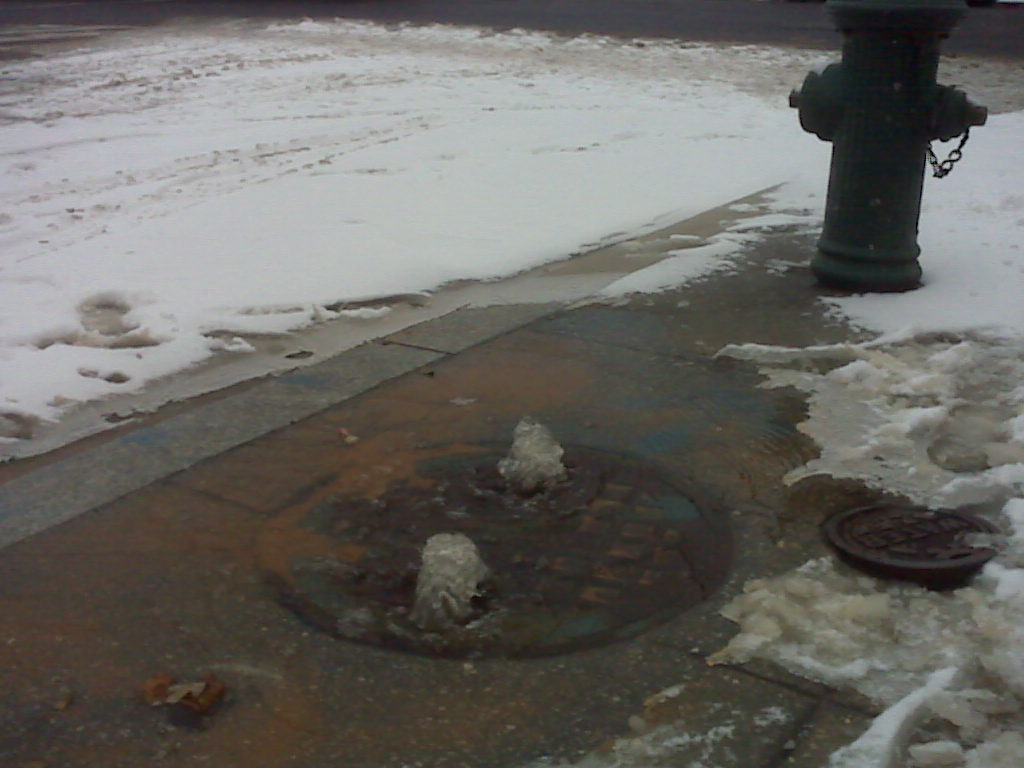
    I saw this water main break while I was walking to work this morning. Several people walked past it without a glance–could they really not have noticed? It looked relatively recent because the puddle was still modest and had not started freezing. I paused, took out my mobile device and telephoned the mayor’s city-wide call center (in DC “311”–whoever answers will transfer you to the right place; in this instance, “water emergencies”). A couple of people who saw me calling looked at me as if it must have been my fault or else why would I be calling,

    I thought about what it was that moved me to call. I saw harm to the environment (colossal waste of water while we are in a drought if the leak was allowed to continue without the earliest possible intervention) and potential danger to people from spreading icy water that will turn into ice late this afternoon. What is it, though, that leads one to take action to change or fix something that is technically not one’s business. What makes it part of one’s duty or responsibility when it is not directly related to one’s individual property or person? At some levels, it is just social contract. By choosing to live together in closely proximate society, it is in all of our self-interest to take care of shared areas, though the ubiquitously unshoveled sidewalks leads me to believe that most people haven’t been taught or grasped the principle that if we all contribute “our share” the whole place and our own lives would be far more enjoyable.

    These thoughts led me to think of the application of the yamas and niyams in Patajali’s Yoga Sutras and in particular, the principle of brahmacharya, which is one of the five yamas on the first level of the eight-fold path of yoga in Patanjali’s Yoga Sutras.

    Brahmacharya literally means being like Brahma, but it is often translated as celibacy. Brahmacharya, from a less socio-morally result-driven interpretation, could also be thought of as aligning with the divine. Before we are enlightened, though, how do we know what will help us align with the divine? I once heard Professor Douglas Brooks say, in a lecture I attended a number of years ago, that the yamas and niyamas, the ethical precepts that lay a foundation for the practice of yoga are for the goal of the individual reaching enlightenment. I was a bit taken aback by the statement at the time. It sounded as though the yoga precept was that the purpose of ethical behavior was self-interest, and was not because ethics was summum bonum. I am less troubled by the idea after much contemplation. What is the harm of the goal enlightenment serving to motivate and shape our behavior? The methodology that includes the yamas and niyamas would have us engage in certain ways of living and practices in order that we can change our karma by shifting the patterns (samskaras) that take us away from spirit rather than lead us toward spirit.

    To me, this means acting in away that not only does not harm (ahimsa–the first of the yamas), but seeks to expand the possibility of fostering the collective good, including the good of the earth. In this sense, to the extent that brahmacharya is a precursor to enlightenment–the merging of the individual self with the greater “Self” or spirit, acting from a placed of enlightened self-interest can be seen as helping us to find the true Self (as long as we are not attached to a particular good or outcome, but that is a whole other topic).

  • | |

    Special Holiday Thank You (Web Version of E-News)

    Dear Friends,

    You’ve just received an unexpected gift that does good! rose garden yoga sent you a gift card from Oxfam America Unwrapped.  Follow this link to see your card. And learn about how you’ve made a difference.

    Much love and gratitude.  News for the holiday and new year to follow in a separate e-mailing.

    Peace and light,

    Elizabeth

  • | | |

    Renunciation v. Discrimination (and Celebrating the Holidays)

    A fundamental precept of classical yoga is that of vairagya or renunciation.  The yogin is meant to gradually renounce all of the life of mind and body until he or she transcends them and sees only spirit.  I have been thinking about how renunciation fits in with the holidays and how we, as a society, have come to celebrate them.  As some indulge to excess and all sorts of tinsel trappings, others denounce the excess as taking away from spirit and renounce the whole thing.  A reactive renunciation of the holidays wholesale because they are so commercialized can feel just as harsh as full consumption of the holidays, as marketed on TV, can feel bloated and unhealthy.

    When we approach yoga from a tantric perspective, the practice is not geared towards vairagya. We seek instead to be fully engaged in life, trying to live each moment, taste each bite, breathe each breath, take each step as a way of connecting more deeply to the spirit.  This does not mean reckless indulgence.  It does not mean heedlessly consuming and taking into ourselves that which does not nourish ourselves or which harms other beings or the earth.  Through practice and study, we develop viveka or discrimination, which informs us of what will enhance our lives and lead us towards a place of light and health.

    In the context of the holidays, to make them truly holy days, the tantric observer will not reject holiday celebrations out of hand simply because they have generally become commercialized and often unhealthy.  Rather, he or she will discern ways to celebrate and honor earth, family, friends, and self that are in alignment with nature and optimize the connections among them.  This may mean picking and choosing how and with whom to celebrate, but always with honor and respect.  This is an art that I am working on personally; sometimes it is hard to know where to draw the line, especially if co-workers or family are living in ways that do not feel nourishing for us.  Then the game is to not seem Scrooge-like to those who think that the holidays are about lots of heavy food and shopping, while we are choosing to honor the season in another way.

  • | |

    The Dance of Opposites and the Emanation of Language (Selections from 48 Hours of Spam)

    I do enjoy the manner in which you have presented this specific challenge plus it does give me personally some fodder for thought. However, through just what I have witnessed, I really trust as other comments pile on that people today continue to be on point and in no way embark on a soap box regarding some other news of the day.

    Along with everything that appears to be building within this specific area, your opinions are generally rather exciting. On the other hand, I beg your pardon, but I do not subscribe to your entire suggestion, all be it radical none the less. It looks to me that your opinions are actually not completely justified and in actuality you are your self not really fully convinced of the point.

    In it something is. Now all is clear, I thank for the help in this question.

    I am sorry, that has interfered… But this theme is very close to me.

    Excuse, that I interfere, but it is necessary for me little bit more information.

    I apologize, but, in my opinion, it is obvious.

    The matchless phrase, is pleasant to me.

    I am final, I am sorry, but it not absolutely approaches me. Perhaps there are still variants?

    Excuse, I have thought and have removed the message.

    I am sorry, that I interfere, but, in my opinion, there is other way of the decision of a question.

    I think, that you are not right. I am assured. I suggest it to discuss.

    And other variant is?

    You are absolutely right. In it something is and it is good thought. I support you.

    I believe, that always there is a possibility.