Found Exhortation (Excerpt)

Peace and light, E — Posted with WordPress for BlackBerry.
Peace and light, E — Posted with WordPress for BlackBerry.
Regret nothing.
Regret is nothing.
Regret no thing.
Is regret nothing?
Is regret no thing?
What a shift in perspective we can make by looking at something or saying something or thinking about something just a little differently than we have before.
Regret will undoubtedly arise on its own. But can we ultimately release regret so it is nothing to us and our ability to move on in the best way we can? That is one of our most important endeavors in growing and practicing and engaging life (engaging in life).

Peace and light, E — Posted with WordPress for BlackBerry.

Peace and light, E — Posted with WordPress for BlackBerry.

Peace and light, E — Posted with WordPress for BlackBerry.
Mixed message? Not really. If you don’t hesitate to sit regularly each day for meditation at home, it will be a lot easier to wait for a seat at a restaurant.

Peace and light, E — Posted with WordPress for BlackBerry.
MoveOn just posted this Howard Zinn quote on Facebook: “Civil disobedience is not our problem. Our problem is civil obedience. Our problem is that people all over the world have obeyed the dictates of leaders…and millions have been killed because of this obedience…Our problem is that people are obedient all over the world in the face of poverty and starvation and stupidity, and war, and cruelty. Our problem is that people are obedient while the jails are full of petty thieves… (and) the grand thieves are running the country. That’s our problem.”
It spoke my mind and resonated with what I wrote about yesterday with regard to how to be open to yoga’s invitation to practice humility without ceding power to authoritarian structures. This quote is spurring me to think aboutPatanjali’s eight-limbed path of yoga, and particularly the niyama (observance) of ishvara pranadhana (surrender). I don’t see why a true, radical yogini could not simultaneously surrender to the mysterious outrageousness of being while still being appropriately disobedient to authoritarian structure. But maybe that is because I was raised a Quaker; there’s quite a bit of overlap between some of the tantric yoga principles and the teachings of Quakers.

Peace and light, E — Posted with WordPress for BlackBerry.
Last night at house practice, we were led to think about humility (in Sanskrit vinaya). Yoga, similar to religion, tends to privilege the idea of humility.
From a one perspective, it is easy to think of the benefit that those in charge–the priests and the moneyed and privileged classes that support religious institutions to get help staying in power–get from preaching the virtues of humility. If the relatively powerless are led to believe that they will benefit spiritually from practicing humility before humans and institutions that hold sway over them, that certainly helps perpetuate a patently unfair status quo.
We can recognize our own skills and talents and relative worthiness and actively seek justice and fairness, though, and still be humble. However much intrinsic power we have and extrinsic fairness in distribution of power we seek, we can still recognize that we are not ultimately in charge of exactly how our life will play out in the vast and complex web of being. Feeling humility in the face of all that we do not and cannot know is just living in awe at the wonder of life. This, I think, is true and sustainable humility.

Peace and light, E — Posted with WordPress for BlackBerry.
The sign may be temporary, but this is a state that I would want to be as long-lasting as possible. Yoga, well-practiced and studied, provides us with ever more resilience–one hopes a lifetime’s worth– to handle the wild vagaries of existence with as much grace as is possible.

Peace and light, E — Posted with WordPress for BlackBerry.
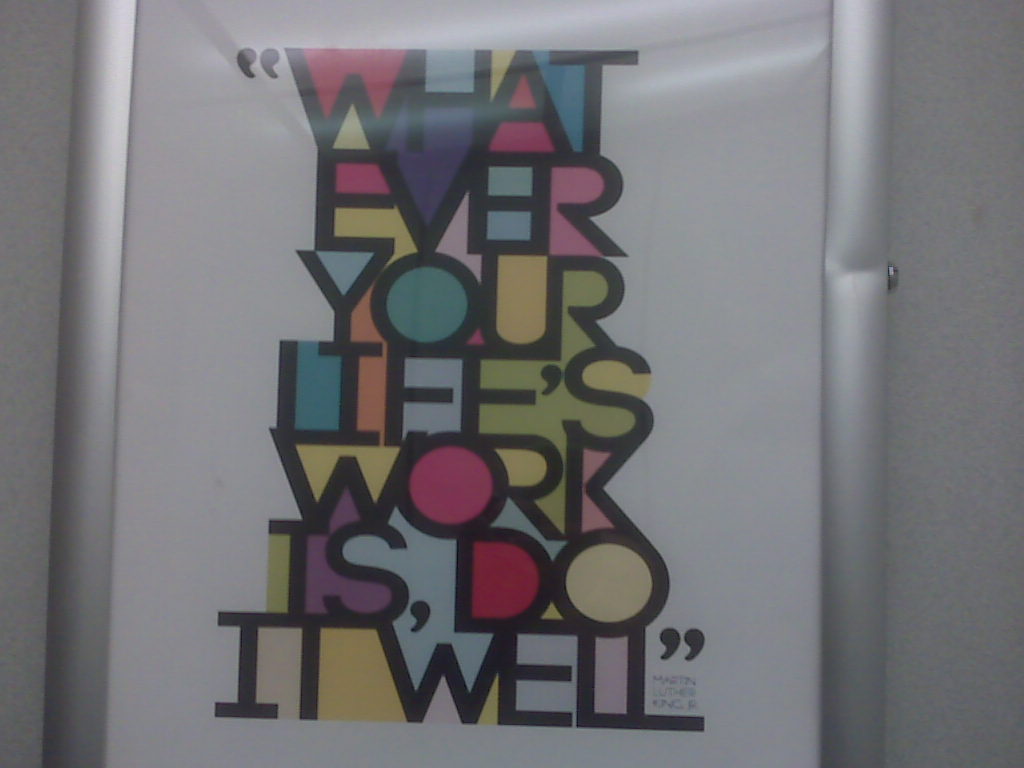
This week’s Department of Labor elevator poster. Krishna said as much to Arjuna in the Bhagavad Gita. Except that Krisha told Arjuna what was his life’s work (dharma).
Peace and light, E — Posted with WordPress for BlackBerry.