| | | | |

Whether It Is Good Weather

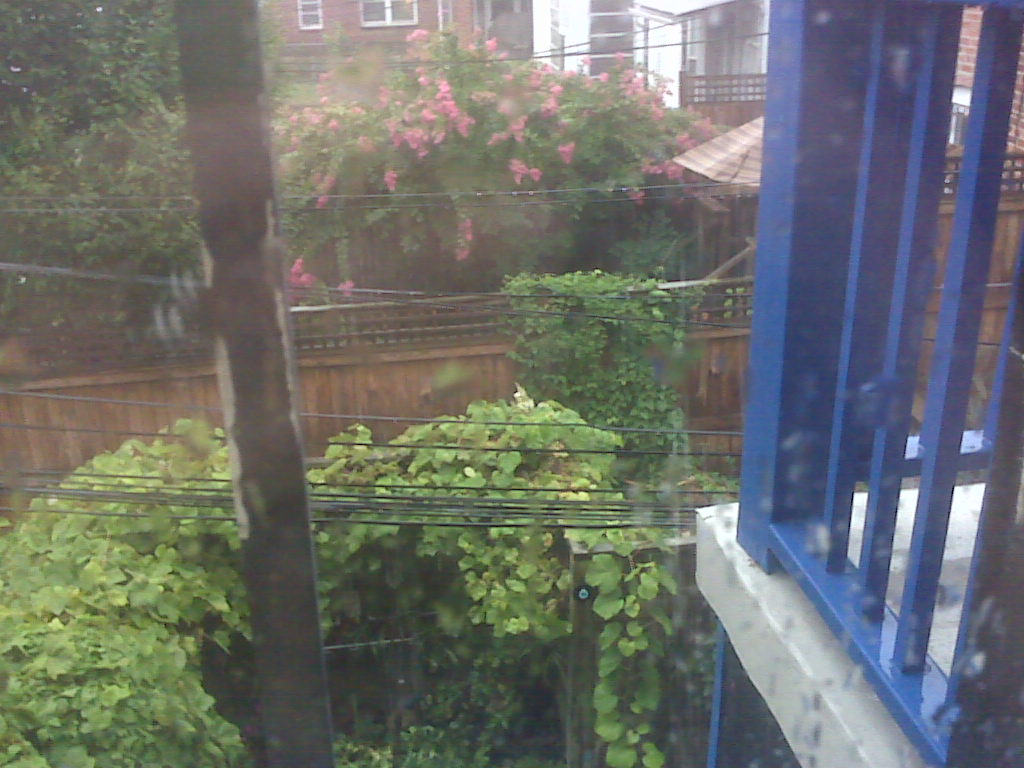
When I was out doing an errand at lunchtime, I bumped into a neighbor I haven’t seen in a long time. We did not spend much time talking; I needed to get back home to my work within the short allotted time, and she was meeting someone. “Did I just hear thunder,” she asked. The sky was thick and white with heat and “Code Orange” air. “You might have heard thunder, but there isn’t any rain with it” I replied. We talked about how much we need some good rain. The trees are really struggling. (Note: forget about cleaning any outside things with water. Forget non-edible annuals. Water established trees and perennials very deeply once a week instead of less watering more frequently. Shallow watering in drought conditions promotes growth of fungus and other pesky things.)

As gardeners, my neighbor and I notice how much rain we are getting in any given season and week. We think about whether the rainfall is what the farmers and the trees and birds and wild animals need, in addition to whether it will interfere with a child’s soccer game or a planned outing. We were at the point that we would far rather get caught out in a deluge than miss out on any chance of rain. On the other hand, those in flooded parts of the north are praying for a few warm (but not blazing hot) dry days in a row. Today’s storm is welcome and needed, though one storm does not end a drought. We need some more good ones for days on end.

I think the approach of various classes and intensity levels of asana practice can feel like a whether a thunderstorm is welcome weather. Sometimes an outrageously intense and fierce practice is what will bring me to my fullest possibility of growth and expansion. At other times, I need to step back and rest my body. Restorative and other gently therapeutic practices are what nurtures best. Sometimes, I have long, steady periods of moderate practice.

The more sensitive, aware, and knowledgeable I get about the weather outside and how it impacts life around me, the better able I am to take care of my garden. The more I am sensitive and open to the weather inside and the more knowledgeable both from study and experience of how my practice best aligns with inner and outer weather, the better able I am to live out the yoga principles I seek ever better to follow–the most important being to see the highest first and to be of service.
Peace and light, E — Posted with WordPress for BlackBerry.
Similar Posts

  • | | | |

    Some Books About Gurus

    As I have discussed with a few of you, I have been contemplating deeply and for a long time the questions of what is a guru and who is a guru.  In the context of this contemplation, I read to enhance my background and understanding, deepen my contemplation, and give myself food for thought or additional exploration.  Here are some books that I have in my library about gurus or those who have been labeled gurus (in no particular order).  Some are written with loving devotion by disciples.  Some question or comment on the interrelationship between the status of guru and the sometimes all too human foibles of the guru and his disciples.  Some are of the guru’s own experience of practice and his relationship with his own guru.

    Be Love Now, Ram Dass, HarperOne (New York, NY 2010)

    Miracle of Love — Stories About Neem Karoli Baba, Ram Dass, E.P. Dutton (New York, NY 1979)

    Autobiography of a Yogi, Paramahansa Yogananda, Self-Realization Fellowship (13th Ed., reprinted 2001)

    The Golden Guru — The Strange Journey of Bhagwan Shree Rajneesh, James S. Gordon, The Stephen Green Press (Lexington, Mass. 1987)

    My Guru and His Disciple, Christoper Isherwood, Penguin Books (New York, NY 1981)

    Ramakrishna and His Disciples, Christopher Isherwood, Simon and Schuster (New York, NY 1970)

    Great Swan — Meetings with Ramakrishna, Lex Hixon, Shambhala Dragon Editions (Boston, Mass. 1992)

    Bhagawan Nityananda of Ganeshpuri, Swami Muktananda Paramahamsa, SYDA Foundation (South Fallsburg, NY 1996)

    The Buddha from Brooklyn — A Tale of Spiritual Seduction, Martha Sherrill, Vintage Books (New York, NY 2001)

    Yoga and the Quest for the True Self, Stephen Cope, Bantam (New York, NY 1999)

    At the Eleventh HourThe Biography of Swami Rama, Pandit Rajmani Tigunait, Himalayan Institute Press (Honesdale, Pa. 2001)

    Play of Consciousness, Swami Muktananda Paramahansa, SYDA Foundation (Oakland Ca. 1974)

    The Great Oom — the Improbable Birth of Yoga in America, Robert Love, Viking Press (New York, NY 2010)

    ps Jess–Yes, the widget for Library Thing is coming for the website.  I just need to add more books, so that it is a decent start at a representation of at least the yoga-related portion of my library.

  • | |

    Some Idiosyncratic, Feminist Musings About Ayyappa

    Ayyappa is the half-brother of Ganesha and Subramanyam. Ganesha and Subramanyam’s mother is Siva’s wife Parvati.  Ayyappa’s mother is Siva’s brother Vishnu while he was the woman Mohini.  Even in the glossed over versions that don’t get into what a modern reader might think of Ayyappa’s mother, he is the extra and unwanted child of the family, although he is needed to save the world from evil.  Ayyappa is the character in the story who represents those who have ever been or felt unwanted or third-wheel or lost or excluded or is somehow missing in society or in relationship, but is still inherently worthy and divine and essential to the functioning of society, even though he is cast out into the wilds of the forest.

    Being the god of such, at the festivals at a major temple in Kerala on the pilgrimage route, all castes are welcomed. No need to be a Brahmin.

    But only prepubescent girls and elderly, post-menopausal women are permitted; women who have the capacity to conceive are forbidden.  Those connecting with the god of the unwanted, the extra, the missing, the cast out, themselves deliberately exclude from access to this god others they make even less privileged.  Even for the men of the lowest caste, the step-brothers, the bastards, and the otherwise unwelcome and unrecognized for their intrinsic worth, by the exclusion of all women of child-bearing age/capacity, Ayyappa’s pilgrims get to experience the sense of inclusion and privilege in society of the more powerful and glorified and popular brothers who have never been themselves cast out.

    Could this by design?  Is it that one cannot really understand what it means to be excluded unless one also experiences the power of being able to exclude in turn? If yes, how easy to pick, in a patriarchal culture, women of child-bearing age as the outcast and denied.  (Do they ask any woman who shows up whether she still bleeds?  If a woman has stopped bleeding, but doesn’t look “elderly,” does the prohibition still apply?).

    I have personally experienced far too many things that have been partly or completely closed off to me, overtly or invidiously, because I am a woman or not of a particular social or religious background, and much where it was worth risking ease to challenge the status quo.

    As for an Ayyappa pilgrimage, I’ve seen photos of half a million escstatic and determined male worshippers surging towards the temple for festival (looks something like returning to the tube station after seeing the Rolling Stones at Wembley Stadium in 1982 or the infield on a muddy day at the Preakness only more testosterone than that), and what first came to mind was not, wow, I really want to join that party.  Rather, I asked myself where do they urinate and defecate.

    I personally cheerfully leave this one to the men (and my more intrepid and determined sisters), even if it makes some of them feel special in part because they have excluded a whole class of people from being able to formally worship.  I’d much rather spend time with Kali. Thank you very much.

    Maybe I’d go stand outside Sabarimala in off season, when the temple is closed.  I’d take a photograph and contemplate what the idea of Ayyappa–god of the unwanted, the unwelcome, the third wheel, the excluded, the extra, the cast out from the benefits but saddled with the hardest task–means to me–both as one who has experienced the pain of exclusion and one who has excluded others (as most all of us do even when we try not to), and how it can inform me to relate to others with more grace and compassion.

Leave a Reply

Your email address will not be published. Required fields are marked *

This site uses Akismet to reduce spam. Learn how your comment data is processed.