| | |

“American Veda” (and some recollections)

I am reading Philip Goldberg’s American Veda–From Emerson and the Beatles to Yoga and Meditation; How Indian Spirituality Changed the West.  It is another of the recently published works on the interplay and inter-influence of east and west.  What distinguishes American Veda is that it is more about how Indian spirituality influenced western/American society overall, than an analysis of the yoga that we practice in the west.  Much that one might expect to be in the book is there:  Emerson, Thoreau, Swami Vivekananda (and the Parliament of the World’s Religions), Ramakrishna, Paramahamsa Yogananda, Osho, Muktananda, the Beatles, Maharishi Mahesh Yogi, but there are other connections that are less well-known.

As one generally familiar with the history of Indian philosophy and yoga practices coming to the West, it reads more like a survey or overview than an analysis to the extent that it tries not to leave out any one who could have been an influence and goes into little depth regarding any particular influence.  (Note:  the author himself says that the book is limited to Vedic/Hindu influences; he refers the reader to other sources, in particular, How the Swans Came to the Lake, for the transmission of Buddhism to the west).

What is most interesting to me about reading American Veda is that it reads like old home week.  I recognize the names and the philosophies and the way people speak about spirituality and religion, and the author lovingly and thoroughly shows how profound and widespread is the influence of Vedic thought in America, even where no attribution is given.  I recognized even when I first discovered Indian philosophy texts in high school the interplay between how me and my fellow unprogrammed. liberal Quaker friends were talking about mystical experience and understanding of God/Spirit and the Indian philosophy, and it is lovely to have a book where someone went out and did all the research and gathered the sources.  By the time I was thinking about anything at all really, Indian philosophy was already something in my consciousness thanks to the Beatles and the Beats.  The Beatles discovered Maharishi Mahesh Yogi when I was six, which was the year that Sgt Pepper’s Lonely Hearts Club Band and Magical Mystery Tour came out and my parents for some now unfathomable reason gave them to me for my Christmas present.  My older sister and I played those albums over and over again on our portable record player, whirling ourselves into states of dizzy ecstasy with the sitar grooving in the background on our favorite songs.

I was moved to read the Bhagavad Gita by reading J.D. Salinger’s Franny and Zooey. I do not remember whether this was in 9th or 10th grade, but I read Salinger because was what cool, smart kids read.  What I remember is that I read both Franny and Zooey and Catcher in the Rye (probably read the latter first) before Catcher in the Rye was assigned reading in 10th or 11th grade and that while I was not particularly impressed with Holden Caulfield, I really wanted to be as brilliant and educated and extraordinary and talented and philosophical as the children in the Glass family, and so I tried to read what they read (though alas, I read it in translation, where they were able to read the Greek and Latin and Sanskrit, etc.)   By 11th grade, a teacher had given me J. Krishnamurti to read, and his anti-guru guruness appealed to my Quaker sensibilities.

Similar Posts

  • | | |

    “If there were lights to turn on…” (and Purna) (at the Anusara Grand Gathering)

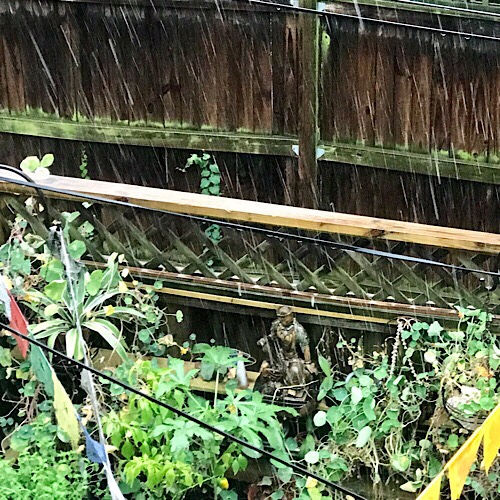
    The first two days, including the Solstice, of the Anusara Grand Gathering were bright and blue and sunny and pleasantly cool in the morning and warm in the afternoon–“perfect” New England summer days.  The third morning dawned cloudy.  By the time the morning session was underway, a pleasant drizzle had turned into a deluge.  Rain started coming in from the sides where the tent was open, and then the roof started leaking.  The clouds were sufficiently dense that the light was no more than at dawn or dusk.  It was getting pretty dark and wet in the tent.  At one point, after having told stories about rain being regarded as blessings in Hindu rituals and exhorting us in surya namaskar to jump forward and splash in a puddle like a kid, John said, “I would turn the lights on, but there aren’t any lights to turn on.  So this is perfect!”

    One of the conundrums in explaining the philosophical principle of purna, which means “perfect” or “fullness” is reconciling it with the evident fact that our divine perfection or fullness aside, we are still working to shift and realign our minds and bodies through the practices.  The divine consciousness, which is everything, say the yogis, is utterly perfect as it is and completely full (or fully empty and thus all potential, depending on how you look at it).  We are told that we (and all of being) are the divine consciousness manifest and then given a slew of techniques and instruction to help us change ourselves.

    If we are completely perfect and full, what is the point of learning all the technique and seeking to expand and shift our bodies and minds?  The yoga teachings say that we forget that we are this fullness and perfection, and it is our forgetting that leads to suffering (which is different than pain, but discussing that distinction will have to wait for another blog entry).  The practices are not to perfect or improve us, but rather to shift our alignment (mind and body) so that we remember the perfection of ourselves as spirit.  When we remember, we are better able to recognize the perfection in ourselves, other people, beings, things, or events, even what we find challenging or difficult.  From this space of recognition, in my experience, we naturally become happier and more generous of spirit.

    I think that moment at the Anusara Grand Gathering is a perfect (word choice intentional) illustration of the apparent dichotomy of seeking change and appreciation of the perfection of every moment.  If there had been lights to turn on, John would have turned on the lights so that we could have observed the alignment better during the demonstrations and he and the assistants could have seen the students more easily.  The universe did not have it in store for us to have a light-filled dry day; we were getting a wet and dark one whether we liked it or not.  Having no lights to turn on, John reminded us in a light-hearted way that the teachings and practices would invite us to fully embrace and enjoy the weather we got and practice space we had (while staff were busily making alternative arrangements for classes later in the day), getting the most out of it.  I thought it was pretty fun to practice in the cool rain, though it’s easy for me to say since I and my things stayed dry, and the rain was a welcome respite from the worsening drought in the DC area.


  • | | |

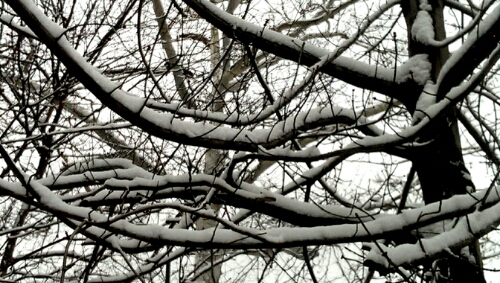
    Snow on Trees

    image

    It was really quite beautiful when I took a break from my work computer to go outside and shovel.

    My nearly 90-year old neighbor, Mrs. G., was also out shoveling, though no one else on our side of the street had made any effort either this snow or the last to clear their sidewalk.

    When I was mostly finished, I  went to say hello and to tell her, though we have never really socialized, how much I love and appreciate having her as a neighbor. She thanked me for saying so and said she has always tried to be a good neighbor.

    I asked if I could give her a hug. She hugged me and then asked rhetorically when that had last happened. Her doctor. Before Christmas. Gave her a hug. “It’s always good to hear,” she said, “that you are appreciated.”

    I offer my appreciation to you for reading and for how much so many of you enrich my life.

  • | |

    Snowdrops and Crocuses (and Spanda)

    Snowdrops have been showing up for more than a week, but crocuses?  They seem a little incongruous with the bitter winds and as much a reminder of global warming as of spring.  I feel a bit confused seeing them, though delighted.

    It has been a good winter.  I have learned to appreciate the cold and dark, which gives us time to enjoy the pleasures of home and introspection.  Now, I am looking forward to spring, the effusive colors, the warmth, the ability to get back out into the garden.

    This time of year, with the radical contrasts of cold winds and flowers does highlight the play of opposites, the very pulsation of existence — in yoga terms, the spanda.  This time in society seems to have a similar play of bitterness and sweetness.  Staying steady with our yoga practice and our community, we can delight in what we see and what we have, even as we may be worried and working for change.  That too, is part of the play (lila).  To invite in a steady warmth and support from our practice and our community, even as we see difficulties and challenges, want things to be different, and know that our work may not necessarily bring about the change we seek.

  • | | | | |

    The Photographer’s Dilemma (and “Morning Sprout Sandwich”)

    At which point I put down the camera and ate.  Uma turned her back and looked out the garden.

    Morning Spout Sandwich–whole grain toast, tahini, avocado, assorted homegrown sprouts, fresh herbs picked the moment before garnishing (dill shown here), a sprinkle of sea salt (optional)

2 Comments

  1. As the author of American Veda, I want to thank Elizabeth for the kind words. It’s very gratifying when people forward me links to blogs that mention my book favorably. In my workshops, I sometimes play “Within You Without You,” from Sgt. Pepper’s and the audience hears it with fresh ears. But I can’t imagine hearing it for the first time at age six! Thanks.

  2. I also was profoundly changed by being introduced to this ancient way quite young. As a meditation teacher of spirituality for Robert Adams I found your page quite impactful both as one who devoutly believes and has experienced, and as the perspective shared as an astute observer of the effect of this ancient wisdom on the American consciousness, and the generation before me. Thank you. Peace and Bright Blessings Always. Mellie Warner

Leave a Reply

Your email address will not be published. Required fields are marked *

This site uses Akismet to reduce spam. Learn how your comment data is processed.