Blossoms Around Town

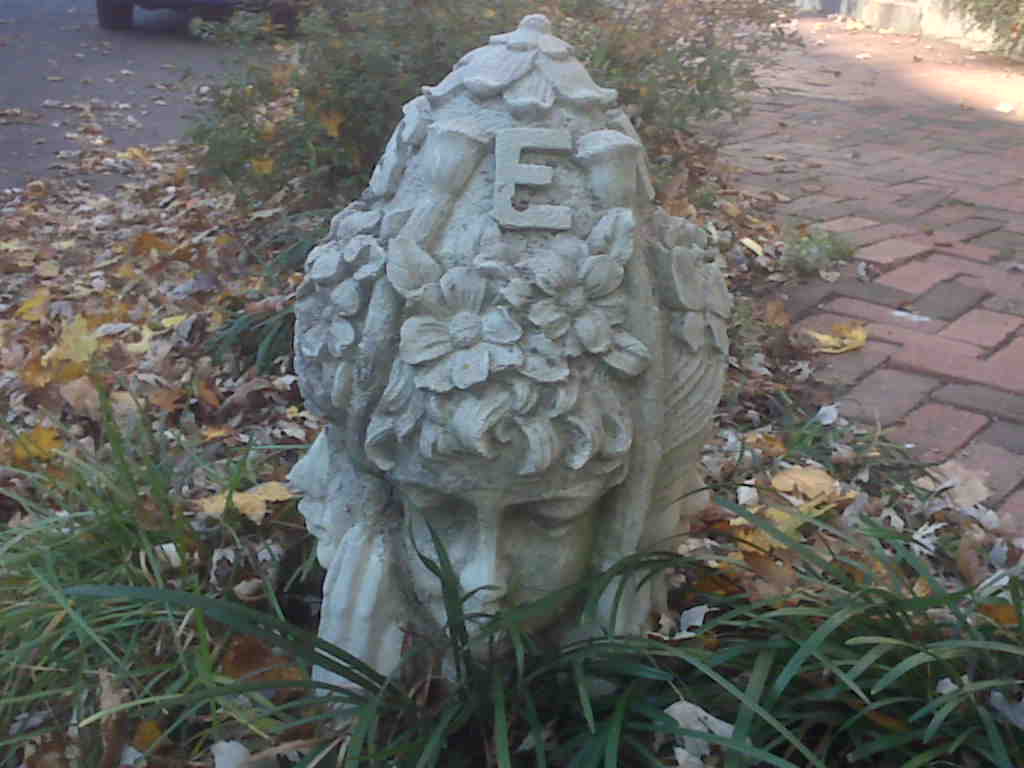
Peace and light, E — Posted with WordPress for BlackBerry.
My adorable new neighbor appears in the photo to be outside looking in with me taking a picture from inside looking out. From the perspective of who was in the house and who was standing on the sidewalk, it was of course the was the opposite.
The paradoxical illusion in the photo led me to think about moksha — the yoga concept of liberation.
What I get from the various teachings for my own living practice is that to experience freedom in this embodiment we need to be able simultaneously to be on the inside looking out–from our individual embodiment appreciating a sense of universal connection–and also be on the outside looking in–bringing back to particularized embodied action what spaciousness we learn from practice and study.

Next Saturday, March 14th, 2:30-5pm, is the Yoga for Gardeners Workshop at Willow Street Yoga Center’s Takoma Park Studio. A portion of the proceeds will go to the benefit of the Youth Garden at the National Arboretum. It will be a most enjoyable way to prepare for the gardening season, especially after having been inspired by this weekend’s incredibly spring-like weather. Advance registration is appreciated, though not required, and all levels of yogins and gardeners welcome.
You can come just open to what will be offered — I’ve got lots to share — but if you have specific questions about how to use yoga alignment while gardening, how to address various challenges of embodiment in the garden, or even yoga philosophy or other gardening/yoga topics, please feel free to send them to me as a comment to this entry or by separate email. I may not be able to get to every question right away, but I will try to address common questions in the workshop and here on the blog and am also always available after class to discuss individual questions.
My friend Dan just posted on his blog a great Gary Snyder quote on the need to do maintenance (of the self) in order to be most creative. The idea that we need to maintain our tools and toolbox, as it were, in order to be most creative, is exactly what we are taught about the tantric yoga sadhana — practice. With our yoga practice, diet, lifestyle, work, consumption, participation in community, we seek to live progressively more in alignment with the undulating fabric of space, time, and apparent world so that we have maximum well-being best to serve ourselves and others with delight. In our sadhana, we include both study and experience (experience includes meditation, asana, and pranayama). As both John Friend and Paul Muller-Ortega teach, we engage in the practices and studies to learn with ever expanding insight how to see and experience the highest first and live from that place. Living and practicing with such an intention is, I think, the maintenance done so we can live out all of our lives as a reverential and creative act.
Dan–I look forward to reading the sermon.
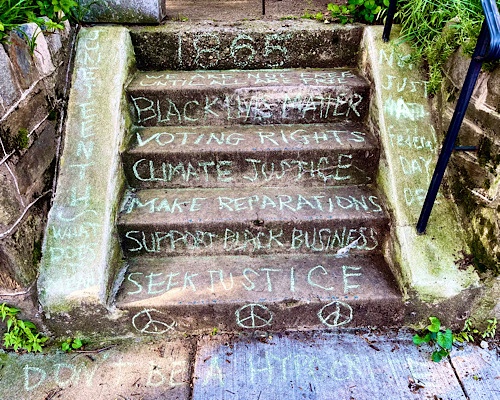
Asteya in Sanskrit means non-stealing and is the third yama of the yamas and niyamas set forth in Patanjali’s Yoga Sutras as a critical part of the path of yoga. White people giving themselves a holiday created by Black people for themselves without both taking action against current injustice and inequity is a classic example of what would be stealing.
Could you give extra support to a Black business today? Donate to a Black-run organization working to fight for civil rights or voting rights or equal access to health care, education, and support services or against police brutality? Give mutual aid? Write to your elected officials about said issues?
We don’t have to do everything every day, but it is not ok to do nothing.

One of my favorite practices is to find the wonder in things, if only the outrageous complexity of experience and relationship.