Mudra of Calm Abiding
I was taught that placing your hand on your thigh palm facing down is the mudra of calm, abiding. I personally find it soothing. So, apparently, does Maitri, who demonstrates another variation.
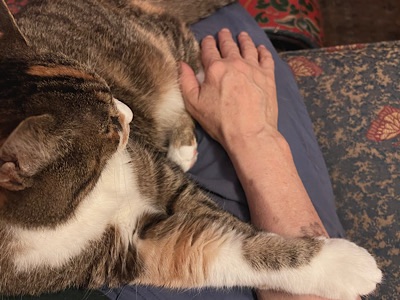
I was taught that placing your hand on your thigh palm facing down is the mudra of calm, abiding. I personally find it soothing. So, apparently, does Maitri, who demonstrates another variation.
It was already hot when I went out into the garden after I sat for meditation. I try only to water every third day it does not rain and have used soil supplements such as “soil moist” to make that possible, but it was critical that I water so that the plants survive today’s blazing heat.
Before I went out, while listening to the weather forecast, I drank my second glass of filtered tap water. I thought how lucky I am to have fresh drinking water from the tap, shelter from the heat, ice if I want it, and water for the garden. All those warnings to stay inside, keep cool, and drink plenty of liquids are meaningless unless one has access to those things.
I am grateful, too, for my practice. I know that a slow, quiet practice helps keep me cool and rested, and that I can get extra enjoyment from the way the heat warms my muscles without any effort at all on my part. In the heat, stillness is so welcome that sitting is as sweet an activity as I could know.
I came home from the workshop with much to explore in my own practice, and it was good to see old friends from the yoga community and make new acquaintances.
One of the things I appreciated were the demonstrations of therapeutic applications. Bonnie Bainbridge Cohen noted that the first issue is survival, observing that since we were all safely together in a nice yoga studio, that we had survival covered.
The second thing, she suggested, before offering healing, is to make sure that both the person receiving and the person making the offering are comfortable.
I add to the latter that having both people be comfortable increases the likelihood that they will be able to stay present and mindful, which should increase the possibility of efficacy.

Dear Friends,
It is Saturday morning of Independence Day weekend. I have sat for my morning meditation, watered the garden, pet the cats, and done a few errands around the house. In an hour or so, I will be heading up to Willow Street to teach my noon class. As I take the time to care for garden, cats, house, and prepare to teach, I have been contemplating the concept of freedom.
In the tantric shaivite tradition, we are taught that one of the key aspects of spirit is svatantriya — ultimate freedom. We are also taught that we are ourselves inseparable from spirit, just as a drop of ocean water is no less part of the ocean for being a drop. Spirit chooses, out of its freedom and play (lila) to embody itself in forms that are limited in space and time. One of our greatest sources of suffering is feeling bound, thinking that we are stuck with who and what we are in the constraints of this mortal body, with all its quirks, forgetting our own auspiciousness.
I could get grumpy about the need to do errands and to teach on a holiday weekend. I could feel constrained from my usual activities around town by the combination of single-tracking on the Metro and the influx of tourists for the activities on the Mall, the combination of which will likely add an hour’s communiting time to teach today and to do volunteer work in Georgetown tomorrow at the Lantern Bookshop. I could choose instead to be grateful that I have a house that needs caring, a garden to water, a class that gives me great joy and abiding satisfaction to share the incredible yoga principles that have so enhanced my own life, and volunteer work that I have enjoyed for over 15 years.
I am not going to be telling anyone that we are without limitation, being as we are in time and space. We are always and perfectly free, however, to choose to turn towards the auspicious, the light, the good, the uplifting, the highest or we can turn away. We can act in ways that bring us ever more in alignment with spirit , or we can act in ways that take ourselves and that in our orbit farther from the good. The more we exercise our freedom to turn towards the auspicious, the happier and healthier we will be, regardless of the fact of life in a mortal body. That choice is our true freedom and the way to our hearts.
To help you experience svatantriya, to choose freedom of heart, there’s nothing better than some free yoga. The weekend of July 15-17, Willow Street Yoga will be offering it’s summer free class weekend. I’ll be offering gentle/therapeutics at noon on July 16th in Takoma Park. Preference is giving to new students and to returning students who have brought new students with them.
For July at William Penn House, I’m offering a two-part freebie: (1) brand new students get first class free; please invite your friends and neighbors; (2) if you are an existing student who brings a new student with you, you get a free class when the new student comes back for a second class.
Have a wonderful Independence Day, however you choose to celebrate and see you soon.
Peace and light,
Elizabeth
Patanjali’s Yoga Sutra II.48, tatah dvandaha anabhighataha is translated by B.K.S. Iyengar as “from then on [after the yogi through steady practice has absorbed him/herself in the practice of yoga), the sadhaka (practitioner) is undisturbed by dualities.” This sutra follows the only two in all of Patanjali’s Yoga Sutras that specifically discuss asana, which Patanjali describes as a controlled and perfect ease and steadiness of mind and body.
I was thinking about the freedom from the “pairs of opposites” — pleasure and pain, etc. — when I read an article in the Washington Post yesterday dividing everyone who was impacted by the blizzard as a winner or a loser. Children off from school were winners, frustrated parents, travelers who were grounded from flying, and politicians sure to be blamed for not having planned in a Southern city to have the snow removal equipment, personnel, and budget of a city like Buffalo, NY, were losers. I am fairly certain (based on the harangues on the blogs) that the author was not alone in seeing everything as winning or losing. To me, though, it feels like one of the “afflictions” described by Patanjali. I was a grounded flyer. I was much looking forward to a trip to San Francisco to see a dear friend from college and then to attend the weekend workshop with John Friend. It would have been great fun to be there. I was disappointed. But it never would have occurred to me to label myself a loser. Do so so would just had me hold onto unhappiness.
Yoga teaches us to look for the good, to accept what we cannot change, and to seek to respond in the highest. In essence, we are changing what we can change, which is how we react. If my only reaction to the storm was pain and sadness from having the pleasure of my planned trip taken away from me, then I would in fact be a loser. If I just accept that no one can anticipate when record-breaking winter storms are going to arrive and then have the best day I can under the unavoidable circumstances, then I am a winner. I am not a winner in a game where someone else is a loser. I am not a winner in that I did not let Mother Nature win. Rather, I have learned that the steady practice of yoga makes life more easeful and delightful even in challenges and disappointments. I am motivated to practice more. The lessons learned from being confined a blizzard when I was warm, well fed, and surrounded by friends are a hopeful prelude for how the yoga will serve when I really face a challenge.