| |

6:50am flight from BWI (I’ll be off of the computer until Monday)

I am lucky to have a non-stop.  The storm is supposed to have passed through.  So I can enjoy myself know matter what travel brings, I pack up a variety of reading materials — philosophy, handouts for the workshop, and fiction.  I switched my ankle warmers to bamboo knitting needles so I could get through security and knit (the ankle warmers are on size 2 needles, so it is taking me as long as a sweater).  I have my journal and a pen.  Best, I am traveling with two friends (all different flights, but no one waiting alone in the airport) with whom to visit, who are going to the same retreat.  Takes the edge off of the early wake up time.  Starts the retreat when I leave the door instead of when I arrive at the retreat center.

Similar Posts

  • | |

    Solar Panel Installation Update

    Last week the supplemental electrical panel necessitated by living in “this Old House” was installed.  The existing panel did not have room for the solar panels to be connected.

    Today, the DC Building inspector came, inspected, and gave approval (conditional on contractor sending photos of the roof).  Last step is to get PEPCO to come and change the meter.  That could take a couple of weeks.  Meanwhile, there is no rain in the 15-day forecast.  Best start doing the rain dances.

  • |

    On A Bus

    This morning I found myself on a bus instead of the train to New York because of the horrible accident on Tuesday.

    While waiting for the bus, I was interviewed by local TV. They were interested in reactions of people whose travel plans were impacted by the accident.

    This is roughly what I said:

    This was a horrible tragedy that need not have happened.  (I suppose it was for the best that I had not seen the news that a certain candidate for President was quoted as saying that we shouldn’t use a tragedy as an excuse to spend more money on things like safety lest I explain why we need better safety, more spending on mental health care, better treatment of employees, and more investment in infrastructure instead of lowering taxes for the wealthy, etc.) I said that the inconvenience meant nothing to me when I think of those who were on the train. I said that I wouldn’t stop taking the train. One accident would not change my commitment to using public transportation instead of the greater environmental impact of driving.

    And I said I’d had a good experience with Amtrak customer service. I didn’t say it to the camera, but I expect part of my positive experience was my recognizing when I spoke with an agent that the customer service employees must be having an incredibly stressful time of it.

    image

    View from the bus, approaching Manhattan.

  • | |

    Brahmacharya, Civic Responsibility, and Enlightened Self-Interest

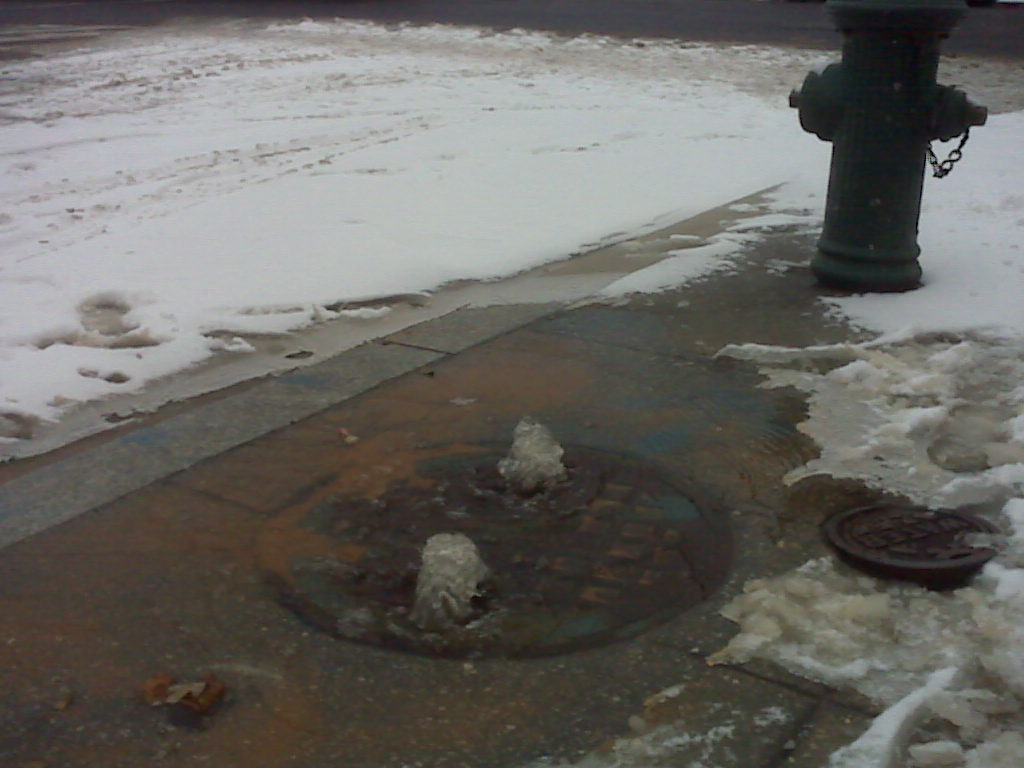
    I saw this water main break while I was walking to work this morning. Several people walked past it without a glance–could they really not have noticed? It looked relatively recent because the puddle was still modest and had not started freezing. I paused, took out my mobile device and telephoned the mayor’s city-wide call center (in DC “311”–whoever answers will transfer you to the right place; in this instance, “water emergencies”). A couple of people who saw me calling looked at me as if it must have been my fault or else why would I be calling,

    I thought about what it was that moved me to call. I saw harm to the environment (colossal waste of water while we are in a drought if the leak was allowed to continue without the earliest possible intervention) and potential danger to people from spreading icy water that will turn into ice late this afternoon. What is it, though, that leads one to take action to change or fix something that is technically not one’s business. What makes it part of one’s duty or responsibility when it is not directly related to one’s individual property or person? At some levels, it is just social contract. By choosing to live together in closely proximate society, it is in all of our self-interest to take care of shared areas, though the ubiquitously unshoveled sidewalks leads me to believe that most people haven’t been taught or grasped the principle that if we all contribute “our share” the whole place and our own lives would be far more enjoyable.

    These thoughts led me to think of the application of the yamas and niyams in Patajali’s Yoga Sutras and in particular, the principle of brahmacharya, which is one of the five yamas on the first level of the eight-fold path of yoga in Patanjali’s Yoga Sutras.

    Brahmacharya literally means being like Brahma, but it is often translated as celibacy. Brahmacharya, from a less socio-morally result-driven interpretation, could also be thought of as aligning with the divine. Before we are enlightened, though, how do we know what will help us align with the divine? I once heard Professor Douglas Brooks say, in a lecture I attended a number of years ago, that the yamas and niyamas, the ethical precepts that lay a foundation for the practice of yoga are for the goal of the individual reaching enlightenment. I was a bit taken aback by the statement at the time. It sounded as though the yoga precept was that the purpose of ethical behavior was self-interest, and was not because ethics was summum bonum. I am less troubled by the idea after much contemplation. What is the harm of the goal enlightenment serving to motivate and shape our behavior? The methodology that includes the yamas and niyamas would have us engage in certain ways of living and practices in order that we can change our karma by shifting the patterns (samskaras) that take us away from spirit rather than lead us toward spirit.

    To me, this means acting in away that not only does not harm (ahimsa–the first of the yamas), but seeks to expand the possibility of fostering the collective good, including the good of the earth. In this sense, to the extent that brahmacharya is a precursor to enlightenment–the merging of the individual self with the greater “Self” or spirit, acting from a placed of enlightened self-interest can be seen as helping us to find the true Self (as long as we are not attached to a particular good or outcome, but that is a whole other topic).

  • | | |

    An Opening

    Last night in group practice, we were working on the mini-arm balances.  As I demonstrated a pose, my spine shifted.  From the middle thoracic vertebra right behind the heart all the way up to C7, each vertebra popped sequentially, releasing energy not only from each vertebra, but upward.  I felt an incredible lightness moving from the heart space all the way through the crown of my head.  We talked about it a little in practice, because the fact that some kind of opening had occurred was fully evident to everyone in the group.

    As a purely physical matter, opening my thoracic spine is good.  I have degeneration in my cervical and lumbar spine.  Those parts of my spine are very mobile, almost unusually so, whereas my thoracic spine is quite tight.  This imbalance can cause pain and muscle tension, though through therapeutic practice of the Anusara principles, I progressively find a healthy balance of stability and freedom.  Go to any decent physical therapist for neck or lumbar pain, and the therapist will work to open the thoracic spine, which although it should be stiffer (being attached to the ribs and protecting the heart), likely needs to be more mobile to be in better balance with the rest of the spine.

    This morning, I woke up still feeling more open around the heart space and noticing a shift in the energy in my upper back, neck, and head, and the sensation of the opening I experienced carried itself through my morning meditation.

    We never know when we are going to get an opening in our practice.  I keep coming to the mat and the meditation cushion because I want to be more open, more grounded, more free, more full of energy, more compassionate, more at peace, more in tune with others.  It is fairly rare, though, that I experience a noticeable opening all at once (and the reason to practice should not to be to have wild moments, sensations, visions, etc).

    When one comes, though, it leaves open the question:  what will I do with it?  Will I get absorbed in talking about it and reliving it?  Will I think that I can slack in my practice because I have had a big opening?  Will I return to how things were before?  It is easy enough to do.  Just witness the collective energy and momentary hopefulness of this country when it elected President Obama.  Upon not getting instant change and relief, the country has returned to blaming, divisiveness, ineffectiveness, finger-pointing, greediness, warlikeness, and catering to the corporate war machine instead of moving towards universal health care, peace, and “green” energy consumption.  It would likewise be easy for me to have enjoyed experiencing something wild and special on my mat and then go outside to walk to work and be tense and grumbly about the ice on the sidewalks, the snow in the forecast, and the limits I experience in my daily life.  I know there will be some going backwards, but I will strive to take this experience to shift to a more optimal place in my practice on and off the mat.

Leave a Reply

Your email address will not be published. Required fields are marked *

This site uses Akismet to reduce spam. Learn how your comment data is processed.