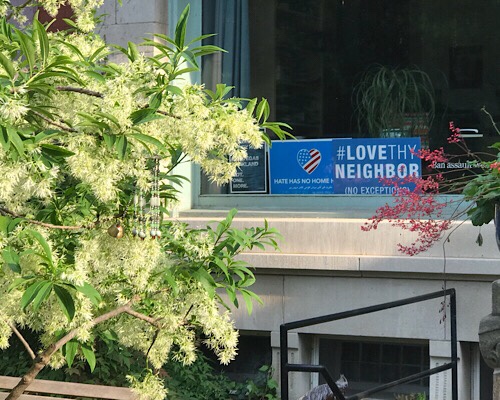
When to Get a Hug (and shoulder loop)

It has been my experience that there are times when a hug feels like too much or not right or that it will not ease what hurts.  First there is a need for an openness of heart, a little intrinsic brightness, some recognition of worthiness to receive the love, before a strong embrace feels right.  In Anusara, we are taught to practice the opening, brightening, expanding principle of “opening to grace” before we draw in with the embrace of muscle energy.

“Shoulder loop” helps us refine muscle energy and by drawing the shoulder blades onto the back of the heart and then lifting and expanding the chest, it can be incredibly powerful and healing.  My experience with shoulder loop, though, especially when I have active shoulder or neck pain, is that if I am at all collapsed, if I am not doing maximum “inner body bright” shoulder loop feels OK, but it it is much harder to access and receive.  When I open to the possibilities by radically filling with light and energy, especially around the back of the heart — in a word, meeting the possibility of embrace from the inside out — then the embrace of shoulder loop is almost instantly healing and empowering.

Similar Posts

  • | | |

    Wonder Here at Home

    image

    I have been pining for a great adventure that would crack open my heart and remind me of the exalted.

    A look at the sky as I did errands in the middle of my work day reminded me that all we need to find that ecstatic sense of awe is to be open to it right where we are.

    The sadhana is to stay filled with awe as we do our work and chores, no matter how prosaic or stressful.  Easier said than done, but worth every bit of effort (tapas).

  • | | | |

    Balance of Stability and Freedom

    Last night, we were talking about the parameters of cultivating a steady and fruitful meditation practice, and Paul Muller-Ortega suggested that it was about the balance of stability and flexibility. He had learned the principle from a different source, but I have contemplated and explored the principle in depth from teachings I have received from John Friend.

    A critical aspect of the Anusara alignment principles is to find the perfect balance of stability and freedom. We need stability to stay fully and safely in each pose. We need freedom to achieve the fullest and most delightful expression of the pose.

    We find the stability both by making certain that we have established our foundation (which is an aspect of the first principle of opening to grace). By then using the three aspects of muscular energy–hugging the muscles to the bone, drawing into the midline, and drawing energy from the periphery to the focal point, we make possible an expansion of our edge, whatever that might be. Having a solid, aligned foundation and affirming our very core with these actions, gives us security and balance. We also want to reach out, to be playful, to expand to our fullest, which we do using the expansive, outreaching organic energy — from focal point to the periphery, from the midline to our outer edges, from the very marrow of our bones through bone, muscle, skin, and beyond.

    If we over-emphasize (including natural inclination) stability, then we can get stuck. If we just let ourselves be free, then we end up all over the place. When these elements are perfectly balanced, we can safely find our deepest freedom of expression.

    When I teach this principle as the focus of a class, I always invite my students to think of how important the balance of stability and freedom is for every aspect of our lives.

    The discussion last night put this principle in the context of the regularity and steadiness of our practice, with the recognition that to stick with our practice, we will sometimes need to vary the time or amount of our practice, or what elements are included in the practice.

    To get the fullest benefits of a practice (this applies to any practice and not just to meditation), we need to show up consistently and to practice in accordance with how we have been taught. To stay steady, though, we need to give ourselves the permission or freedom not to show up, or within appropriate parameters, to modify the practice when life gets in the way of what we think would be the ideal practice. If we think we have to do things at the exact time and place every day in a perfectly precise way, we become rigid. On the other hand, if we are loosey-goosey about it, then we do not have much of a practice and will not realize the benefits that we could get.

    Where in your practice or life would more stability and steadiness give a field for greater freedom and happiness? Where could you give yourself a little more flexibility so that you feel that steadiness brings the possibility of joy, rather than tying you down?

    Peace and light, E — Posted with WordPress for BlackBerry.

  • | | |

    Christina Sell Writes About Teaching at Willow Street and Suzie Hurley

    I had the good fortune to be able to study with Christina Sell last weekend at Willow Street.  Christina writes here about the Willow Street community.  Her gracious words reveal the light in her own teaching and personal expression.  I look forward to studying with Christina again.

    And Christine–ditto on everything you write about Suzie and her extraordinary capacity to expand community.

  • | | |

    New Spinach (and Udyamo Bhairava)

    The fifth sutra in Abhinavagupta’s Siva Sutras, is “udyamo bhairava” — the great upsurge of consciousness.  When we are open and aware, we can witness this upsurge, the very pulsing of life energy in all that is in and around us, from the springing up of thought in our minds to the burgeoning of spring.  The more we practice and live attentively, the more we will see the joy in this upwelling.

    When I go out into the garden on the early spring days to see what needs to be cut back, what is volunteering, and what is coming up from fall plantings, I approach with great openness.  When we plant in the fall, we do not know with any certainty what kind of winter we will have.  Although the long-range forecast was for colder than normal with precipitation near normal (which translates into more than average snow), who could have expected three mammoth snow storms?

    I plant with hope and some expectation, but am ready for the loss of some perennials, the failure of some seeds to germinate, and the unexpected pleasure of experiments working or welcome volunteers.  This steady planting without specific expectation, with openness to discovery, with joy and attention to the miraculousness of what rises up in the spring, is a very tangible example of what I read in the yoga philosophy.  It is how I, I believe, we most optimally would approach asana and meditation, as well as all aspects of our daily being.

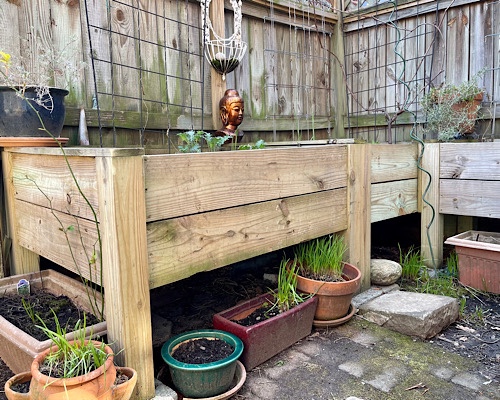
    Below:  new spinach coming up in a container from seeds I planted around Thanksgiving from an expiring packet.

Leave a Reply

Your email address will not be published. Required fields are marked *

This site uses Akismet to reduce spam. Learn how your comment data is processed.