Found Objects Around Town
When I enter into a contact improv jam, I make a commitment. I commit to paying attention with all of my being, to myself, to my partner or partners of the moment, to all the others in the room, and to a spatial, energetic, and creative attention to the dance itself and for the dancers as community and co-creators of the dance (and sometimes for the observers, too).
I think this is not unlike the commitment of the tantric yoga practitioner who ideally engages all of life with a simultaneous attention to the inner and the outer, to the dance between the self and all that to which ones self comes into relationship and to the dance of relationship.

Peace and light, E — Posted with WordPress for BlackBerry.
I am looking forward to February’s meeting of the Willow Street Book Club this coming Sunday, where we will be discussing David Frawley’s, Spiritual Secrets of Ayurveda: Tantric Yoga and the Wisdom Goddess. Especially since many of us will likely have been to hear some or all of Professor Douglas Brooks’ discussion of the great goddesses last weekend, the meeting promises to be full of lively, thoughtful, and insight-provoking discussion.
One of the things I have been pondering on this latest read is how I can fully imbibe the wisdom that is offered with the imagery and stories of the goddesses, without getting caught up in being troubled from a feminist perspective. Many yoga practitioners I know rely on the call in the texts to worship the “goddess” as a way of saying that women are not diminished in the classic texts. My conundrum is that when one looks at the texts and the images about the goddesses, all the stereo-typical notions of beauty and youth are inextricably intertwined. Like the Western fairy tales I gobbled up in my youth and their entrancing but insidiously prejudicial archetypes, the sweet, loving, desirable goddesses are the young and fair; the fierce and powerful goddesses are the ugly crones.
Monument to Andy (but, I ask, does he really need one?)

Peace and light, E — Posted with WordPress for BlackBerry.
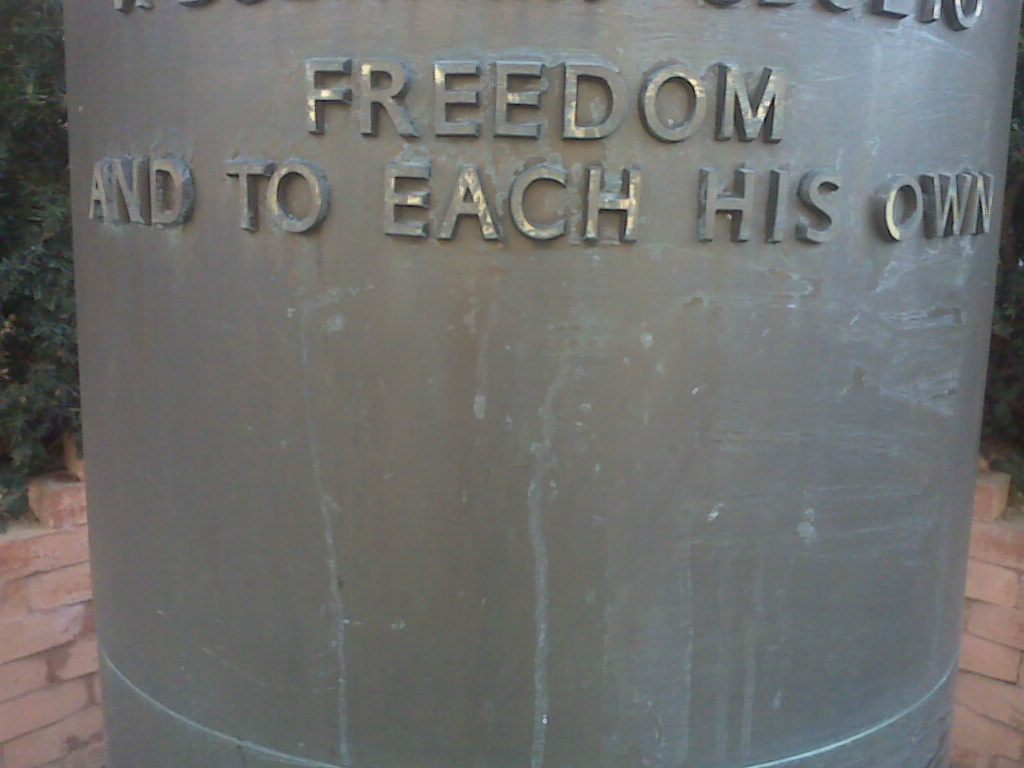
I found on first and second and even third reading this declaration a little confusing. It may be that something was lost in translation (from the Bulgarian–a completely unknown language to me).
It does not say that to each his own is freedom, but that we should have freedom AND to each his own.
I think this means that true freedom is not everyone getting his or her own. Rather, out of freedom, we choose the binds of community and sometimes elect to forego complete individualism so that we can maximize the fulfillment of each individual as a member of the community.
To each his own as the only governing principle does not permit anything other than suspicious and antagonistice relationship. Honoring that everyone wants to be recognized as a free individual but that getting the benefit and support of community requires freely choosing to submit, commit, and work to a relationship in which maximum individuality thrives but the community of individuals is greater than any of its individual members–that’s a great and worthy dance.
Peace and light, E — Posted with WordPress for BlackBerry.