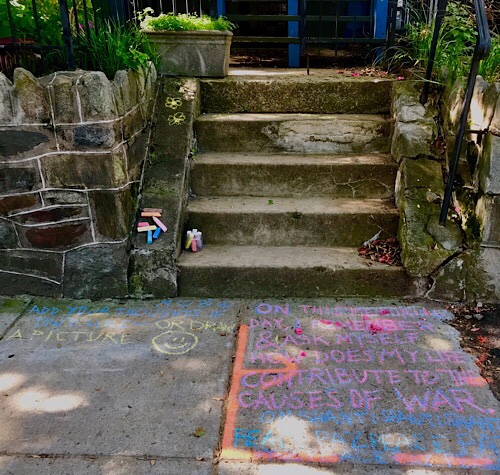
On This Memorial Day I Worked Hard in the Garden and Wrote on the Sidewalk
I participated today in the determination as to whether the noon gentle/therapeutics class at Willow Street should be cancelled due to the weather. It is hard to know when and what to decide unless the roads are absolutely unpassable or it is clear that that storm is not impacting most roads and sidewalks. Some students will have wanted to come to class regardless of the weather, even if it would have been both difficult to get the ice off of their cars if driving and very slippery going from house to car and parking spot to class. If class was held, other students would have wondered why class was not cancelled and felt it unfair that they now had to do a make-up since they were too sensible to go out in the ice. It is a balance of trying to offer the yoga as committed and making decisions about the reasonableness of trying to hold class given safety and logistical concerns. For a class with lots of physically intrepid students within walking distance, the determination is different than for one with people who are facing injuries and other challenges of embodiment, which can make it a challenge to get to class on even a beautiful day.
I’d love to get your feedback on where you think is the weather line between holding class as usual and cancelling. For me, part of the call was that within an hour of class, my porch, front stairs, and sidewalk were still solidly slick with ice. It would have been a challenge even to get to the corner, much less walk ten blocks and take the metro. Things did not really start to melt until mid afternoon.
This murti of Nataraja has been in the window of a store near where I work for at least 20 years. I often walk past is and just as often stop to admire it. I have never really considered taking it home, lovely as it is. The murti is simply too large for any of my rooms. I have mentioned its needing a home to a couple of different friends, who were looking for large murtis of Nataraja, over the past few months, but none have followed through.
Today, when I was walking past it on a lunchtime walk to the bank, I noticed a “commercial property for rent” sign in the window. I will miss having this resplendent image in my work neighborhood, but not enough to buy it and bring it home. I decided, though, to take a photograph. I know the owner only very casually, but well enough to know he is retiring, rather than being driven out by rising rental costs or the recession. The neighborhood has gotten trendier since Nataraja first appeared in the window. Nataraja might be replaced with a delicious restaurant or a fabulous store purveying things that entice me. Or the space could stay vacant or be used for something that holds no interest for me whatsoever.
Nataraja–lord of the dance of concealment and revelation, of dissolution and manifestation–is dancing here. The murti will be sold or transported away when the shop closes and will physically be gone.
I will have my memories of the image, a photograph I took with my BlackBerry, and will have had a sweet opportunity to observe the lord of the dance dancing away his own image.

When a student asks a question and I do not know the answer, I do not try to answer it then and there. I do go home and take the time to try and find an answer. If I find enough information to be useful, I follow up. Last night, before the William Penn House class, a student asked whether I had received a recent mass e-mailing from John Friend in which he mentioned teaching about biotensegrity. I knew the answer to whether I had received the email–yes, a friend had forwarded it. I did not know, though, how John was using the term biotensegrity. I went and did a little research.
Buckminster Fuller coined the word “tensegrity”as the conjunction of tension and integration. The idea of tensegrity is being actively taught by anatomy teacher Tom Myers, a student of both Buckminster Fuller and Ida Rolf and a teacher of certain of my yoga teachers. It also bears a trademark when called “Carlos Castenada tensegrity.” I never got into the “magical passes” of Castenada’s students turned teachers, but at some point relatively recently found a used copy of “Magical Passes.” As I had delved fairly deeply into Carlos Castenada in my youth, I picked up the book and made it part of my library, though did not read it at the time.
I am not surprised that John is talking about biotensegrity. From my few hours of reading, it seems resonant with the “universal principles of alignment” that were the foundation of his Anusara teachings and also consistent with his movement towards the exploration and teaching of “sacred geometry” near the end of his Anusara days.
Yes, I know I haven’t actually said what is tensegrity or biotensegrity in the yoga/body awareness and movement context. But I do not teach unless I have learned something well enough to integrate it fully into mind and body such that I can articulate it in my own words, and I have not thought enough about the term tensegrity as it relates to yoga practice, though the concept makes initial intuitive sense. If the links inspire interest, I invite you to look more deeply. And I’m going to put “Magical Passes” on my stack of reading, though not necessarily at the top.
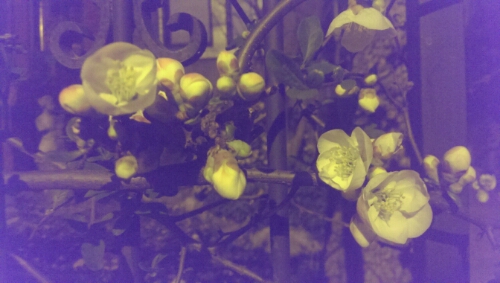
Quince on a neighbor’s fence

Peace and light, E — Posted with WordPress for BlackBerry.
