Blossoms Around Town

I spend a lot of words on this blog extolling the benefits I have perceived in myself and in my students from the various yoga practices. I also candidly admit (when asked) that not all practices are for every one and certainly not all of the time.
It probably seems obvious that challenging asana would not be right in the presence of certain injuries or illnesses, even if asana practice, which is good for our strength, balance, and flexibility, among other things, is generally beneficial overall. Being an advanced practitioner entails in good measure being sufficiently sensitive and aware of our edge day by day and even moment by moment in our practice so that we expand our capacity to live life to the fullest without blowing past our edge out of ignorance, carelessness, or ego and needlessly injure ourselves.
What is more subtle is finding the same edge in meditation. I am not talking about physical discomfort sitting for meditation. That can be easily remedied with appropriate props, for example a cushion or chair. There can be such a thing as too much meditation or not the right type of meditative practice for certain practitioners or under certain circumstances. Going deeply into the self beyond the surface level of thought can release things that had been buried. We may not be surprised if we have nightmares or anxiety dreams when life is presenting us with lots of challenges and difficulties. It may be more shocking, though, if negative thoughts or emotions come up when we sit for meditation. Meditation is supposed to be benign and health-optimizing.
One way to deal with the shock is to stop, but then we lose the wonderful benefits of meditation. What is more optimal is to learn where is our edge in meditation, just as we do for asana. As we get more proficient and experienced with meditation, if things are coming up that are difficult to handle, we learn when to shorten our time sitting, when to add in more physically comforting and boundary-enhancing asana, and how to release the negative stuff that is arising without it impacting our lives or relationships.
The challenge is that it is precisely the steady, intense practice over time that gives us the insight to know when the practice is too much at a particular time. For me, finding the edge where I can expand perfectly can be a challenge, but is ultimately and completely worth my while.
For some of the alleged dark sides of practice, try entering into your favorite search engine “meditation side effects.” Then read with appropriate skepticism; it is the internet after all, and you should be as skeptical about the claims of the negative aspects as you might be or once have been of the potential benefits of the practices.
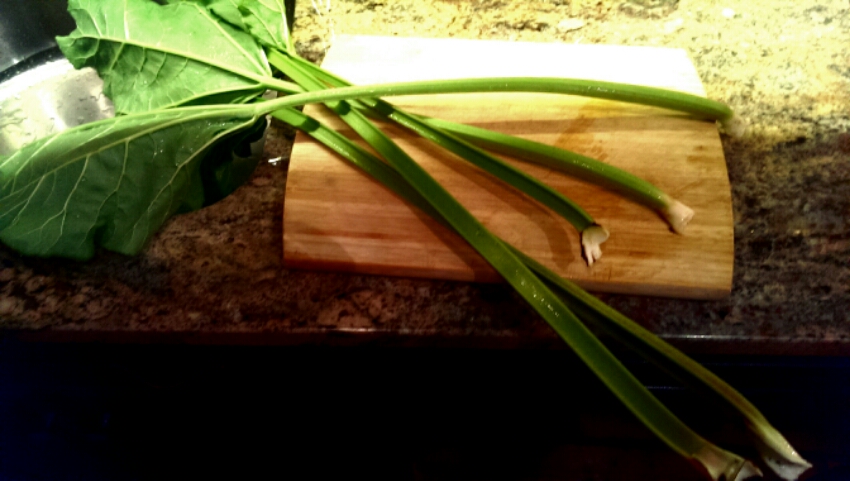
Rhubarb
When I have not looked at my email for several days, I am faced with dozens of emails in my two regular accounts, plus the spam folders. The first thing I do is see what in the spam folder is not spam. In doing that, I give some attention to everything in the folder. Then I go through my in box to figure out what should have gone to spam. Then I delete the spam. Then I decide what emails from list serves there is no point in reading because if I have not read them immediately, I will have missed the letter-writing, petition-signing, event-going, offering-enjoying that is described in the email. Those get deleted without being opened. There is another level of emails that I open, but just skim. Then I either delete quickly or leave to be read after I get to the important stuff. Then there are the personal and business emails that I want to read and require my attention. I look at them to see if they need immediate attention or can wait.
The thoughts that arise during meditation have a similar filter. Some are spam. There is a certain almost mesmerizing quality about the quantity and array of the thoughts, but I just let them go — returning to my mantra or the breath because the mantra is far more delightful than the thoughts. Other thoughts, I acknowledge, but leave for later (i.e., the proverbial “to do” list), again finding more delight in the spaciousness and light of meditation. Sometimes particular thoughts relevant to my practice and very being will start resonating in the light itself and becomes messages. These thoughts sometimes dissolve again into the light of meditation and do not come with me from the session in a tangible form. Others stay with me and give me fruit for contemplation, for investigation and study, for illumination of my day, or for discussion with others for further refinement.
Always, though, there is an acceptance that thoughts will arise as inevitably as one with multiple active email accounts and many list serves will get email. The practice is learning which thoughts I should give heed, which to discard, and when and how to listen to those that will serve and inform.