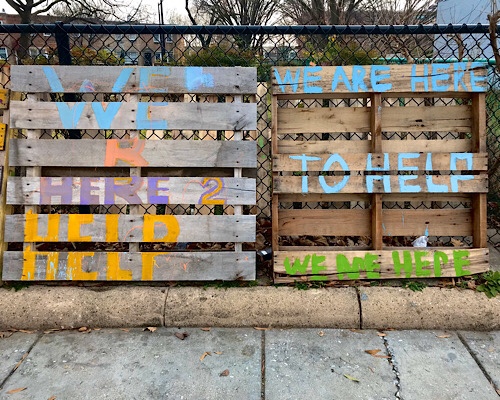
Signs and Blossoms Around Town
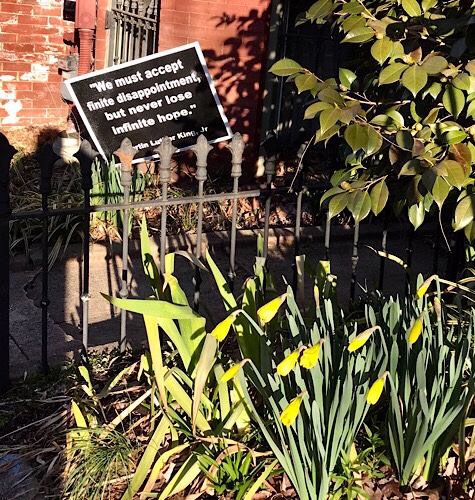
Several years ago, I was introduced to Don Miguel Ruiz’s The Four Agreements in a yoga book group. I come back to them periodically. I am not usually one for self-help books, but I think the agreements are a wonderful teaching.
I have them taped to the bottom of my computer monitor at the office because I find them especially useful in the office setting. In particular, they are helpful in my relations with a co-worker senior to me in the chain of authority who tends to be very critical or speak in a strained or loud voice when anxious about work. As it involves my projects (or we wouldn’t be talking in the first place), it is hard not to react and take it as personal criticism. Today, I found myself in two different discussions about them. First, I found myself reading them aloud to someone who called me to talk about a painful situation through which he is living. The response was “thank you” and, in particular for Agreement 2, “amen.” In the second situation, I was talking to two co-workers. One was describing a work situation, and she said she had found it very helpful to come back to her desk and read “agreement number two.”
The Four Agreements are (I found them on the Facebook page for The Four Agreements, so I feel OK printing them in full here; you can also see them on the “inside flap” view on Amazon.com (I have honored copyright by buying the book long ago for the book club meeting):
Agreement 1: Be impeccable with your word – Speak with integrity. Say only what you mean. Avoid using the word to speak against yourself or to gossip about others. Use the power of your word in the direction of truth and love.
Agreement 2: Don’t take anything personally – Nothing others do is because of you. What others say and do is a projection of their own reality, their own dream. When you are immune to the opinions and actions of others, you won’t be the victim of needless suffering.
Agreement 3: Don’t make assumptions – Find the courage to ask questions and to express what you really want. Communicate with others as clearly as you can to avoid misunderstandings, sadness and drama. With just this one agreement, you can completely transform your life.
Agreement 4: Always do your best – Your best is going to change from moment to moment; it will be different when you are healthy as opposed to sick. Under any circumstance, simply do your best, and you will avoid self-judgment, self-abuse and regret.
I find Agreement 1 the most challenging. When I am under stress, I tend to fall back into the ways in which I was raised and use “the word” to diss myself pretty fiercely, though I am getting better at not doing so persistently. With Agreement 2, the tricky thing is simultaneously not to take things personally and keep perspective, but still to listen openly for ways in which one might still want to seek to grow and shift in response to what is said.
Are you familiar with The Four Agreements? How have they assisted you in giving perspective in your relationships and life?
How luminous the
Low, long, afternoon light come
The winter solstice.

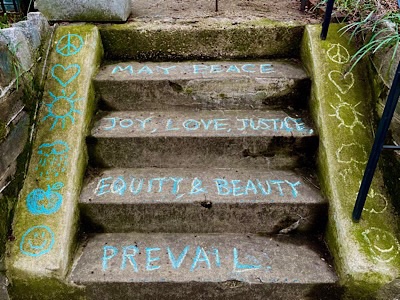

Cucumber growing, not as typically in the shape of the symbol for lingam, but in the shape of the symbol for yoni.
Desiree Rumbaugh, in the afternoon break-out session on hip openers yesterday, referenced the earlier teachings at the gathering on love, and said with a giggle that her class was “hip openers for peace.”
She shared a story of a teacher having his students create pictures representing peace. He picked two images that best depicted peace. The first was a serene picture of a mirror lake in the mountains (not unlike the tantric yoga principle of using our practice to find in ourselves the mirror of divine spirit). The second was of a barren and craggy landscape with a stormy sky. In a corner of the painting, though, was a nest with a small bird singing. Amidst challenge and chaos, one being living peacefully and joyously. This is why we do yoga, suggested Desiree, to find our own place of peace amidst whatever chaos is life. Noting how challenging hip openers can be for body and mind, especially if our bodies feel tight, she said that the practice can be like the second picture. We want to learn how to feel calm and centered even when we are deeply challenging ourselves on the mat, so we can tap into that place when life gets harder than we think we can bear.
The technology she offered for finding peace in hip openers was not tricks for stretching, but rather to strengthen the core muscles so that the outer hips and the hamstrings do not need to clench to protect themselves. When the core is powerful (as John Friend would say, “adamantine”) then the outside can soften and be open to what comes. This principle, in my experience and as given by my teachers, holds equally true for facing life and the most challenging of yoga poses.
Peace and light, E — Posted with WordPress for BlackBerry.