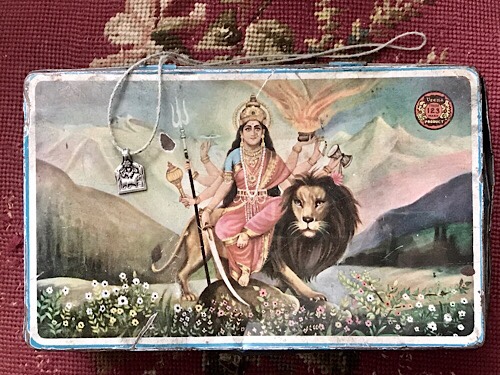
Jai Durga
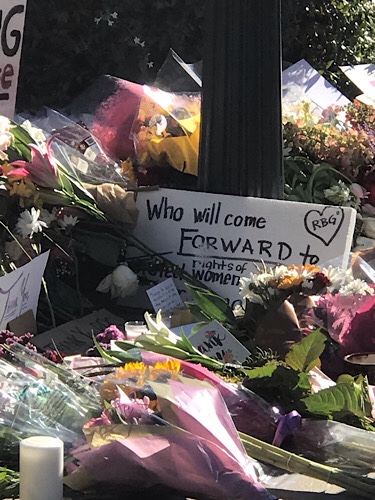
Why would we celebrate “goddess ” only once a year, but be expected to be devoted to “god ” every day.
Every day is women’s day.
Why would we celebrate “goddess ” only once a year, but be expected to be devoted to “god ” every day.
Every day is women’s day.

It is a constant dialogue that arises for me with others in my various communities about the place of political discussion in a spiritual community. Is there a place for examining the state of the world, calling for action, and trying to change things when we believe (or are seeking to understand) everything as being at its essence infused with the light? I just happened to read this parable today, after being advised that spiritual and political dialogue have no place being conjoined (today, it was about the budget and the war; it could just as easily have been about how to address from a place of spirit the complexities of how to shift and respond to the Gulf oil spill):
“RAMAKRISHNA: … [W]ater remains water, whether it stands still or breaks into waves. Divine Reality remains exactly the same when one is silent and one speaks. Relax your mind a moment and consider this parable. A guru teaches his disciple that every being and event is simply God. The ardent disciple, while walking home meditating on this truth, encounters a mad elephant. The elephant-driver, who has completely lost control of the animal, shouts to all who are in the way, warning them to run. But the stubborn disciple refuses to deviate from his path. He continues his contemplative exercise, regarding himself as God and the elephant as God. The crazed beast picks up this foolish man with its trunk and dashes him to the earth. The guru, famous for his healing powers, is called to revive the unconscious victim. After certain prayers are recited and holy water is sprinkled, the young man regains consciousness. He is surprised to find his guru gazing at him. When asked why he did not run from such evident danger, he replies: ‘Why should I run? My guru, you teach that all beings and events are God. I have implicit faith in your inspired words.’ The venerable master then addresses his immature disciple: ‘But my child, why did you fail to heed the inspired words of the elephant-driver, who is also God?'”
Lex Hixon, Great Swan: Meetings with Ramakrishna (Shambala Publications 1992)
Capitol Hill Neighborhood, Eastern Market, House Office Buildings, US Botanical Garden, Barbara Kruger at the Hirshhorn, United States Holocaust Memorial Museum, Washington Monument, Franklin Delano Roosevelt Memorial (Sculpture of Eleanor Roosevelt), Vietnam Memorial, Street Art on George Washington University Campus, and various points in between.
My friend Dan just posted on his blog a great Gary Snyder quote on the need to do maintenance (of the self) in order to be most creative. The idea that we need to maintain our tools and toolbox, as it were, in order to be most creative, is exactly what we are taught about the tantric yoga sadhana — practice. With our yoga practice, diet, lifestyle, work, consumption, participation in community, we seek to live progressively more in alignment with the undulating fabric of space, time, and apparent world so that we have maximum well-being best to serve ourselves and others with delight. In our sadhana, we include both study and experience (experience includes meditation, asana, and pranayama). As both John Friend and Paul Muller-Ortega teach, we engage in the practices and studies to learn with ever expanding insight how to see and experience the highest first and live from that place. Living and practicing with such an intention is, I think, the maintenance done so we can live out all of our lives as a reverential and creative act.
Dan–I look forward to reading the sermon.
When I was a kid, my friend who lived next door and I would use small pieces of slate to draw hopscotch boards and such on the pavement.
In recent years, more and more of my Hill neighbors have been decorating the sidewalks with chalk drawings–mostly done by children.
In south India, many of the thresholds were decorated with beautiful designs made with chalk or colored powder, and I kept thinking how delightful it would be if we engaged in that practice here.
It is on my wish/to do list to get some chalk to draw some welcoming decorations of my own on the sidewalk in front of my house.
Peace and light, E — Posted with WordPress for BlackBerry.
Earlier this week I was talking to a long-time friend of the family (my father has known him and his wife for over 60 years; they have known me since I was riding around in the womb). My parents had sent me an email while I was on the meditation intensive with Paul Muller-Ortega last month, to tell me that our friend was in intensive care recovering from an operation. I waited until I knew he was home to call because it can be so tricky to get the right time at the hospital. When we spoke, I told him that my father had said that his intrepid cheerfulness was a complete inspiration. “What choice do I have,” he asked, “what can you do when you wake up in intensive care on your 82nd birthday, but look for the gift it will have to bring?”
In the past several weeks, a number of other friends and family members have been seriously ill or lost loved ones or home or work or more than one of these. The outrageous suffering from a seemingly relentless series of natural disasters and war and the financial crisis is a staple in the news. In trying to stay present for my friends and community, while still taking care of my own needs and emotions, I found myself led to practice bhavana on (deeply contemplate) the first sutra in Patanjali’s Yoga Sutras: atha yoganusasanam–now begins the practice of yoga and how it relates to the Anusara first principle of “opening to grace.”
Teachers and commenters say of the Yoga Sutras that it was not meant for beginners, but was meant for students who have already established a practice and reached a level of initiation (diksha) that established they were ready to be given the teachings. I have also often heard said that one is drawn to the practices because of other experiences in this or a previous life; in some sense, the first time we show up, we are not a beginner and are ready for the teachings. Whatever knowledge and skill we bring to our studies and practice on any given day, they start new. They are starting “now.”
Now begins the practice of yoga (yug)–of uniting ourselves with each other and with spirit and linking our mind and body one-pointedly to the fullness of the teachings. The teachings are methods for knowing and experiencing this perfect union. In that regard, I think that an essential element of the teaching conveyed by the Anusara first principle of “opening to grace,” is this now, this beginning anew both to know what already is in our hearts and to learn how the practices can make it ever more accessible, whether we are beginners to what we understand to be yoga or meditation or have been practicing seriously for years. We want this “now” in every moment. As we get more skilled, and part of developing our skills is challenging ourselves deeply in the controlled environment of class and our own practice so that we will spontaneously open to grace in the moment when, as my friend said, there is no viable choice but to be cheerful (to “open to grace”).
The “now” of Patanjali, the practice of “opening to grace” in Anusara yoga, is a way to teach those of us (like me) who do not otherwise learn or intuit from living itself that there is no viable choice other than cheerfulness in the face of the most difficult of challenges. The “now” conveys that it is now time to go deep, time to expand understanding and practice, time to discover truly how the practices can connect us to spirit and alleviate suffering. Now is the time to be and to learn better how to stay grounded in and connected to the flow of energies, not just so that you can face what you yourself might be experiencing, but also to have ever more space for love, compassion, support, and service for others who are in need. Now is the time to open to grace.
Photo from exhibit in San Francisco on the 10,000 year clock project.