| |

The Four Agreements

Several years ago, I was introduced to Don Miguel Ruiz’s The Four Agreements in a yoga book group.  I come back to them periodically.  I am not usually one for self-help books, but I think the agreements are a wonderful teaching.

I have them taped to the bottom of my computer monitor at the office because I find them especially useful in the office setting.  In particular, they are helpful in my relations with a co-worker senior to me in the chain of authority who tends to be very critical or speak in a strained or loud voice when anxious about work.  As it involves my projects (or we wouldn’t be talking in the first place), it is hard not to react and take it as personal criticism.  Today, I found myself in two different discussions about them.  First, I found myself reading them aloud to someone who called me to talk about a painful situation through which he is living.  The response was “thank you” and, in particular for Agreement 2, “amen.”  In the second situation, I was talking to two co-workers.  One was describing a work situation, and she said she had found it very helpful to come back to her desk and read “agreement number two.”

The Four Agreements are (I found them on the Facebook page for The Four Agreements, so I feel OK printing them in full here; you can also see them on the “inside flap” view on Amazon.com (I have honored copyright by buying the book long ago for the book club meeting):

Agreement 1:  Be impeccable with your word – Speak with integrity. Say only what you mean. Avoid using the word to speak against yourself or to gossip about others. Use the power of your word in the direction of truth and love.

Agreement 2:  Don’t take anything personally – Nothing others do is because of you. What others say and do is a projection of their own reality, their own dream. When you are immune to the opinions and actions of others, you won’t be the victim of needless suffering.

Agreement 3:  Don’t make assumptions – Find the courage to ask questions and to express what you really want. Communicate with others as clearly as you can to avoid misunderstandings, sadness and drama. With just this one agreement, you can completely transform your life.

Agreement 4:  Always do your best – Your best is going to change from moment to moment; it will be different when you are healthy as opposed to sick. Under any circumstance, simply do your best, and you will avoid self-judgment, self-abuse and regret.

I find Agreement 1 the most challenging.  When I am under stress, I tend to fall back into the ways in which I was raised and use “the word” to diss myself pretty fiercely, though I am getting better at not doing so persistently.  With Agreement 2, the tricky thing is simultaneously not to take things personally and keep perspective, but still to listen openly for ways in which one might still want to seek to grow and shift in response to what is said.

Are you familiar with The Four Agreements?  How have they assisted you in giving perspective in your relationships and life?

Similar Posts

  • | | | | | |

    June Greetings (Web Version of June E-Newsletter)

    Dear Friends,

    One of the yoga practices in Patanjali’s Yoga Sutras is sauca, which means cleanliness or purity.  It does have a basic aspect of physical cleanliness, which has lead me this year to do an especially vigorous spring cleaning.  I think following the principle of saucra also applies to the clarity of our intention for the practice of yoga:  are we seeking to experience and act from a place of deep connection to spirit (or good or oneness or divine or whatever you name it)?  In practicing sauca, I think the most basic question is whether we have dust on the mirror that reflects the good in ourselves obscuring our vision, whether there are blockages to the energy flowing to bring us to optimal physical and emotional health, or whether anything is getting in the way of our manifesting our intention?

    When it has been too hot to go into the garden over the past month, I have been reorganizing and sorting through old papers.  As a once every five or ten years spring cleaning, it is lasting longer than usual.  I tend to be good about keeping on top of these things, but there are crevises of old records of my life that seem to just get stuck back into a folder to be decided on some other time.  This afternoon I came across intimate letters from a friend who, not long after we went our separate what had become cross-continental ways with regret on both sides, discovered he had brain cancer.  There were a few notes not in envelopes.  I reread those, but did not open the envelopes.  Back into the miscellaneous file until the next time.  The same with the print-outs of emails to and from Peru right after 9/11.  It wasn’t avoidance.  Over time and distance, regret and grief have faded.  I did not have the need or the time to read them now.  They went back into the file because I am curious what will be my reaction to these documents when I am 87 should I be around in this body then.  I find that when I see them after again more years have passed, I can see how much the yoga (asana and meditation) as a steady practice over time has shifted how I relate to my past, to all the decisions better or worse that brought me here today.  I am more at peace with the various detours and convolutions for the teachings and the good at the time, even if they do not appear to have been squarely or most efficiently on the path.

    Just as most of us have pieces of paper or things that for some reason get saved, but spend most of their time in a drawer or a file cabinet or a closet, we have thoughts and emotions around past experiences that can emerge into memory at what can seem to be the oddest of times.  With a strong meditation practice, it can sometimes feel like we are cleaning out the closets of our mind.  With a therapeutically focused asana practice, it can seem as though we have found old energetic entanglements, and it may feel that it would have been easier never to have practiced at all.  If we stay steady and keep coming to class and our own practice, we witness how much change can be wrought.  When we remember to bring our clear intention to the yoga mat, the meditation cushion, the garden and the kitchen, the laundry, work and commuting and everything we do, then we in an ever more refined and deepening way open to grace, the fundamental AnusaraR principle.

    I am happy to let you know that I am now E-RYT 500.  My spring cleaning on the physical level motivated me to do the paperwork with Yoga Alliance.  My carrying the designation E-RYT 500 means that teachers taking my classes and workshops can get Yoga Alliance continuing education credits, in addition to Anusara study hours.

    I am looking forward to studying with Christina Sell at Willow Street Yoga next weekend.  Come join fellow yogis for what promises to be a joyously challenging weekend of classes.  The following weekend, I head up to Vermont for the Anusara Grand Gathering.  If you are going, let me know and we can try to connect.

    Special June Location Information for William Penn House Classes:  June 14 and 28, William Penn House will be completely taken over by conference groups.  Class will be held at the house location.  RSVP’s are required.  For those who have been regulars, but who have been full up with other things in life than class, it is a sweet way to get back.

    Hope to see you soon.

    Peace and light,

    Elizabeth

  • | |

    Wash Your Hands A Lot

    I have not much been one for hand sanitizer, though I have long washed my hands well and frequently and avoided touching directly door knobs and elevator buttons, etc, and appropriate social isolation when I am sick.

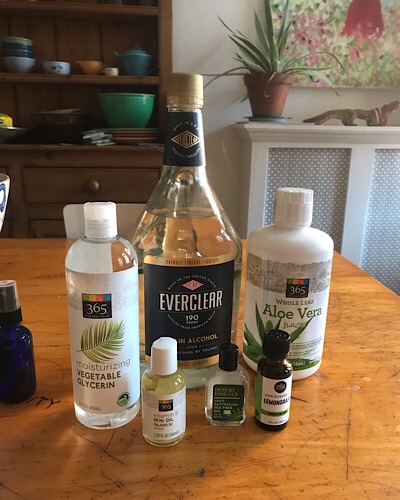
    In the present moment, it seemed like a nice idea to try and make hand sanitizer at home and then share it. I already had the alcohol for making tinctures and the tea tree oil, but mixing this combination of things all together will be a new thing. I would have done better with aloe vera gel than juice and a good deal less, but this was the smallest size. As long as it’s more than 60%alcohol, it should both sanitize and keep.

    The remaining ingredients are meant to add moisturizing and/or antiseptic properties. Both tea tree and lemongrass oil can be irritating, so that will only be a few drops.

Leave a Reply

Your email address will not be published. Required fields are marked *

This site uses Akismet to reduce spam. Learn how your comment data is processed.