Untitled
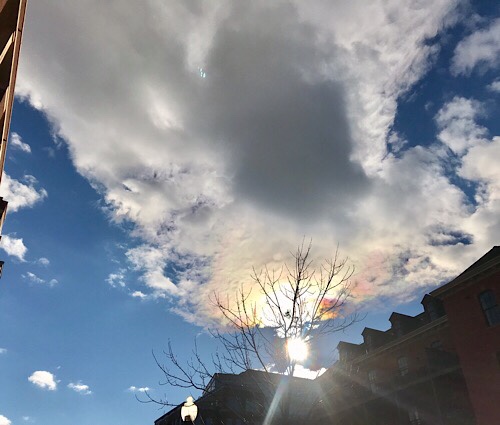
In what, how, where do you find abiding comfort?

Peace and light, E — Posted with WordPress for BlackBerry.
The texts speak of the siddhis–beings with great powers from the steady dedicated fire (tapas) of practice (sadhana).
One of these powers is bi-location — that of being able to be in two places at once. A friend and fellow practitioner once said to me that I shouldn’t want to be able to bi-locate. What that is called, she said, is schizophrenia.
The resting in two places at once that I think we do want, is always to be able to rest in the vast, peace-filled, and gracious space of meditation while we are fully going about the daily business of living.

Peace and light, E — Posted with WordPress for BlackBerry.

I tried to take a picture of the brief snow flurries that greeted us on the way home, but they were too sparse to be photogenic. The sounds of helicopters circling, too, defied documentation.
We offered our loving best energy as we practiced just steps away from the preparations for this ever critically important event.
I came home last night from my cousin’s funeral to discover that the temperature in the house was 83F (it is now up to 86F). The air conditioning system, which had been serviced last week, is now not working at all. The repair person is not scheduled to return until Friday afternoon, and the forecast is for blazing heat. I have two choices: (1) I can get into a dither about whether the work last week in fact broke the system and get stuck in suffering from the heat; (2) I can be grateful that I have electricity, which is giving me ice and fans. I can wear comfortable clothing, eat lightly, and do yoga practices suitable for the heat.
I am choosing the latter (I am not long from the period of years when being too hot on an irregular, but consistent basis is both inevitable and beyond my control, so this will be good practice). I may not be able to control the heat, but I can, to some degree, control my reaction. Part of controlling the reaction is just accepting the situation with equanimity and grace, so that my mind and emotions do not get heated. One of the reasons we do strenuous and challenging poses on the mat is so that we can get progressively more skilled at feeling comfortable with where we are, even when mind and body are taken out of our comfort zone by forces beyond our control.
By keeping my reaction cool, I actually physically am noticing the heat less. As I will not be able to cool off much after practice, I will be choosing practices that are still and inward and take advantage of how warm are my muscles, rather than engaging in exertion that will make it hard for me to get cool afterward. Balanced and cooling breathing practices, meditating on stillness, and sweet hip openers and forward bends are definitely in the picture.
Last weekend, I went with a friend to see The Steins Collect at the Metropolitan Museum. I made a special effort to see the exhibit because of the incredible impact on art and culture that the Steins had by virtue of their collecting. Many of the paintings in the exhibit were familiar; I’d seen them before either at the Met for those from its own collection, at other museums, or in books. Some, which have ended up in other private collections or in the collections of museums that I have not visited, were completely new to me.
Among the paintings in the exhibit is Picasso’s Boy Leading a Horse (which, as you can see from the link, the MOMA website currently indicates as “not on view”). I’ve seen the painting many times before at MOMA. The shift of location and context shook up my perceptions of the painting, and I indicated that to my friend. Another woman who was looking at the painting too engaged in the conversation. “It seems wrong here,” she said. “It’s a different view,” I replied. “It is disconcerting, but seeing it in different light, context, and company is enabling me to see new things in the painting and to find a more enhanced appreciation.”
I have been thinking this week, and talking about it in my classes, how a change of context can bring us new vision. How often, when things just keep going in a set pattern, do they collect dust and cobwebs (literally or figuratively)? I asked my therapeutic students whether they had preconceived notions about various challenges of embodiment, especially the chonic ones. Do you see them as part of your identity, something that causes you pain instead of giving you the joy of movement? What if you embraced being ever more conscious of alignment instead of being conscious of pain and limitation (and learning better and sooner when you cannot get out of injury without outside help)?
What of it? What of the change of perspective? After all, things get rearranged for us and the dissolution can be gradual or violent or something of both and be something of greater or lesser magnitude. Times of flux and dissoluti9on are the perpect time for questioning, for new vision, for discovering new ways to experience what had become too familiar, for seeing how one might wish to shift one’s own perspective for the good, to know and take responsibility for one’s own place and piece of this relationship to whatever it is that is shifting, dispersing, or dissolving., to seek to become unbound from the habitual binds of whatever invisible clothing we might be wearing.