Tandava
I don’t know how I missed this pickling cucumber before it grew to such enormous proportions. I’ve scooped the seeds and pulp and added some water to ferment for a couple of days. Then I will dry the seeds that don’t float and save them for next year. This plant has been more successful than prior efforts to grow pickling cucumbers. They may have cross-pollinated with the Persian cucumber, but I’m trying to expand my seed-saving beyond the easy herbs and greens.
I won’t know how well I’ve done until next year, when I try to grow cucumbers from these seeds. There is a sense of connection to the cycles of life, with such required patience with the changes of season.
And the cucumber falling from the vine, ripe, and ready to go to seed, is a line in the Maha Mrityunjaya mantra, chanting to release and aid the passage of spirit from this realm of consciousness.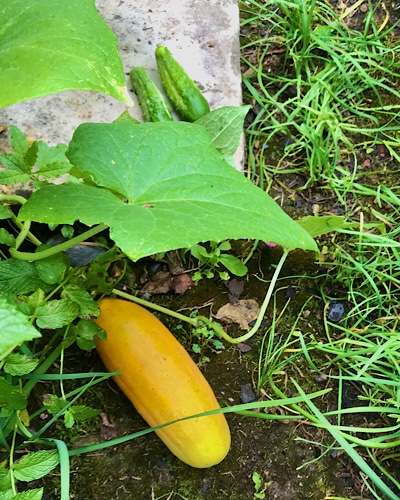
I returned home yesterday from teaching my Willow Street classes and having a late lunch with a friend to a message on my answering machine from my mother advising me that a cousin had died. Although I was not close to my cousin, her parents, my great Aunt and Uncle, were a significant part of my formative years.
As I made telephone calls and sent emails to get coverage for work meetings on Monday and care for the cats so that I could leave for New York, I found myself flooded with long-ago memories of my cousin, my family, and myself. I could also hear and feel old patterns surfacing, as they tend to do in such situations.
In counterpoise to the tumble of memory, I felt a strong pull to go into the space of meditation.
In the spaciousness, I no longer feel trapped by the inevitable consequences from the events giving rise to all those memories that have partly shaped my path. The light of consciousness itself, as the ground of the play and the illumination of inner space, begins to reveal the links and sequnces of the memories, the cause and effect, thus allowing me to see other ways to react. Instead of remaining entangled by trying to dismiss or reject or cling to any part of my history, I could see shapes, sequences, and opportunities.
At lunch, one of the things my friend and I had been discussing was the idea of bringing into “luminous spaciousness” our relationships. John Friend had invited us to think about that concept at the Teachers’ Gathering last month, and I have been contemplating the practice in a variety of contexts and discussing with fellow Anusara yogis what it would mean to them to bring luminous wisdom to relationship by seeking to create the true spaciousness we can find in our practice of yoga and meditation. I had talked about it previously with the friend with whom I lunched yesterday. She asked, “where was your blog entry on luminous spaciousness; I’d been looking forward to it.” “I haven’t found the right context for describing it that would convey what I think it means for my practice,” I’d replied. When I came home to my mother’s message, because I had been continuing both the contemplation and the dialogue, I was focused on the practice when I found myself in a situation where I really needed it. (Great reminder of the need for a steady practice).
I am now on the Long Island Railroad, heading to my parents’ house. Tomorrow we will go back into the City for the memorial service.
As I allow my thoughts to be stirred up–giving myself space, as it were to have natural mind processes–I seek space and light for myself in my relationship with my family to try and foster more love and clarity.
A number of years ago, I attended a week-long workshop with Rod Stryker. He invited us to meditate on absolute stillness — cara sthira — meditation. Sitting comfortably, still the skin, the muscles, the bones. Draw the attention to stillness. The breath and heart will still move, but the concentration is on stillness rather than on any movement. Rod Stryker discussed the next day the challenges of this meditation, especially for those who are intellectual, who enjoy being active in the mind. I found it difficult at the time and even dreamed about the issues the meditation brought up for me. Meditating on stillness can be very challenging in a way that meditating on a mantra or the breath would not necessarily be.
I believe the origin of the meditation comes from the principle of sthira being the absolute unmovable, the essence of being (not dissimilar to Kant’s unmoved mover). We invoke pure stillness, pure potential out of which movement comes because that is part of our essence and a place where we can rest our spirit. See, for example, the Srimadbhagavatam.
I discovered absolute joy in this meditation a couple of years after I learned it. I was suffering from a severe sinus infection and bronchitis simultaneously; I joked that I was fine as long as I didn’t breath through either my mouth or my nose. In the midst of my suffering, I remembered the teaching. For a few days I stayed in the meditation for hours at a time. I found the place where I did not really need the breath. Enough came to survive, but I forgot about wondering how to breath or finding a place for it or my struggles with it. In the stillness, there was space and peace and supreme bliss. Ever since then, I have chosen this form of meditation when I have a cold, a sinus infection, or other challenges with breathing. Meditating on the breath, obviously, will not be soothing when breathing is a struggle. But when even breathing is a struggle, peace can be found in complete stillness.
Peace and light, E — Posted with WordPress for BlackBerry.