|

Poor Man’s Caviar

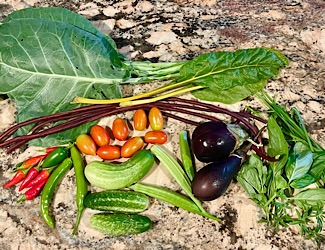
Last year, when it was dry and hot early, I had an extraordinary season of peppers, tomatoes, and cucumbers.  This year, the peppers and cucumbers were not particularly abundant.  The heat came too late and the rain has been too inconsistent for them to thrive.  The eggplants, though, were ecstatic this year.  Every week brought at least two and sometimes four.  When cooking for one, it is easy to find two eggplants a week far too many.  It was a relief to go to Santa Fe, where I could eat seasonal vegetables that did not include eggplant.

I was delighted, though, knowing I was about to host a party, to come home to five eggplants almost ready to be picked.  What better base for a potluck party dish than eggplant?  Knowing the crowd, I anticipate baba ghanoush by the bucketful; could not make that.  The tomatoes are not longer succulent enough for caponata (they must all become sauce); that was out.  I chose, then, eggplant caviar.  Not a bad pick.  What could be a better offering for a party in Washington DC at this time in history than what is often called poor man’s caviar?

I do not know the historical basis for it being named poor man’s caviar.  It does not look like caviar.  Not really.  It does not taste like caviar.  You can put it on bread or crackers the same way you would serve caviar, but that certainly does not further the explanation.  It is, though, a delicious and festive dish that pretty much requires only having eggplant growing in the backyard (or a trip to the farmer’s market) and the time to take care of it.

Eggplant caviar is a dish that reminds me that with only a little space and the willingness to provide nurture and pay attention for a season and to cook a simple dish slowly, I can experience what it is to enjoy and share little luxuries without being entirely dependent on money.  I am finding that comforting and encouraging.  (I do recognize that there are those for whom a little space and times are luxuries they cannot even imagine.  For me, choosing the simpler luxuries allows for more to share and offer.  Going entirely without comfort would not help much of anything.  As for sharing and giving, I certainly do hope those help.)

Recipe (adapted from Thomas Keller’s Eggplant Caviar in “New York Cookbook,” Molly O’Neill)

Take 3 to 5 eggplants, depending on size of eggplant and number of portions desired. Cut them in half, score the flesh and salt it.  Let the eggplants drain cut side down, weighted by a heavy plate or pan, for 45 minutes to an hour.  Rinse and squeeze out the eggplant.  Roast, cut side down, until very tender.  (In my convection oven, that’s about 25 minutes at 350F).  When cool enough to handle, scoop out flesh and chop coarsely.  Drain again in a strainer for 10-15 minutes.

Meanwhile, wisk together olive oil, pressed garlic cloves, and dijon mustard to taste (to be local, you could use walnut oil, and it would taste excellent; I expect, however, that there may be party guests who are allergic to nuts).

Squeeze out the eggplant pulp and mix it with the remaining ingredients.  Best if sits overnight or at least a few hours.  When ready to serve, adjust the salt and pepper.

Variation Make with mushroom.  Skip right to roasting (or even just mince finely and saute until juices evaporate).
Similar Posts

  • | |

    Hot Water Bottles and Wristwarmers

    One of my father’s joke bits of wisdom is “everything in moderation, including moderation.”  When I first studied philosophy academically, I was very much taken with Aristotle’s concept of the “golden mean,” which (this is a gross oversimplification) advocates living in moderation as a way of right living.  Pantanjali in the niyamas in his Yoga Sutras invites the yogin to balance effort (tapas) and surrender  (ishvara pranadhana) in our practice.  The Bhagavad Gita suggests that extreme austerities are just as indulgent as wildly excessive consumption of food, sleep, and comforts.

    What does that mean in our modern, middle class lives in a time when we are being confronted head-on with the impact on the earth and our fellow beings of the way we, as a society, have been consuming?

    In part, I think it is mindfulness.  It is not denial, but balance — choosing ways to consume less, but still not feel deprived.  I am fortunate in that much of what we are learning now about both lifestyle and impact (the stuff under the “green living” umbrella) is not new to me.  My parents were children of the Depression and my father had a modest income. I went to Quaker youth camp in upstate New York in the 1970s, and I did volunteer work for the first Earth Day when I was in college.  We turned the lights off when we weren’t in the room, we turned off the faucets when we were brushing our teeth, or lathering our hair in the shower.  We creatively changed what we cooked out of Julia Child, Craig Claiborne, Virginia Lee, or Diana Kennedy or the New York Times Food Section with what we learned from Diet for a Small Planet.  We wore warmer clothing inside to be able to keep the heat down.  It is important for me to try to live mindfully, but I also very much like to be warm and comfortable, love the feel of beautiful fabrics, and one of my greatest pleasures is eating well.

    I have a number of reasons I like to keep the heat down in the winter:  it feels better on my sinuses because the air is not as dry and I do not like to have to run a humidifier (yet another electrical appliance); it costs a lot of money to keep an old row house at even 65F in the cold months; and I am concerned about my carbon footprint.  I can get really cold when I am working at my desk or getting ready for bed.  I don’t like being cold, and it seems silly to insist on being miserably uncomfortable just so I can feel better from the perspective of some perceived moral ground.  So I try to create a balance.

    Hot water bottles and wrist warmers are part of the balance.  Two hot water bottles taken to bed (and then I use the water on the plants the next morning) makes going to bed toasty and delightful, but not too hot in the middle of the night.  If I am working at home and it is midday, I can warm myself up with a two-minute handstand or a few sun salutes or some abs work or other arm balances. That’s not an option if I am on a conference call or at the office.  Nor does it make sense after dinner when it is time to get energetically quiet.  The wrist warmers, though, make an amazing difference (I also enjoy wearing them when I start practicing until I warm up as another layer that easily can come on or off.  I kind of like the way I look and enjoyed all the complements I got when I was meandering around New York over the holidays.  They are a great way to use scrap yarn (especially if you don’t have the time, yarn, or inclination for a larger project — see my post on “Sauca (and the blanket).”

    If you want to make your own wrist warmers and you are a fantastic knitter, you can go for four double-pointed needles, multiple colors, and add a thumb section.  For those of you who are newer to knitting or who want wrist warmers very quickly, here’s all it takes to make the one’s shown above.

    1.  Two needles of appropriate gauge and less than a skein of yarn.

    2.  Measure loosely around your knuckles.  That’s the right width for your wrist warmer (notice that the girth of your knuckles and your forearm a couple of inches below the elbow are about the same).  Then knit about a two-inch square to make sure you know how many stitches you get per inch horizontally.  When you have your gauge correct, unravel your test square to use that yarn in your wrist warmers.  I recommend rechecking the gauge about an inch or two into your first wrist warmer to make sure you were right.  It is easier to start over at that stage than to try and fix it later or have to give them away to someone larger or smaller (unless you want to).

    3.  Cast on the correct number of stitches for how many stitches per inch you get with your yarn and needles and the width you measured around your knuckles.  It is OK to round to the nearest half inch.  First two rows are simple rib — k1, p1.  Then do basic plain knitting (k first row, p return row) until the first wrist warmer is about 6-8 inches long and reaches almost the desired length up your lower arm.  Then do 6-8 rows of moss stitch (row 1 — k1, p1, row 2, p1, k1) [or you could just do more ribbing].  Cast off.  Measure second wrist warmer against the second.  Turned inside-out, using the knitting yarn, sew into a tube, leaving a whole for the thumb a the end with just the double row of ribbing.  The sewn part at the knuckle end should be about 2/3 to 3/4 inches, then there should be about a 1 1/2 to 2 inch whole (just hold it up on your hand to make sure it fits).

    4.  They will stretch out as you wear them, but if they are a little too wide or tight, you can wet them and then make them either longer and thinner or shorter and wider by blocking.

    4.  Bored with the colors you have at home?  It’s pretty easy to swap with a fellow knitter.

    5.  Want to be just a little fancier?  Do stripes by alternating colors when you change rows.  Want to practice cables.  Do one center cable, just remember that it won’t be in the center if you want it to go on the top of your hand; it will start a quarter of the way in.

    6.  New to knitting?  Go into any yarn store, tell them that this is your project, and they’ll tell you a good yarn, what needles you need, and show you how to cast on, knit and pearl.  There are farmers at the Dupont Circle Fresh Farm Market on Sunday who have beautiful homespun, hand-dyed yarns.  They might not show you how to knit, but they include patterns for hats.

    7.  Have fun.  Be creative.  Be part of a fashion wave.  Stay warm.

  • | | | |

    Spring Cleanse?

    Though there is still snow on the ground, the days are about to be longer than the nights, and my inbox is full of both expensive and discount offers for cleanses of various sorts, and I’m seeing Facebook posts asking about good spring cleanses with all sorts of suggestions in response.  If I were a different kind of reader and practitioner, I’d no doubt be beset with explanations and special offers for dieting into a bikini-worthy body.  If I were an even different sort of reader, I might be thinking I needed an official spring cleanse, one of the ones that yoga acquaintances say make them feel light or high, etc.

    I don’t much believe in cleanses, but I do believe in listening–really paying attention–to my body and emotions and how they relate to the cycle of the seasons.   In winter, I tend to gain a few pounds from spending more time inside and eating the heavy, dense food my body wisely craves in winter both for warmth and protection from starvation (granted the latter is not a real threat for the middle-class, but my genetic make-up doesn’t know that). I fully trust that when the days get warmer and lighter and I can spend more time outside walking and spring vegetables and fruit start to show up at the market, I will lose a few pounds.

    Before you get too caught up in thinking that to have the body you’re supposed to have (whether it be for looks or some fashion-driven notion of health) you need to go on some formal diet you might not need or spend money having someone tell you what to eat and when (although if you find that works for you, who am I to say no?), why not try noticing whether the change of light and temperature alters your natural cravings (not the ones for junk food or excess sugar or salt)?  If you can notice a change in what food attracts you, try honoring the change.

    You might find that small portions of kitcheree (lightly spiced rice and lentil porridge), along with plenty of fruits and vegetables (and as spring produce comes in, you’ll find spring vegetables and fruit want less cooking than do winter ones, or perhaps none at all), feels like a nice way to lighten up for several days as the seasons transition.  Ssssh!  That’s pretty much what’s in a spring cleanse.  If you want to make your change of diet feel sanctioned by the yogis add some reading on Ayurveda or mindful eating to invigorate your practice and your dedication to paying loving attention to your body and how it relates to the seasons and the web and cycle of being.

  • | |

    “Do you have an umbrella?”

    As I was headed out at lunch, a co-worker in another office whom I know only from the hallway, asked, “do you have an umbrella?”

    “Yes, I do, how are you?” I replied, knowing that she was trying to be helpful. So many of us work in spaces without windows, it was not unreasonable for her to think I might not know it was raining.

    Another woman who I did not know said, “I heard it might rain all weekend,” revealing herself as one who gets all knowledge of the weather from tv.

    I thought, but did not say, “yes, there is that pesky hurricane coming.”

    Peace and light, E — Posted with WordPress for BlackBerry.

One Comment

  1. This must be what they serve at Rock Creek Restaurant. I am not a fan of baba ganoush. When the server presented us with lovely, crusty, whole grain bread and a little dish of eggplant spread I thought “meh”. I’d rather have some luscious, creamy butter to slather! I was so very, very wrong. This spread was positively unctuous (great word, no?)! It was savory, garlicky, and rich. And now I have a recipe! Thank you!

Leave a Reply

Your email address will not be published. Required fields are marked *

This site uses Akismet to reduce spam. Learn how your comment data is processed.