| |

State of the (Container) Garden

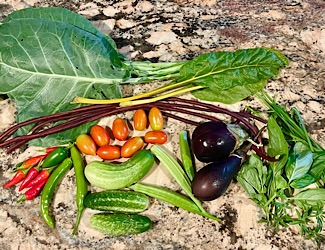
Avoid food-borne diseases, limit fossil fuel consumption, save money, have the joy of getting in the dirt, learn to balance preparation and planning with going with the flow, and have tastier food.

Still have a lawn? Put a few container beds on it. Live in an apartment? Grow some herbs on a windowsill.

Similar Posts

  • |

    Celebration and Loss (last of the arugula)

    last arugula

    As you can see from the photo, this tender arugula was not likely to make it through the night (temperatures forecast to be in the mid-20s).  It is a cause for great celebration that it made it through last weekend’s snow storm, several nights below freezing, and provided a little spice to my salads for a couple of months.  It lasts this long because I over plant, first eat the greens as I thin them, then pick them by the leaf rather than by the root to encourage the plants to grow more vigorously, and finally start pulling them up by the handful when the danger of hard frost calls for the inevitable demise.  Tonight, I cut everything in the pot down to about a 1/2 inch.  It is possible, though not likely based on the current forecast of a cooler than normal winter, that if we got a couple of warm weeks in late January or early February that it would come back.

    I am celebrating what I have grown in this tiny space and the exquisite delight of eating greens from right outside my door this late into the year.  I am sad that the outdoor gardening season is just about over; I will miss it.  If I had more space or a firmer intention (maybe the latter will come in another year or two),  I could build a cold frame or go for plastic tunnels.  In my little micro-climate, that would probably get me through the winter.  I rather like, though, a space of time with no obligation to the outdoor garden.  A time to dream rather than work.  I know what a luxury it is to be able to rest in such a way and still have bountiful food.

  • | | |

    Gardening, Cleaning, Cooking (and Vinyasa Krama and Kali)

    Vinyasa krama is the art of sequencing.  How a yoga practice or flow is sequenced can determine whether it is uplifting or inward going, exhilarating or calming.  When we are trained and attentive, we start to know the most optimal order to open our bodies and our focus to align with the time of day, the season, the weather, our mood, and our health.  This incredible art helps us be positioned and aligned in a way that we feel free in time and space, rather than being constrained by time and space.

    This morning while I was out in the garden, I was thinking a lot about vinyasa krama and the goddess Kali — goddess of, among other things, time and change, and thus, of sequencing.  I woke very early, brought to consciousness by the long light of the solstice even through closed curtains.  As I went about my morning, rinsing the sprouts while heating the water for my morning coffee; cutting back the greens and herbs before starting breakfast; doing the major pruning and clean-up before doing more decorative garden work; finishing cooking before taking out the recycling; applying a facial mask before starting to vacuum; never walking up or down the stairs empty-handed; waiting to gather the bills until after I was clean and waiting for friends to arrive, etc., I realized how important sequencing is to the richness of my days.  By knowing the best way to order tasks for my needs, my day is simultaneously productive, unhurried, and enjoyable.

    By the time my friends arrived around noon, I had meditated, taken care of the garden, gathered food for my own breakfast and to share with friends, talked to neighbors, cleaned the house and myself, done a little asana, written in my journal, and sorted the mail.  Had I not known from long experience and conscious attention how to sequence all the different elements, knowing which ones went together, which took longest, which ones if done earlier or later would create double clean up, etc, I would have been tired and the tasks unfinished.  Instead, after brunch, I came home to a tended garden, a freshly made bed, and time to enjoy a quiet evening.

    These sequencing principles also apply for me on major projects at work.  If ordered one way, the work is exponentially harder, the deadline a fearsome thing; if ordered another way, everything comes together mostly as it should when it should.  When I order my work with attention (this assumes others cooperate with this endeavor), I have time to do a good, careful job and still take breaks, eat well, and leave the office in time to take or teach yoga class.

    Whether you are doing your home yoga practice or cooking or working, choose to sequence the elements of your practice, your activities, or your day, with attentiveness, reverence, love, and respect, and Kali will support you and not show you her most fearsome face.

  • | |

    Yoga of Eating Part I (what it is and what it isn’t)

    Yesterday, a former student of mine stopped me in the hallway at Willow Street and asked whether the “Yoga of Eating” workshop I will be leading on June 13th  will cover Ayurveda.  “I will mention it,” I said, “but I will not be teaching it.”  I didn’t have time to explain further because I was about to lead class.  As far as I got was to add that I was not sufficiently trained to teach it.

    Ayurveda is a wonderful science, and I honor and respect my yoga friends and colleagues who study, practice, and teach Ayurvedic principles.  Ayurveda is a much broader discipline than yoga, though, and is really medical practice rather than yoga.  Asana are among the practices that might be recommended by an Ayurvedic practitioner for a client or patient, but eating in accordance with the Ayurvedic principles is not the same as bringing yoga to how we eat.  For me, many of the principles of Ayurveda I have read or been taught are useful, but it has not resonated for me as a governing system, just as I do not believe in applying all of the principles of Western medicine to how I heal and nourish my body.

    Bringing yoga to my eating, like bringing yoga to all of my life off the mat,  is both simpler and harder than being taught a science such as Ayurveda with fairly clear, but quite complex, do’s and don’ts and then following them.  For me, practicing the yoga of eating, is practicing conscious eating.  It is practicing reverance and moderation.  It is balancing nourishment and pleasure.  It is knowing deeply when the will to eat is serving us or getting in our way.  It is both simple and subtle.  It is easy to say, but deeply challenging and sometime complicated to practice — just like practicing the Anusara yoga principles of alignment.