| | | | |

State of the Garden

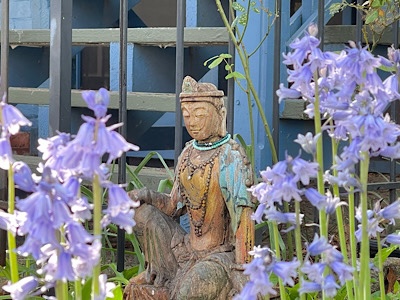
Last year I decided to bring this murti of Kuan Yin outside. I asked my neighbor if it was ok, as her parents came here from China, . My neighbor welcomed this presence in the space between our yards and also appreciated that I asked.
Similar Posts

  • | | | | |

    “Meeting for Discernment for Peace,” Bhavana, and Heart-Oriented Posturing Language

    On the Friends Meeting of Washington list serve this week, there has been a fair amount of email exchanged about an upcoming “meeting for discernment for peace.”  Very roughly described, a meeting for discernment begins with a period of silent worship in which those present settle into the silence and surrender thought to allow the light of spirit to illuminate a specific subject of contemplation.  The subject of the meeting serves to enlighten both the individuals participating and to further both the business and spiritual state of the meeting as a whole.

    As I read the emails and invited myself to contemplate the questions offered for the meeting (I will not be able to attend because I had previously committed to volunteer work), it led me to think not only about the topic under discernment, but about how similar it seems to me to the yoga practice of bhavana and how bhavana supports the Anusara teaching method of “heart-oriented posturing language.”

    When we practice bhavana ,we invite the fullness of consciousness to illuminate ever deeper levels of understanding of particular teachings from the yoga texts or similar ideas.  It is similar to meditation in that we don’t try to think our way through the concept, but rest with it.  Bhavana  differs from meditation exactly because it is focused on the deepening of a particular concept rather than simply going into the space of meditation as an end in itself.

    Although a meeting for discernment is practiced as a form of collective worship rather than an individual practice, it is much like bhavana, and I brought the Quaker method of resting in the light to reveal deeper insight regarding a concept when I first starting teaching Anusara yoga with its emphasis on having a class theme and using heart-oriented language to invite myself and students to experience a heart quality through asana practice.

    The queries for contemplation at the meeting for discernment for peace, include the following:

    What does it mean to “live in the virtue of that life and power which takes away the occasion of all war?”
    How am I deepening my understanding of peace?
    How am I living into this understanding?
    How do I support others in following peace?
     
    What can be most powerful about our practice on the mat is bringing what we learn in relationship to our body, mind, and emotions in attempting and achieving poses, off the mat.   As I will be doing myself this week in my own practice in support of my friends who will be attending the meeting for discernment, I invite you, as you are practicing at home after reading this, to observe with love, spaciousness, and humor how you react to certain classes of poses, efforts you make, moves you are able to do or not do with ease.  Where are you in conflict with yourself?  What are you doing to deepen your understanding of how to be at peace with your strengths and shortcomings?  How are you taking the observations on the mat into your daily life?  How do you and how can you better use what you learn to support others, to eliminate the causes of war, and to foster peace?
  • | |

    On Seeing

    When I paused to photograph this marker on a DC sidewalk yesterday, I wondered how many hundreds of people have walked past it–once or hundreds of times–without noticing it at all. I connected this sense of acute awareness with a conversation I had with Douglas Brooks in India, in which he said to me that he guaranteed that at that moment he was seeing more than I was seeing. He had experienced the place before, studied it extensively and intensively, and was still open to seeing. I did not take offense and none was meant. I am one who notices, but it is a given that study and experience, if one retains an openness to new understanding, maximizes the opportunity to witness.

    Paul Muller-Ortega describes the expanding ability to see and understand in terms of the essential interrelationship between jnana and vijnana–book knowledge and experiential knowledge. One without the other does not permit for complete understanding. The two together, with ever-expanding and present openness is what leads to wisdom.

    Thus, though I am one who tends to notice much of what is in my field of vision, I could not, on my first visit, possibly have seen as much in the immediate landscape as one who has devoted much of his life both to studying and experiencing it.

    Peace and light, E — Posted with WordPress for BlackBerry.

Leave a Reply

Your email address will not be published. Required fields are marked *

This site uses Akismet to reduce spam. Learn how your comment data is processed.