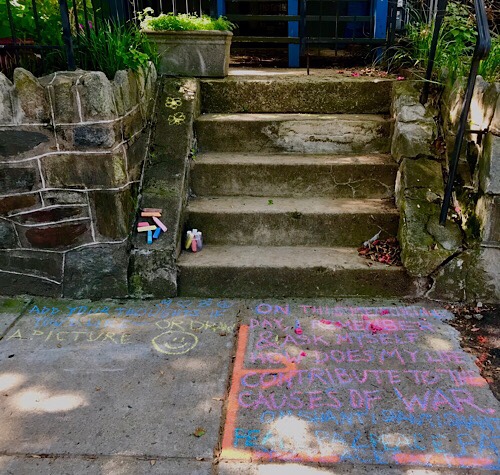
Art Around Town (Interdependence Day and Justice for All)
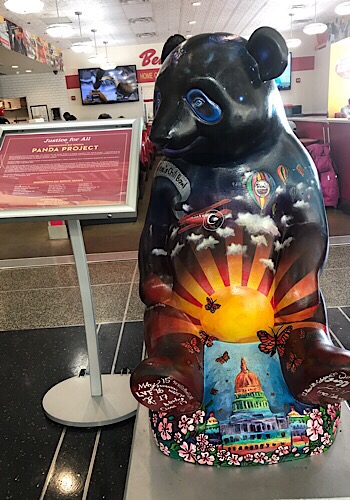


At Eastern Market metro stop in a patch of brown grass surrounded by concrete–brave and bold these delicate yet hardy blooms.
Anusara yogini and teacher extraordinaire, Amy Ippoliti, started a “30-Day Yoga Challenge,” which she updates monthly, for students and friends who are her Facebook friends. For the past several months, the challenge has been to work towards some very challenging poses (how appropriate for a challenge). This month Amy invited students to practice without air conditioning, or for hot yoga practitioners, without extra heat. Granted, she is based in Boulder, Colorado, where it is not 101F today, but she speaks my mind. Whenever people have asked me what I think about hot yoga, I have answered that it serves some people very well, but I always find myself asking the question, whence is the heat coming and will it enhance my yoga to change the room temperature if I need to burn fossil fuels to practice?
Why is practicing without a technologically altered environment a yoga challenge? Have you ever found that if conditions aren’t right, you think you cannot do your practice? If we are truly practicing with commitment, then what we want to do is to find the practice that will fit the environment (including not just the outer environment, but the state of our mind and physical well-being) on any given day, even if it means that the practice will not meet our expectation of what our practice should be.
When we practice steadily and listen to the teachings, one of the things yoga teaches us is how to be more sensitive to our environment and to what we put into our minds and bodies. A friend complained of being terribly sleepy the other day. I said it was the heat; look at your pets; don’t you notice that they are sleeping more in the heat? What practicing in accordance with the ambient temperature means (or eating or sleeping or dressing or engaging in leisure activity) learning better how to align with the energies around us, including being sensitive to how we would optimally practice in the heat. As yogis, I believe that what we want, ever more deeply and more profoundly, is to live aligned with nature and our own being in it so that we can find better recognize the fullness and the light of being whatever challenges arise.
I’m doing a modified version of Amy’s challenge here in DC this week: at the William Penn House, I’ll take whatever air conditioning is on (which, for those of you who are wondering, can be pretty nice and cool since it is the ground floor). At the house practice, I’ll keep the house at the same 80-82F I typically keep the house when it is over 90F outside; I won’t lower it because I am practicing, but we won’t be having it over 90F. At Willow Street, I’ll go with the flow.
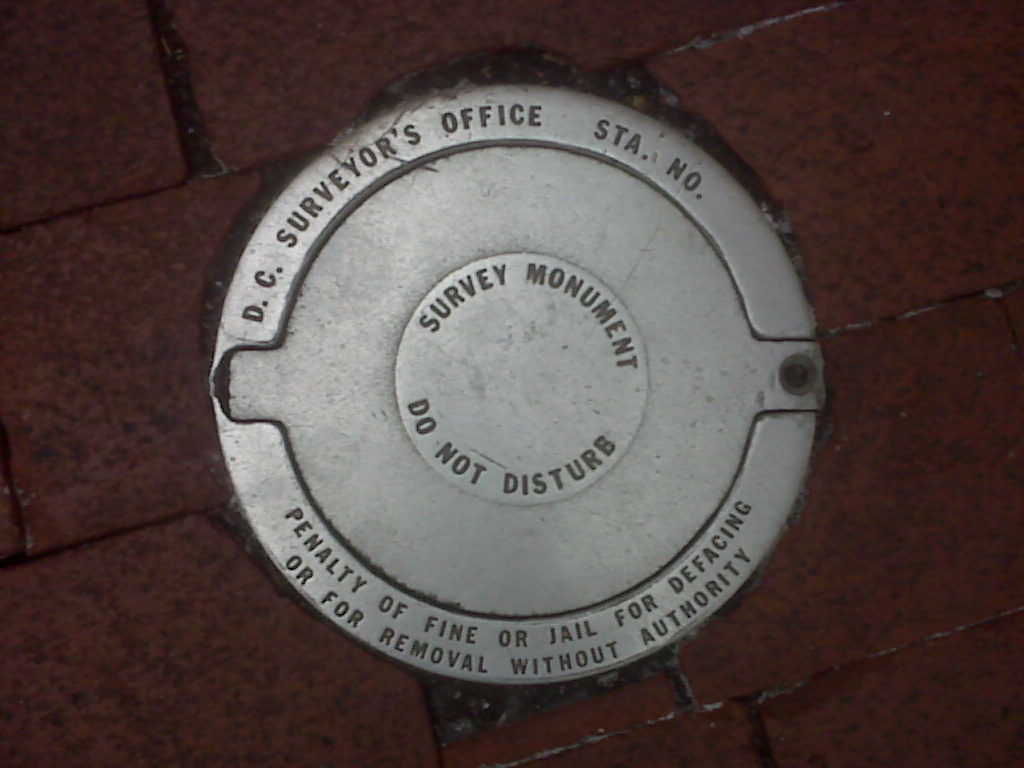
The other day I noticed this “do not disturb” warning on the sidewalk and today, when I was walking past it again with a friend, paused to photograph it. I cannot imagine that most people who walk over or past it even notice it or read it, much less contemplate or know how to disturb it. When I found myself being led to wonder how I could disturb it (or perhaps what is inside or underneath it), I thought about how as soon as someone asks whether you are happy or you ask yourself or notice that you have been perfectly still or at peace or in complete meditation, the state of perfect being without thinking dissolves.
Peace and light, E — Posted with WordPress for BlackBerry.
Here’s the text of an email we received earlier in the week from building management:
As a result of sequestration, effective Friday, March 8th the Frances Perkins Building (FPB) Facilities Management Office will be modifying the hours of operation for the FPB heating and cooling systems to achieve required savings detailed in OASAM’s sequestration plan. Normally, the FPB heating and cooling systems are operational for 14 hours, from 5:00 a.m. to 7:00 p.m. daily. In order to achieve the reductions required by the sequestration, the FPB hours of operation for the heating and cooling will be adjusted to the General Services Administration standard 10-hour operating day, from 7:00 a.m. to 5:00 p.m., Monday through Friday.
We encourage you to prepare for the building being cooler/hotter in the morning and evening hours by:
–making sure that window blinds are opened or closed appropriately to maximize the sun’s effect,
–leaving private office doors open to maximize air circulation, and
–dressing appropriately, layered clothing that can be added or removed during the day.
We appreciate your cooperation as we implement these sequestration-driven cost reductions.
We apologize for any inconvenience.
Here’s what I wrote back (restraining myself from noting that when President Obama called upon federal workers to make suggestions for how to save money two years ago, I suggested that we change the dress code and the building temperature to reflect the season, not some outdated notion of what is “professional” dress and was resoundingly ignored):
This is fantastic news. I have long advocated making the inside temperature more consistent with the outside weather for our health and for the environment. I hope that you will keep a policy of spending less money and precious fossil fuels on heating and cooling even if the budget picture improves.
I’m thinking that building management doesn’t usually get positive feedback. 😉
We will all need as much compassion as possible–for others and ourselves–for the great amount of work ahead of there is to be any meaningful healing and sustainability.