| | |

Shaktipat?

Some of the yoga traditions that include a guru lineage believe that a guru can transmit grace (whatever that might mean) through their presence or touch. Back in the days when I was doing my first yoga teacher training, a fellow student asked me whether I had ever received shaktipat? My answer was yes–when I’d had the opportunity to shake hands with William Brennan. He’s not a guru, my fellow student objected.  But he is a being of extraordinary grace, power, and intelligence who has devoted himself to the service of our collective well-being and my being in his presence inspires me to show my best light; isn’t that what’s supposed to happen with shaktipat? I don’t think she was ever fully persuaded by my unorthodox reading, but I had no need to persuade.

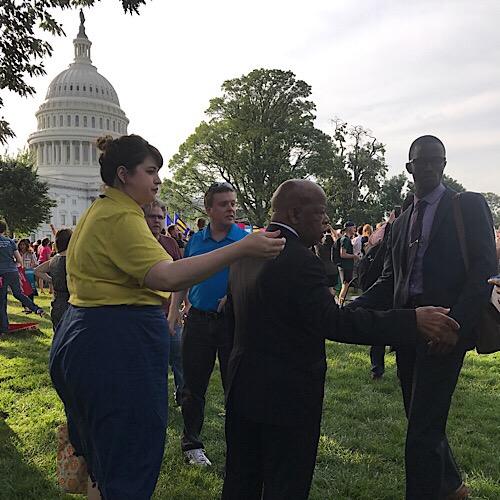
I found myself thinking about that discussion today, having gotten to shake John Lewis’s hand when he walked through the crowd to speak at day 2 of the people’s filibuster for health care. In the presence of his inspiration, I am compelled to figure out what more can I be doing.
Similar Posts

  • | |

    Intention, Discipline, and Freedom

    One of the primary themes at the Anusara certified teachers’ gathering this week with John Friend has been how discipline and technique serve our yoga. In keeping with the elemental Anusara principles of “attitude, alignment, and action” (iccha, jnana, kriya), the point has not been to emphasize rules for the sake of rules, form over substance, or technique for its own sake. Mastering technique, by itself, will not bring us to the ultimate intentions of yoga: living liberated (jivamukti), experiencing the very wonder, bliss, and dance of being.

    But just playing or seeking freedom for its own sake, while we are embodied in human form, will not likely lead us to the most expansive and steady experience of ultimate freedom (svatantra). It is discipline and technique with the constant remembrance of the reaon for being disciplined about how we practice and live that will take us further on the path.

    It can be nice, for example to go to a class where there is little emphasis on form, and the call is just to flow and feel. For me, though, because of my physical limitations (degeneration in my spine, old groin injury, etc–these do not define my being; they just inform how I practice), I feel far freer and more able to expand how much I can play the more attention I give to the physical alignment. In such a situation, the rigorous attention to detail is not for the sake of an external idea of what is right and what is wrong. Rather, it is the constant disciplined attention to alignment that frees me to play as free from injury, pain, and fear of injury as is possible in my body.

    The discipline then becomes a way of self-affirmation. It is the limitations that lead me to have to focus more on technique than if I did not have the limitations. That attention then provides a ground for a more expansive practice and a deeper appreciation for the beauty of what the practice can offer.

  • | |

    What Wakes You Up in the Morning

    A little after 5 this morning, the sound of the unexpected rain brought me out of my dream state.  I was not ready to rise, so I realigned myself into a good savasana and just listened — following no other thoughts — until the morning musical awakening arrived at 6.

    I could have thought of it in this language:  the rain woke me up and I couldn’t get back to sleep, but I was still tired so I lay in bed until the alarm went off.

    Hotels, I think, were on to something when they started offering “wake up calls,” though the sound of the phone ringing in the middle of an intense dream can be shocking.  When did we start naming the sound we use to bring us from dreaming to waking “the alarm?”  What perspective does it give to our day to think we need an alarm to start it?  Why not at least “alert” or “signal” for the days when the only technology (think about that piece of it) was a jarring sound?

    I have been thinking a lot about what wakes me up since Becky passed away.  For 21 years, either Henrietta or Becky was lying on or next to me purring before any electronic signal could go off.  They knew when it would go off and every morning sought a little petting (and then food) before they heard any signal to start the day.  They incorporated it into their rhythm and created a good waking routine around my schedule.

    Some of my waking with the cats instead of the electronic sounds must have been me ready to be shifted from sleeping to waking by the cats’ attention, because I am still waking 10-20 minutes before Bose technology utters an automatic sound (usually yoga chants) to make sure I get off to work.  I also know from conscious attention to the effects on my sleep from when and what I eat and what I put into my day and until how late, that when I am keeping my eating, practicing, and sleeping schedule steady, I have no need to be called awake by something outside myself to start the day.

Leave a Reply

Your email address will not be published. Required fields are marked *

This site uses Akismet to reduce spam. Learn how your comment data is processed.