Similar Posts
Eco-Tourism v. Eco-Travel
Last night I dreamed that I was taking a group of yoga students to the Galapagos. I was already on my way, and the dream information did not include the decision-making process that started the venture. Instead of being excited, though, I was feeling anxious and guilty about bringing my inherently destructive presence (the one that eats, defecates, urinates, bathes, wears sunblock, requires built shelters, and, to travel, uses fossil fuels) to a place that we value for its uniqueness in nature and relatively pristine qualities. I woke thinking it was absurd to have had that dream; couldn’t I have enjoyed myself just a little without feeling overwhelmed by questions, doubts, and guilt? Why on earth did my unconscious serve this dream up for me? Is it going to make me live a less environmentally conflicted life (that won’t even begin to happen until I move into a much smaller dwelling unit, my house being my biggest infringement on the environment)? Probably not.
For Christmas this year, I’ll be doing my own version of eco-travel — going to New York City. I’ll be taking the train both from DC to NYC and, on the day I go out to visit my parents, from the City to the Island. To get around NY, I’ll walk or take public transporation. I’ll eat mostly vegetarian/vegan food, some local and organic. I’ll drink tap not bottled water (which is easy to do in NY). I’ll have my bamboo utensils, cloth napkin and carry cup for the meals I don’t eat in a restaurant and my own carry bag. I’ll have handkerchiefs instead of paper tissues. I won’t have the hotel wash the linens until I leave. Oh yes, I’ll be consuming and enjoying. I’ll be eating and looking at art and seeing theater and/or music and/or dance and will inevitably do some shopping.
Where is your balance? Are you comfortable with it?
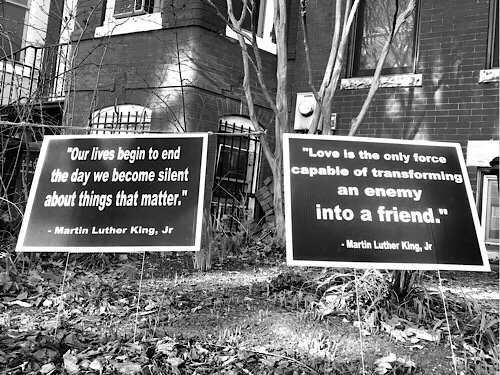
Signs Around Town (and 50 Years Ago Today)
I would have been six. I remember my mother weeping and explaining to me why.

A Dream I Won the Lottery
I dreamed last night that I won 30 million dollars in the lottery. I had no recollection of having bought a ticket (in waking life the only time I ever bought a ticket was 17 or 18 years ago as part of a 15-person group of co-workers who collectively bought two tickets when the prize was 75 million; we were going to quit en masse if we won).
In the dream, an acquaintance also won the same amount. She immediately quit her job and started engaging in activities about which she had previously only imagined doing.
On learning of my windfall, I stopped and paused and found that I didn’t want too much change right away. I deliberated about whether to take a lump sum or an annuity and to whom I would give the money. I wondered whether I could take a couple of months leave and then go back to my job part-time. I thought about whether I would like to move or set up a charitable foundation or teach yoga full-time. I found that after having been given financial freedom, I was still content to work and to live comfortably, but relatively modestly. I wanted to take time to deliberate where I could make the best offering with this outrageous stroke of luck.
The dream reminded me of the Zen proverb that was popularized in the 1970s: “Before enlightenment; chop wood, carry water; after enlightenment; chop wood, carry water.” What was beautiful about my dream was a sense of a deep acceptance, a sense that even with my desire to grow and change for the better, that in my middle age, I am essentially comfortable with how I am living. I will keep seeking a deeper and more loving and compassionate way of being, even as I recognize that there is no prize that will transform me from the challenges of being human.
Simulcast, Drama, and Perception
Last night I went to see the National Theater UK’s simulcast (tape-delayed) of Helen Mirren performing in Ted Hughes’ translation of Racine’s Phedre at the Shakespeare Theater. The tragedy of Phedre is misinformation, misguided helpers, and passion that has gone beyond sweet engagement to maddened attachment.
A stage production is intimate and designed for the small audience of those present in the theater. When it is merely filmed (instead of being turned into a movie), it sometimes feels forced because it is watching a film of a stage production, instead of being invited in as one is when one is either at the stage production or the filming is done as a movie, which is designed to include the viewer in a manner for the film.
What was hard about watching the filming of the stage production, was being forced to have the camera’s and director’s perspective; there was no ability to turn my head and shift which part of the stage to give my attention. At the same time, I felt appreciative of the miraculous offerings of technology: the filming made something that is usually limited to those who can afford theater of that extraordinary quality and who are able to be in a certain place at a certain time available to tens of thousands around the globe, including me and my friend. In that way, the filming both took away the intimacy of being physically present, but simultaneously created a unifying experience for a much bigger group of people.
I was inspired to think about the limitations and differences among the perceptions of the characters, of the critics (talking about the play and the film), of the smaller, elite audience (the actual theater goers’ — I’ve been at that theater in London), of the technologically broadened audience, and of mine in response to the essence of the tragedy, the story and substance of the play, the delivery of the play, and my own life as informed by the play.
It seems an interesting lesson on many levels on how we can choose to live with our passions, how we can react to limits and changes in our ability to perceive our own selves and the world around us, and on how and what we invite in through the doors of our perception.