Bulletin Board (Excerpt)
I have noticed over the years that I sleep more deeply and peacefully if I have made the bed before getting into it again. Smoothing out the sheets and the covers and fluffing the pillows after waking, releases the energy of the dreams from the previous night. This helps make sure that each returning to sleep is a new experience, an opening to the possibility of entering a wonderful state.
The principle of sauca (cleanliness or purity) invites us to be clean and clear before and as part of our physical and meditative practice and all our living. Imagine trying to practice yoga on a dirty mat and going into savasana (corpse pose/final relaxation) on a tangled blanket. Would you think it possible to become deeply relaxed? Probably not. If we want our space smooth to lie down for a yoga pose, how could we not need the same for a good night’s sleep, for a planned visit to another state of consciousness?
The Self in man and in the sun are one./ Those who understand this see through the world/ And go beyond the various sheaths/ Of being to realize the unity of life./ Those who realize that all life is one/ Are at home everywhere and see themselves / In all beings. They sing in wonder:/ ‘I am the food of life, I am, I am;/ I eat the food of life, I eat, I eat./ I link food and water, I link, I link./ I am the first-born in the universe;/ Older than the gods, I am immortal./ Who shares food with the hungry protects me;/ Who shares it not with them is consumed by me./ I am this world and I consume this world./ They who understand this understand life.’ Taittreya Upanishad, 10.5, trans. Eknath Eswaren.
As one who is immersed in the joy of growing, selecting, creating, and tasting food and studying and practicing yoga, it is no suprise that the Taittreya Upanishad (which Eknath Eswaren subtitles “From Food to Joy”) is one of my favorite readings.
The Taittreya Upanishad explains the five sheaths or koshas that make up the self — the food body, the energy body, the mind body, the intuitive body, and the bliss body. What we take in with our senses and what makes us flesh and blood can, with right observance and practice, lead us to a consciousness of self as joy and spirit embodied. This is the yoga of eating and of food.
For more details on the Taittreya Upanishad, please see Jon Janaka’s article, “I am the Food!”
Other sources:
Upanishads, trans. Patrick Olivelle (Oxford World Classics 1996)
The Upanishads, translated for the modern reader by Eknath Eswaren (Nilgiri Press 8th Printing 2000)
The Ten Principal Upanishads, put into English by Shree Purohit Swami and Wm. Butler Yeats (Faber and Faber, London, Reprinted 1952)
Just wanted to let you know that the last two newsletters I’ve sent have had significantly more returned mail than usual. If you have changed your email since you first subscribed and you wish to continue to receive occasional e-mailings about workshops and other happenings, please go to the website and re-subscribe.
I am also getting returns from a few regulars. Please check your spam settings (especially if you are an AOL or Gmail user) and make sure to add my e-mail to your address book. If you haven’t gotten the July newsletter I sent today and wish to receive it, please email me directly at rosegardenyoga@gmail.com, and I will forward it to you.
I remind myself that I would not have these minor tribulations without having the joys of technology. I think it is worth it.
I am writing this from the terrace area of the Shakespeare Theater, in between parts two and three of “The Great Game: Afghanistan.”. It is a testament to the quality of the writing, acting, and production that we still feel ready for the third set of plays. What “The Game” emphasizes, whomever authored the segment or what moment in history is being emphasized is that we are all connected and that if we do not learn from our history, we are destined to repeat ourselves and so suffer.
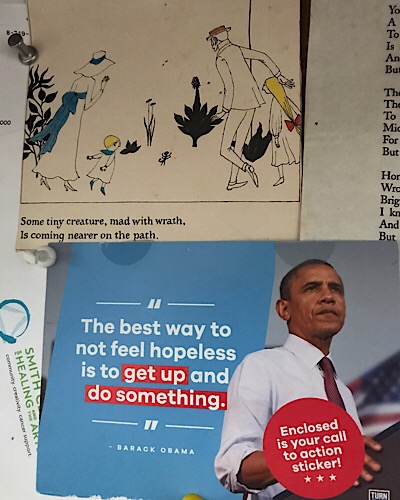
I am certain that there is little that I can do as an individual to prevent history repeating itself in Afghanistan (though I write letters to President Obama on occasion). I can, however, pay attention to the lesson here with regard to my own, individual life. I can strive to unravel and dissolve old patterns from my history and to create new patterns that will better serve me. In asana practice, I seek therapeutically to realign the physical body and the energetic body so that old pains and struggles do not continue to interfere with my living as fully, joyously, and expansively as I can in my body. Through meditation, I seek to know the true joy of being and to have the light of consciousness illuminate how I respond to people and events. When I can do this, I have the choice not to create new hurts and problems that are just like the old ones.
What I know from my own practice and life is that not repeating history is hard, but it is what gives the possibility of living in true freedom. Is it enough to work on just my own self not repeating history? Do we need to try and bring shifts to larger patterns to truly be of service? I do not know the answer to the latter question, but I do know that the duty to try and shift myself is not just for me, but extends beyond me, like the ripples extending out from a pebble thrown into a pond.
is catsitting. Hmmm.

Peace and light, E — Posted with WordPress for BlackBerry.