Art and Culture | Asana, Pranayama, and Yoga Practice | Community and Family | Food for the Mind (Yoga Philosophy, etc) | Photos | Quaker
Found Exhortations


Ether (akasha) is the fifth of the mahabhutas. In science and perception, it is the space between the other elements, it is that in which the other elements reside. It is to some degree, the critical element of how we are able to perceive the other elements. I find focusing on the Anusara alignment principle of “open to grace” is the best way to experience the element of ether in myself. By softening, opening, and inviting spaciousness, I can better experience the subtle elements and appreciate how it is that I experience them.
The subtle elements or the panca tanmattras are smell (gandha), taste (rasa), form (rupa), touch (sparsa), and sound (sabda). The subtle elements are not what we sense (which is composed of the mahabhutas) nor are the tanmattras our sense organs. Rather the tanmattras are, as it were, the space in which perceptions arise, the ability to be perceived.
The next sets of elements are the panca karmendriyas, the organs of locomotion, which correspond to how we physically move, digest, and change in the physical world, and the panca jnanendriyas, the organs of perception or cognition, which correspond to our sense organs themselves. Our movement in and perception of the world bridges the physical elements, the perceptability of the physical world, and ourselves as physical beings, beings who move in the physical world, and beings who perceive the physical world. All of this, I think of as needing space or residing in space. As I consciously think of space giving a place for the world, my movement in it, and my perception of it, I become more conscious of consciousness. The physical practice of “opening to grace” and experiencing the element akasha makes possible for me in my practice knowing or experiencing a greater consciousness.
To start discovering your own understanding of akasha, try this meditation: listen to the sounds beyond the room without trying to analyze or change them. Appreciate how far in space your senses and consciousness can be. Then bring your attention into the room and hear the sounds in the room. Then open your ears to the sounds within you — your heart beat, your breath. Then open to all the sounds (don’t try to change or analyze them), both those physically far away and those within your own body, and be aware of them as all residing within your own consciousness. Appreciate that your consciousness is as spacious as the world around you and within you. Rest in the space of consciousness.
See whether spending a few minutes using this meditation technique helps you when your day has gotten too busy with work, errands, family or other demands. I find it very helpful.
As I was doing my laundry yesterday, most of which I line-dried, I thought about the fact that I have not been to the dry cleaner in nearly a decade. This is one of the small things I have chosen in order to be a little kinder to the environment.
Some of my clothes, especially things I bought several years ago, say “dry clean only.” This includes knits made of wool, tencel, modal, or rayon (all of which are natural fibers) and linen and silk unconstructed clothing. All of these do fine with hand washing (or on the gentle cycle in the washing machine) and being hung up to dry (this also applies to cotton, button-down shirts). Of course, if it doesn’t say to dry clean then you definitely don’t need to dry clean.
Always believed the label? How was clothing made of natural fibers cleaned before there was such a thing as a dry cleaner? Think they look better or it is easier to get them dry cleaned? Think about the solvents, the plastic, the energy for the cleaning method, and whether you drive to the dry cleaners. Then make a decision.
Most things do not need to be cleaned by use of poisonous solvents (just because a solvent is “organic” or “natural” doesn’t mean it is good for the environment) and then wrapped in non-recyclable plastic to take home (many dry cleaners will take back the hangers, but will say they need to use the plastic wrap because their premises are too dusty for your clothes to stay clean outside the plastic wrapper).
So look for clothes that say “gentle wash, line dry” instead of “dry clean only.” If it says “dry clean only” think about whether it really applies. It will not apply for a wool sweater, most knits, or unlined clothes. A business suit — yes, it won’t keep its shape unless you dry clean. Do you really need to wear a business suit? Will a choice not to wear a suit impact whether some people think you are truly “professional”? Possibly. If you decide you need to wear a suit regularly, how many times can you wear it before taking it to the dry cleaners?
PS. Don’t experiment with things that are new and expensive. Try it on older clothes and discover whether you need to believe everything you read.
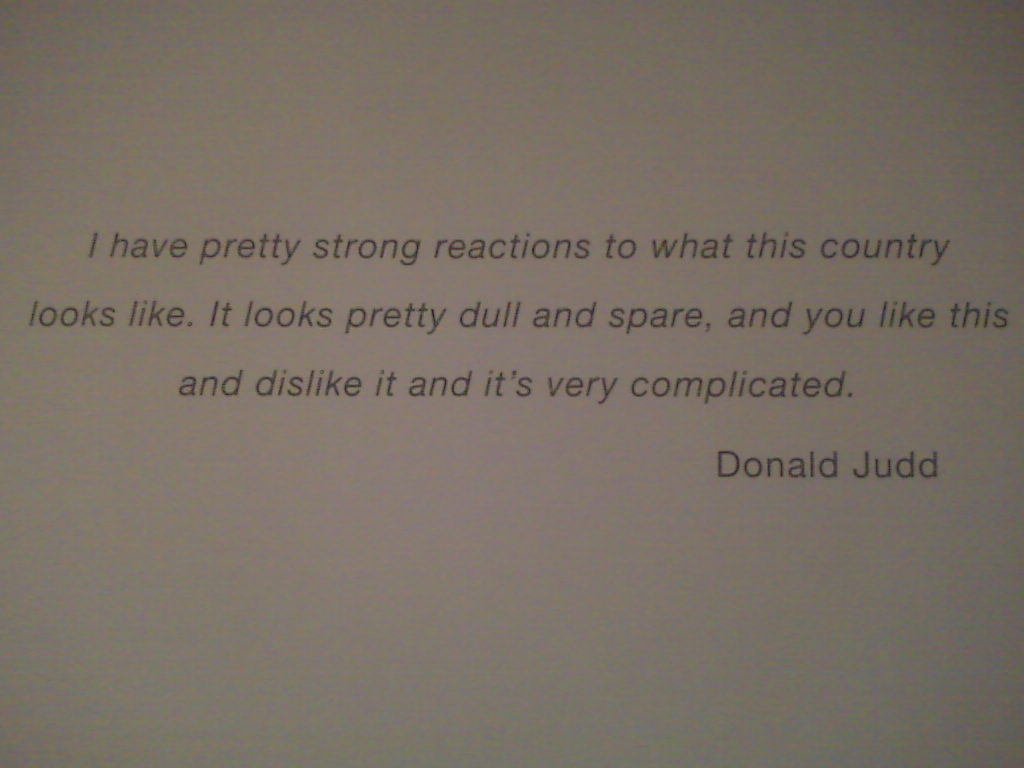
This is a quote on the wall at the Lewis Baltz exhibit at the National Gallery (closing July 31st).
Where I travel, the landscape is often bustling or crowded or fine or grand–though much is spare like Judd’s. Some to love and some not so much. The relationships are perhaps both deep and complex at the level of mind and emotion. At the level of inner wisdom, illuminated by the light of consciousness (when I can maintain it with respect to those things external), though, it is exquisitely simple.
Peace and light, E — Posted with WordPress for BlackBerry.