|

“Dry Clean Only” (Don’t Believe Everything You Read)

As I was doing my laundry yesterday, most of which I line-dried, I thought about the fact that I have not been to the dry cleaner in nearly a decade. This is one of the small things I have chosen in order to be a little kinder to the environment.

Some of my clothes, especially things I bought several years ago, say “dry clean only.”  This includes knits made of wool, tencel, modal, or rayon (all of which are natural fibers) and linen and silk unconstructed clothing.  All of these do fine with hand washing (or on the gentle cycle in the washing machine) and being hung up to dry (this also applies to cotton, button-down shirts).   Of course, if it doesn’t say to dry clean then you definitely don’t need to dry clean.

Always believed the label?  How was clothing made of natural fibers cleaned before there was such a thing as a dry cleaner?  Think they look better or it is easier to get them dry cleaned?  Think about the solvents, the plastic, the energy for the cleaning method, and whether you drive to the dry cleaners.  Then make a decision.

Most things do not need to be cleaned by use of poisonous solvents (just because a solvent is “organic” or “natural” doesn’t mean it is good for the environment) and then wrapped in non-recyclable plastic to take home (many dry cleaners will take back the hangers, but will say they need to use the plastic wrap because their premises are too dusty for your clothes to stay clean outside the plastic wrapper).

So look for clothes that say “gentle wash, line dry” instead of “dry clean only.”  If it says “dry clean only” think about whether it really applies.  It will not apply for a wool sweater, most knits, or unlined clothes.  A business suit — yes, it won’t keep its shape unless you dry clean.  Do you really need to wear a business suit?  Will a choice not to wear a suit impact whether some people think you are truly “professional”?  Possibly.  If you decide you need to wear a suit regularly, how many times can you wear it before taking it to the dry cleaners?

PS.  Don’t experiment with things that are new and expensive.  Try it on older clothes and discover whether you need to believe everything you read.

Similar Posts

  • | |

    A Favorite Sculpture (and the missing mentor)

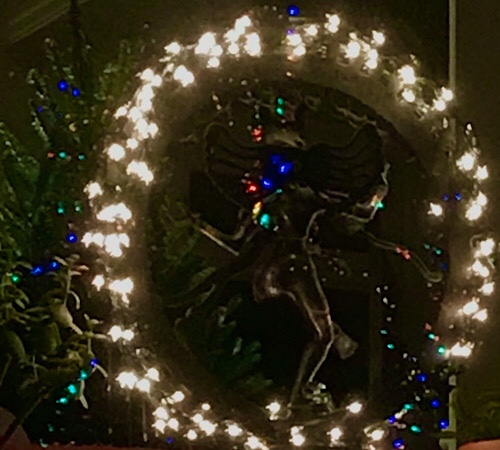
    I have been walking past this sculpture regularly ever since I was a judicial clerk in 1987-1988.  It is in the plaza between the Federal and DC court houses.  It is dated in the subject matter.  The partner-associate relationship has shifted over the years, both from the inclusion of women in the law place and the changing economics.  The shift in economics to assume that most associates will not be partners because the firm simply does not have the space for more partners and because the associates feel freer to move around and for a whole host of other reasons, some more benign than others, has left new workers bereft of the support of a mentor.  In the disruption of the continuity of the workplace, those who stay are less motivated to serve as mentors and lose the delight and strength that comes from the action of mentoring.  Those who come into a workplace without a mentor never learn the way they could.  Although some of the changes are good, the missing mentor is indeed a loss.

    Though the sculpture reminds me of something lost, I love this sculpture, especially where it is set.  It is absolutely suited to its location and was made with great skill and love.

  • | |

    Beginning to See More Light

    It was just approaching the deep dark of the solstice when I left for places warm and light. Last week, when I got home, just by comparison to the sultriness of southern India, it felt dark. This morning, though, I noticed earlier morning light. When the wake up call sounded, I was deep in a rather wonderful dream in the violet-tinged landscape of the American southwest. As I had an early meeting at another governmental agency that required me to walk 10 blocks further than my usual walk to work, and I did not want to miss my regular morning practice, I had to get up right away.

    The light through my second floor skylight seemed softer than it had just a few days earlier. Instead of being absolutely dark, there was enough of a hint of dawn that there was no need to turn on the light just to walk downstairs. I thought perhaps a little of yesterday’s snow might have accumulated. No snow. It was just the first glimmer of the days starting to get longer. When I walked past the Capitol on my way to the meeting, I saw several robin red breasts. With global climate change, many of them now do not fly farther south for the winter.

    Peace and light, E — Posted with WordPress for BlackBerry.

  • | |

    Artha, Kama, Dharma, Moksha (and Politics)

    Last night, Paul Muller-Ortega, as part of the introductory talk for the meditation intensive, spoke at some length about the principles of ardha, kama, dharma, moksha.

    As I have written about before, in the classical yoga view, it is the renunciation of the first three–material well-being, love and relationship, and right work or path, that leads us to the fourth–liberation. From a tantric yoga perspective, it is living and having the first three from the perspective of illuminated wisdom and discerning (viveka) insight (pratibha) that makes us free (jivanmukti) in this life.

    One of the most exquisite things about a steady practice and study, is that each time we revisit a core concept, we hear and understand new aspects to bring into our lives.

    When speaking of approaching these elemental aspects of human being, Paul noted that ardha includes not only material well-being, even wealth, but also the power that wealth brings and how we use it. Although he only mentioned that briefly amidst several other concepts, it really resonated with the current state of my being in relationship to the world and our country.

    I have been contemplating deeply about wealth and power in this time of budget debate, and how they can and should be used to bring nurture, peace, and health to the maximum degree possible. (You might guess that I don’t think increasing spending for war and decreasing spending for education and health is going to bring us freedom).

    Thinking about the power of money as part of our contemplation of our material well-being is something of critical importance at this time. If we shun or disdain in our minds wealth and power while still yearning for our own comforts, than we have lost an opportunity to bring the yoga principles into our lives as optimally as possible. (Of course, grasping and coveting money and power is completely destructive of the possibility of happiness, but most of us think about that, and it is why some say they are bad — money being the root of all evil, etc.).

    If we are really in the world and want to be happy and to share and spread happiness, while living in accordance with the principles of the yamas and niyamas, especially the yamas: ahimsa, satya, aparigraha, brahmacharya, asteya (non-harming, truthfulness, non-greediness, aligning with spirit, and non-stealing), that is when we will start opening up the possibility of true living liberation.

    Imagine, instead of thinking about material well-being as a “guilty pleasure” thinking of ways in which you can use your own well-being (and work through your practice to discover greater health and strength) to be a voice and power for good in your own individual way.

    Peace and light, E — Posted with WordPress for BlackBerry.

Leave a Reply

Your email address will not be published. Required fields are marked *

This site uses Akismet to reduce spam. Learn how your comment data is processed.