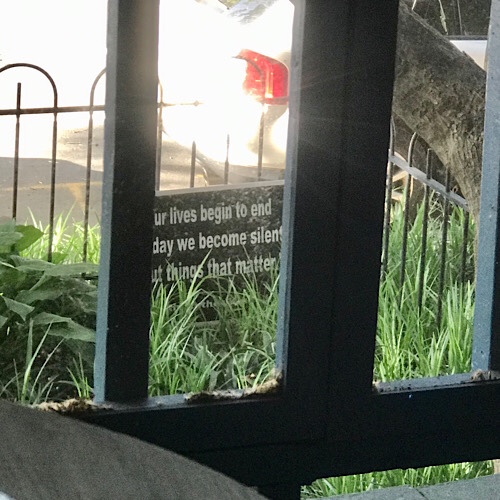
Found Quotations

With a stop at the Tuesday Fresh Farm Market where I bought an egg carton full of figs and some white nectarines.

Peace and light, E — Posted with WordPress for BlackBerry.
In classical yoga, maya is the illusion that the tangible world is what is real. Only atman is real; the world we experience through our senses (and our senses them selves) as reality is an illusion. We renounce the world to escape the temptation of being drawn into it as reality. In so doing, though, we ineluctably must come to the conclusion that all that is ill with the world is as much an illusion as that which is tempting. In turning away from the world we would be also turning away from the pain of seeing inequity and suffering and the desire to seek change in the tangible, sense-experienced world.
As I was walking around New York City, ankle-deep in slush and being hyper-stimulated by the lights and the noise and the smells and the bustle and the choices, I found myself thinking about maya and that in its classical sense has two surface temptations for me. The first is the temptation to turn away from the stimulation, to reject consumption of more than needed to exist. In the face of such excessive stimulation, the idea of nothing, of utter simplicity, of quiet seems desirable. If the turning away is another form of seeking pleasure or escaping pain, though, it is still in the trap of maya — the worldly illusion that binds us in the pair of opposites–pleasure and pain. The second temptation, the temptation to withdraw from everything except seeking the light within, is more subtle. If we truly are to turn away from the world of the senses, we turn away from notions of justice and equality and freedom that are based how we live in the material world as much as we turn away from consumption.
The true path of renunciation, of pure meditation, is a rare and beautiful path, but to stay in the world and to withdraw ineffectually in such a way might earn the hackneyed epithet “navel gazing.” My path is not that of the renunciate yogin, nor do I have the fortitude to live a life of Christian poverty, which would reject riches and live for service. Where can we find the support in the yoga path to stay engaged and yet still live mindfully, fostering the expression and recognition of spirit in ourselves and others?
In tantric philosophy, maya is understood somewhat differently than in classical yoga. The maya is not the world itself. When we think that getting and having and avoiding is all that there is and that it is separate from spirit, then our lives are cloaked by maya, and we are ignorant (avidya) of the true bliss of spirit (satcitananda). To know spirit, we must see through maya. To do that requires discrimination (viveka) in what we take into our senses and ethically responsible action in the tangible world to align our lives in a way that expands the opportunity to recognize spirit, which in my mind includes having less material disparity in society, which disparity most assuredly makes the essential truth of blissful consciousness more opaque (due to the play of maya) for both the haves and the have nots. While we make our attempt to live with more discrimination and grace and with less cause of conflict or suffering (doing better some times than others), we still try to recognize and savor the exquisite divine in each sight and taste and sound and creation. How extraordinary always is New York in all its wild manifestation!
I am lucky to have a non-stop. The storm is supposed to have passed through. So I can enjoy myself know matter what travel brings, I pack up a variety of reading materials — philosophy, handouts for the workshop, and fiction. I switched my ankle warmers to bamboo knitting needles so I could get through security and knit (the ankle warmers are on size 2 needles, so it is taking me as long as a sweater). I have my journal and a pen. Best, I am traveling with two friends (all different flights, but no one waiting alone in the airport) with whom to visit, who are going to the same retreat. Takes the edge off of the early wake up time. Starts the retreat when I leave the door instead of when I arrive at the retreat center.
Last week Orie suggested that as I have a “Yoga for Gardeners” workshop, I should also do a “Yoga of Housekeeping” workshop. A blog post isn’t a workshop, but here are a few preliminary thoughts on yoga and housekeeping.
From an alignment perspective, I have found that the Anusara principles of alignment make safe everything I do off the mat, as well as on. Overwhelmed by all that needs to be done? Doing heavy lifting? Bending and stooping? Reaching for something way up high?
First, soften (open to grace). Appreciate that you have a home and things to clean. Honor each item in the house. Things have energy, too., and they like to be touched and cleaned. If you have anything that you do not appreciate or does not fit in the house, give it a new life in a new home (freecycledc is a great way to pass things forward).
Use muscular energy, drawing the muscles to the bone, hugging into the mid-line, and drawing energy into the focal point (for most housecleaning activities, this will be the pelvis). Using muscle energy will definitely help to keep you from tweaking a muscle or straining the low back or shoulders. When you are reaching, keep the arm bones integrated by hugging the shoulder blades onto the back and then reach from the waist, though each rib to extend the length of your torso (organic energy).
Especially for bending and lifting, after you bend your knees, hug your shins in (muscular energy), take your inner thighs back and apart (inner spiral) and then tuck your tailbone (outer spiral). If you just bend from the knees but hunch your back, your low back will still be vulnerable.
Switch sides for activities like sweeping, vaccuuming, and scrubbing. Yes, it can be difficult and awkward, but it’s worth it to shift sides. Imagine doing all of your yoga practice only on one side. How much imbalance would you be encouraging?
The first niyama of Patanjali’s Yoga Sutras is sauca, which means cleanliness or purity. It is easier to think and live and be hospitable in a clean home.
The first yama is ahimsa, or non-harming. Do your best to use safe, biodegradable cleaning products. Your skin and respiratory system will be grateful. So will the earth. Try to make cleaning your own space and act of honoring your self, your home, and the greater home of the earth.
Fully absorb yourself in the task of cleaning. Make it a meditation. Integrate fully the act of cleaning, the item being cleaned, and you as the cleaner.
Finally, be playful.