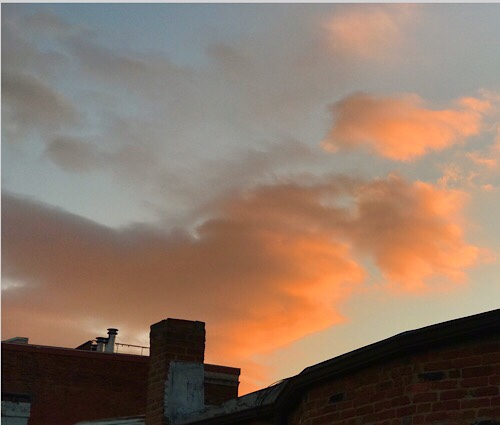
On the Way Home from Tuesday Night Yoga Practice at William Penn House


Three or four weeks ago, I came out of my morning meditation thinking about the teachings of Krishnamurti. (I read a lot of Krishnamurti when I was in high school, so his teachings have influenced me with varying degrees of subtlety). Two or three days later, I was “spammed” with Krishnamurti’s Daily Thought. Someone, apparently somewhere in Europe, somehow got access to an email list to which I subscribe. As I had just been thinking about Krishnamurti, though, instead of hitting “unsubscribe,” I read the thought for the day. I’ve been reading it since, and I am exploring how much my readings in high school have been part of my foundational thinking.
When I was volunteering at the Lantern yesterday, one of the other volunteers called and reminded me that there were books put aside for me. It is not my habit to put books aside, and I had no recollection of so doing, so I was curious to discover the books were there. One of the two books was a slightly water damaged paperback of Krishnamurti On Right Livelihood. The universal energies are obviously suggesting I examine this early influence. I am contemplating what the following question means for me in today’s current context of multiple wars, a deep recession, and burgeoning environmental degradation:
Is it not necessary for each one to know for himself what is the right means of livelihood? If we are avaricious, envious, seeking power, then our means of livelihood will correspond to our inward demands and so produce a world of competition, ruthlessness, oppression, ultimately ending in war. Krishnamurti, Ojai, July 1944
Surely that’s what life was all about? Opening doors and peering through them–perhaps even finding the rose gardens there… (Colin Dexter, The Dead of Jericho)
The good murder mysteries — the ones that teach much about human nature and do not dwell graphically on gore and violence — can teach us much about the power of sadhana (yoga practice). The best mysteries are ones in which the protagonist teaches us by his or her investigation into the mystery that with careful, steady discipline, the application of well-developed technique and study, consistent effort, and an openness to trust intuition tempered by discrimination, we can reveal to ourselves the truth of the matter. The truth revealed is not just the identity, means, and motive of the murderer (mystery solved), but the knowledge of the extraordinariness of human being in all of its manifestations, both good and evil.
Last night, Paul Muller-Ortega, as part of the introductory talk for the meditation intensive, spoke at some length about the principles of ardha, kama, dharma, moksha.
As I have written about before, in the classical yoga view, it is the renunciation of the first three–material well-being, love and relationship, and right work or path, that leads us to the fourth–liberation. From a tantric yoga perspective, it is living and having the first three from the perspective of illuminated wisdom and discerning (viveka) insight (pratibha) that makes us free (jivanmukti) in this life.
One of the most exquisite things about a steady practice and study, is that each time we revisit a core concept, we hear and understand new aspects to bring into our lives.
When speaking of approaching these elemental aspects of human being, Paul noted that ardha includes not only material well-being, even wealth, but also the power that wealth brings and how we use it. Although he only mentioned that briefly amidst several other concepts, it really resonated with the current state of my being in relationship to the world and our country.
I have been contemplating deeply about wealth and power in this time of budget debate, and how they can and should be used to bring nurture, peace, and health to the maximum degree possible. (You might guess that I don’t think increasing spending for war and decreasing spending for education and health is going to bring us freedom).
Thinking about the power of money as part of our contemplation of our material well-being is something of critical importance at this time. If we shun or disdain in our minds wealth and power while still yearning for our own comforts, than we have lost an opportunity to bring the yoga principles into our lives as optimally as possible. (Of course, grasping and coveting money and power is completely destructive of the possibility of happiness, but most of us think about that, and it is why some say they are bad — money being the root of all evil, etc.).
If we are really in the world and want to be happy and to share and spread happiness, while living in accordance with the principles of the yamas and niyamas, especially the yamas: ahimsa, satya, aparigraha, brahmacharya, asteya (non-harming, truthfulness, non-greediness, aligning with spirit, and non-stealing), that is when we will start opening up the possibility of true living liberation.
Imagine, instead of thinking about material well-being as a “guilty pleasure” thinking of ways in which you can use your own well-being (and work through your practice to discover greater health and strength) to be a voice and power for good in your own individual way.
Peace and light, E — Posted with WordPress for BlackBerry.