Asana, Pranayama, and Yoga Practice | Community and Family | Food for the Mind (Yoga Philosophy, etc) | Meditation
This Morning’s Puja Card

Seems appropriate for Yom Kippur.
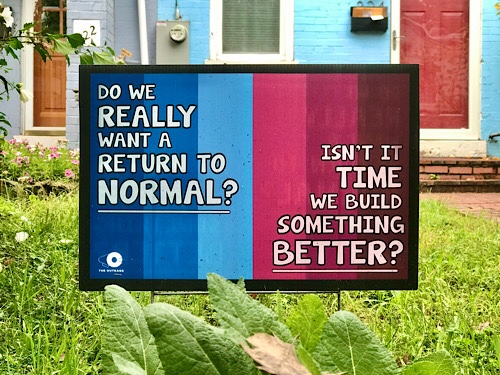
sign reads: “Do we really want a return to normal? Isn’t it time we build something better?”
This morning I went for my bi-annual physical. The first thing that the doctor’s assistant did after having me stand on the scale (a blood-pressure elevating activity out of habit), was take my blood pressure. It was on the low end of normal, as usual for me.
In the middle of the exam, after having intimate discussions about tratment to alleviate suffering vs. treatment for longevity, and similar topics, my doctor took my blood pressure again. No surprise: it was higher than it had been when I irst walked into the exam room.
When we were just about done, my doctor said, “let’s see if we can lower that blood pressure. Close your eyes and relax.” “Relax” can be a hard command to obey. Instead, I went right to where I go in meditation, softening to my mantra. In less than a minute, my blood pressure was lower than it had been at the start of the exam. “A beauty of meditation,” I said. “Yes,” my doctor replied (who is a very traditional western medical practitioner, “I wish I could get all my patients with high blood pressure to meditate.”
This morning I was deep into my regular meditation when I felt the cat (whom I had not known was next to me) swat my shoulder. He has been wanting much attention for the past couple of days, but he has never actually pawed me the way some dogs do to get a petting. I went back into my meditative space and then a couple of minutes later noticed my shoulder was itching. Sully had tried to get a mosquito that was biting me. Good kitty.
A number of years ago I had a conversation with a cherished friend and co-worker who is no longer in this body. I was explaining to her the yoga practice of samtosha (contentment), which is one of the five niyamas that make up the second limb of the eight-limbed path of yoga set forth in Patanjali’s Yoga Sutras. My friend said it felt like a great revelation to think of contentment as a practice. She had thought of it as a state you were either lucky enough to have — or not.
Many states or characteristics or attitudes that we tend to think of as only being innate characteristics or good fortune can be cultivated.
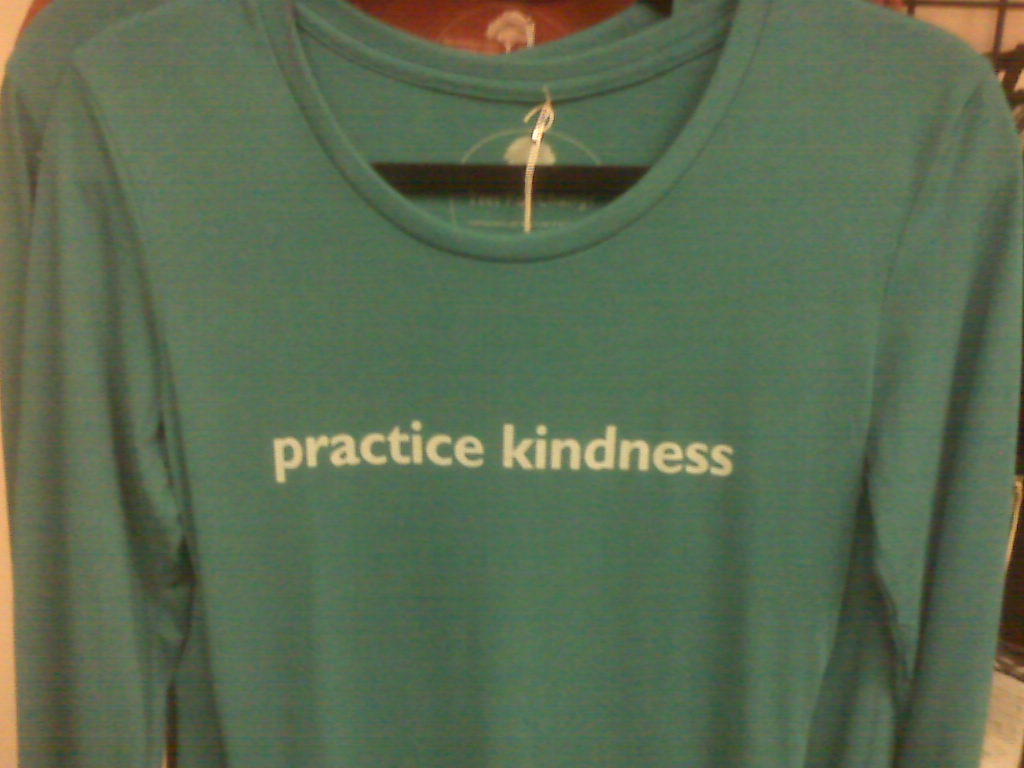
Wearing an exhortation on a t-shirt might not necessarily be my style, but I do agree kindness is worthy of cultivation when it does not happen spontaneously.
Peace and light, E — Posted with WordPress for BlackBerry.
The New York Times just published a lengthy article on “How Yoga Can Wreck Your Body.” The response of one of my fellow certified Anusara yoga instructors was “duh!” This conversation greets me as I am about to offer a free gentle and therapeutic yoga class at Willow Street Yoga to invite new and continuing students to discover the power of the Anusara alignment principles to heal and transform challenges of embodiment. If I were not highly confident in the power of Anusara yoga to heal when practiced mindfully, I might be worried that the article would keep away potential students. Instead, I welcome the “news” as a way to broaden the invitation to discovery.
As I have blogged about before, at an intensive, John Friend once compared advanced asana to digitalis–depending on dosage and circumstances of the individual digitalis is at once the deadliest plant in the garden and one of the most powerful medications to heal the heart. We don’t read much about digitalis in the news, but we are constantly bombarded with contradictory news flashes about the health risks and benefits of lots of things — coffee, red wine, vitamins, running, anything that has been either held out as either a cure all or an evil that is ubiquitously practiced or imbibed. Why? I think it is because we in this society are hungry for panaceas, for effortless solutions, for the latest thing, for something to save us from emptiness and ill health, without actually having to work at it. It is newsworthy that yoga bears risks precisely because we (the general societal we) wanted it to be a perfect solution without actually requiring any change how we live the rest of our lives (including diet, exercise, relationship to others) and to bring to yoga the mindfulness, determination, and steadiness that it requires to bring the peace, harmony, and healing it offers.