| | |

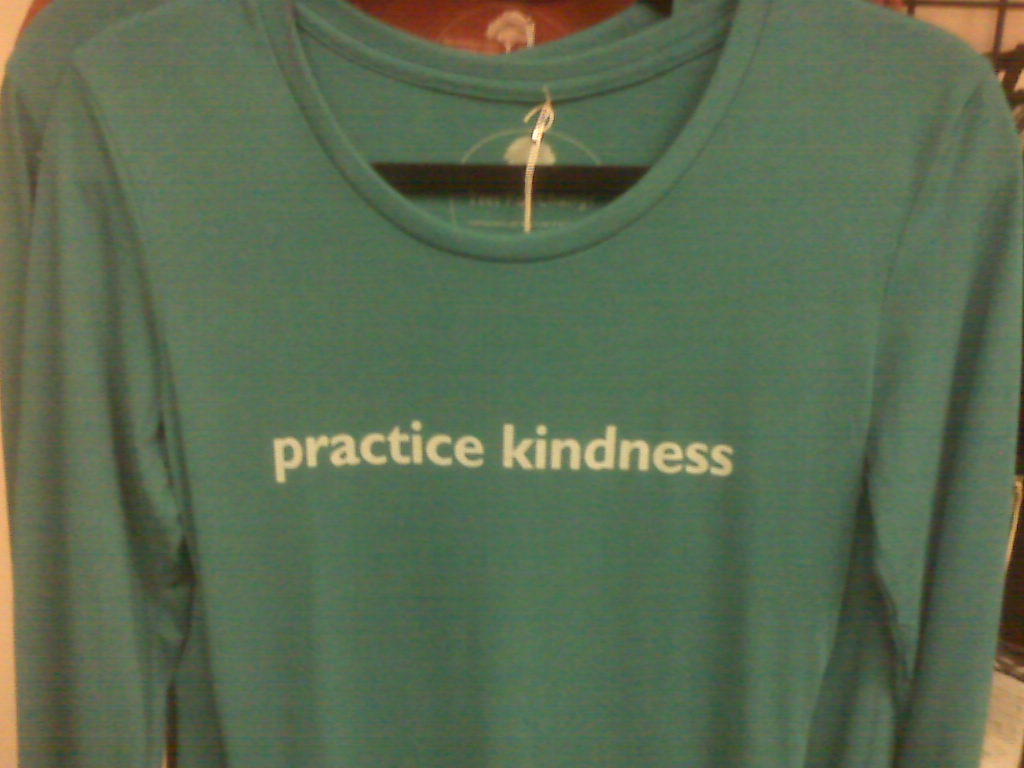
Found Exhortation

A number of years ago I had a conversation with a cherished friend and co-worker who is no longer in this body. I was explaining to her the yoga practice of samtosha (contentment), which is one of the five niyamas that make up the second limb of the eight-limbed path of yoga set forth in Patanjali’s Yoga Sutras. My friend said it felt like a great revelation to think of contentment as a practice. She had thought of it as a state you were either lucky enough to have — or not.

Many states or characteristics or attitudes that we tend to think of as only being innate characteristics or good fortune can be cultivated.

Wearing an exhortation on a t-shirt might not necessarily be my style, but I do agree kindness is worthy of cultivation when it does not happen spontaneously.
Peace and light, E — Posted with WordPress for BlackBerry.

Similar Posts

  • | | |

    Meditate Lovingly

    I started out tonight’s group yoga practice saying that I’d been listening again to the recorded conference calls in Claudia Welch and Cate Stillman’s “Healthier Hormones” course, which while presenting very simple aspects of much more complex systems of thought and practice, I think gives valuable perspective on living with awareness and self care.  In the first call, Dr. Claudia tells a story of teacher who told her that she should meditate lovingly.  Dr. Claudia suggested that practicing just out of a sense of obligation wouldn’t have the same benefits as if you went to it and did it lovingly; and, as a physical matter, you wouldn’t get the same positive hormonal benefits.

    During my intense workday trying to meet a major deadline, I thought both of the intention to make everything one does a meditation and this exhortation to meditate lovingly and decided to have combining the two be my practice for the day.  I’d draft an email or get on the phone or edit documents and say to myself, “lovingly, lovingly.”  I thought, as I contemplated what needed to be said and done, “lovingly” doesn’t mean never tough love.  Doesn’t mean passive acceptance or false praise.  Doesn’t mean anything crossing appropriate work place boundaries.  But the action always done lovingly.  With spacious awareness. Illuminated consciousness.  However you might describe that lovingly place.  Saying the word periodically during the day as if it were japa or mantra made this day better.  More loving for me; probably better for all the people with whom I had to engage on a fairly unpleasant and monstrously complicated task.

    I sent the big email to my boss at 6:30 and got off the phone with him at 6:58, when the yogis arrived.  As I ended the call with my boss, I said I’d be done with yoga at 8:30 and would leave my computer on, and I would be available then.  Practice was sweet–standing poses and hip openers to get ready for more snow.  We’d were shifting into our first restorative and the phone rang.

    8:04pm. The answering machine picked up and my boss began leaving a message.  I’m leading yoga practice.  Boss calling while leading yoga practice not good.

    Lovingly.

    I decided that it would be better overall not to wait until practice was over to return the call.  I asked one of my fellow yogis to lead the others in the next pose (the delicious and simple restorative of lying with a rolled up blanket cross-wise under the back right under the shoulder blades to give the heart a lift and to provide a counter balance to the shape of sitting at a computer).

    I reminded myself what we’d been talking about as the focus of practice; “lovingly,” I said to myself, the lovingly being about how to complete the task at hand, not specific to the individual. I called back my boss.  He just couldn’t wait to call until 8:30; he was anxious about the impending snow storm and its impact on our being able to get things done and he wanted to be done and home, too.  I’d left my glasses in the studio and couldn’t see the computer well enough to work, so I went looking for them.  When I went in, expressing my chagrin, the yogis said they were enjoying listening to the conversation (while they were happily in their poses).  I decided to believe them. When my boss apologized, I replied, “it’s ok; my students assured me that they enjoyed listening.” I am grateful and delighted to practice with such gracious friends, that I could say it truly.

    Then we wound up the practice with supported half shoulder stand, followed by a twist and savasana.

    Lovingly.

    Hard work that lovingly thing sometimes, but I think it might be an efficacious conscious practice for a while for me.

    Feel free to remind me if it seems like I’m forgetting. But lovingly.

  • |

    Twisting, Opening to a New Perspective (and radical affirmation)

    This week I have been working on twists both in my own practice and in my classes. In so doing, I have been thinking about the difference between turning around or doing an about-face and staying steady and true to oneself, while truly being open to another perspective.

    In order to get into twisted and bound asanas, it is critical to be steady in your place and to use the three self-affirming elements of muscular energy — hugging into the midline, embracing the muscles to the bone, and drawing from the periphery into the focal point — to be able to revolve on the midline and open the heart to a new direction.

    The same is true off the mat. If we just flip our position or turn an about-face, we are not grounded or reliable. Inside the beltway, for example, I’ve heard people saying they think McCain and Specter should be voted out of office because it is not clear where they stand. Their positions seem more about expediency than about a steadiness of conviction, coupled with an openness to listen to and work with others with differing views.

    Ideally, we want to embrace ourselves, our history, and our nature, and be sufficiently comfortable and secure with ourselves that we can hear others. Even if it feels convoluted or binding to open to true listening, by reaching while staying steady, we can better have compassion and recognize the light and humanity in those with whom we disagree. By doing so, ultimately, just as we create greater strength and flexibility by practicing twists, we experience a greater openness of spirit with respect to ourselves and all around us.

    This is a big part of my current practice, and perhaps one of the very hardest.   Steadfast commitment to a balance of steadiness and openness makes possible, I think and hope at this point in my practice, radical affirmation of the good in everything.

Leave a Reply

Your email address will not be published. Required fields are marked *

This site uses Akismet to reduce spam. Learn how your comment data is processed.