Morning–Looking Up
I have been walking past this sculpture regularly ever since I was a judicial clerk in 1987-1988. It is in the plaza between the Federal and DC court houses. It is dated in the subject matter. The partner-associate relationship has shifted over the years, both from the inclusion of women in the law place and the changing economics. The shift in economics to assume that most associates will not be partners because the firm simply does not have the space for more partners and because the associates feel freer to move around and for a whole host of other reasons, some more benign than others, has left new workers bereft of the support of a mentor. In the disruption of the continuity of the workplace, those who stay are less motivated to serve as mentors and lose the delight and strength that comes from the action of mentoring. Those who come into a workplace without a mentor never learn the way they could. Although some of the changes are good, the missing mentor is indeed a loss.
Though the sculpture reminds me of something lost, I love this sculpture, especially where it is set. It is absolutely suited to its location and was made with great skill and love.


“Write more, that’s all I have to say.” There were several more lines of text, but none so coherent or compelling as this.
Yes, spammer, I would like to be writing more imaginatively and more about the yoga here and elsewhere. I am fully occupied, though, with a technical writing of quite some magnitude if magnitude were to be measured only by the number of words and ideas included. With the social and substantive complexity relating to the project and how it fits within the fabric of creating the rules that govern our society, it is a creative in its own way, but it is more draining than inspiring.
The exercise involves many drafters who come from a wide range of perspectives, training and background, and who have different responsibilities and senses of responsibility. Most everyone is feeling stressed and under-supported in their own way and acting in the multifarious ways people act when that’s how they are experiencing things. I am struggling to stay compassionately present for myself and all who are engaged in the endeavor.
Reminding myself of reasons to be grateful always helps. The yoga and meditation practices, in addition to my creative pursuits, are at the top of the list. The practices are the only truly steady back up that I have. Perhaps that is true for everyone to a greater or lesser degree. The philosophies that inform the practices–whether renunciate or tantra–ultimately would not, I think, disagree.
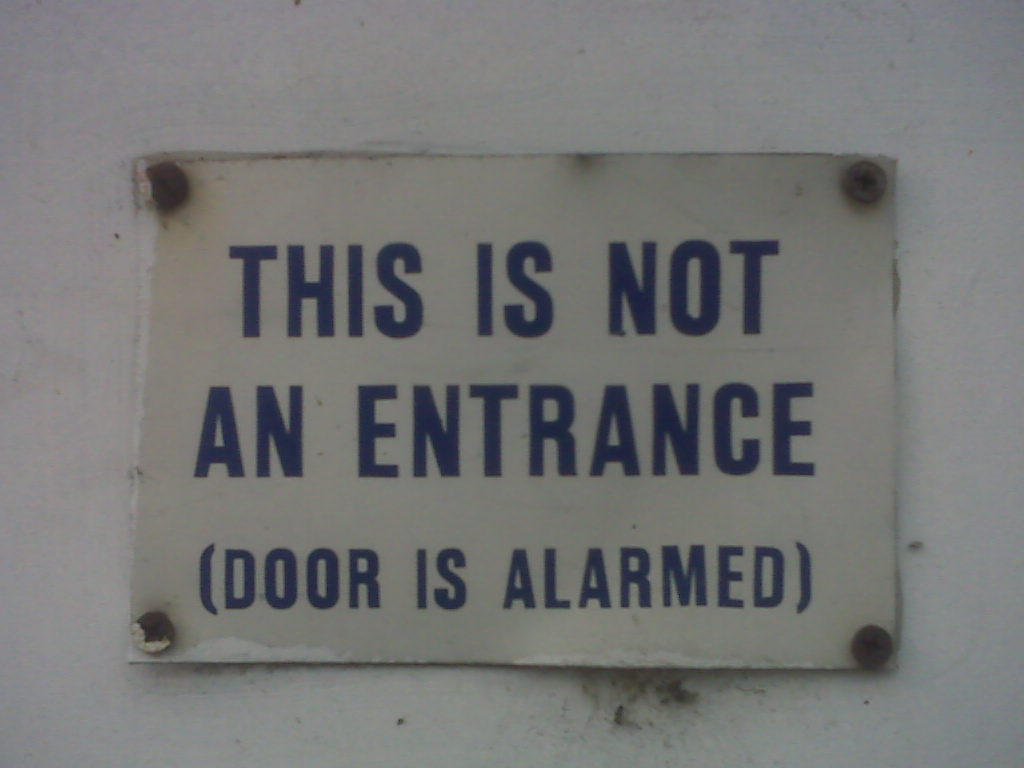
Poor door. I wonder if yoga and meditation might help.
Peace and light, E — Posted with WordPress for BlackBerry.
Finding interest and gratitude in the small things.
What are you going to do about it?
Towards the end of a yoga session I start thinking about what would be a good theme for the next. I start by observing what is going on in the world — from the change of seasons, to whether it is rainy or drought, to what is going on in the political climate, noticing what is recurring in my own practice and the practices of my students, watching what is arising in my contemplations and meditations, and seeing what is resonating most in what I am learning from my own teachers. I will go into my library, reading and rereading things to see what resonates with what I am observing and experiencing. I also take into account the length of the session to be sure that it will fit well within the number of classes. Once I have set the session theme, I spend the week in which I will teach a particular principle, contemplating it, reading about it, practicing with it, and thinking about its relationship to my life off of the mat.
When I selected the tattvas this session it was for a whole array of reasons (some of which have been set out in previous posts). The order I picked to teach them, and which I chose to emphasize, were for what I thought would be the best way to share knowledge and experience and not for the outside calendar. It was then, by sheer serendipity that the themes fit as they did with the calendar:
Now this week, the last week of the session, parama shiva — the highest tattva. Shiva tattva is the most subjective principle and the most universal. It represents the essence of being (sat), consciousness (cit), and bliss (ananda). It is everywhere and nowhere, in all beings and not. It is whatever ever we think of as spirit or force or web of being or light or pulsation or divine — whatever we believe is the very essence of being. It is most interesting that by my series of contemplations and choices over the winter holidays, that I gave myself the homework assignment, as it were, to be specifically contemplating, practicing with, and studying the shiva tattva as I offer peace to Becky as she departs and seek my own peace in my grief over the loss of her physical presence.