| | |

Advice from a Spammer (and Niralamba?)

“Write more, that’s all I have to say.” There were several more lines of text, but none so coherent or compelling as this.

Yes, spammer, I would like to be writing more imaginatively and more about the yoga here and elsewhere. I am fully occupied, though, with a technical writing of quite some magnitude if magnitude were to be measured only by the number of words and ideas included. With the social and substantive complexity relating to the project and how it fits within the fabric of creating the rules that govern our society, it is a creative in its own way, but it is more draining than inspiring.

The exercise involves many drafters who come from a wide range of perspectives, training and background, and who have different responsibilities and senses of responsibility.  Most everyone is feeling stressed and under-supported in their own way and acting in the multifarious ways people act when that’s how they are experiencing things. I am struggling to stay compassionately present for myself and all who are engaged in the endeavor.

Reminding myself of reasons to be grateful always helps.  The yoga and meditation practices, in addition to my creative pursuits, are at the top of the list.  The practices are the only truly steady back up that I have. Perhaps that is true for everyone to a greater or lesser degree.  The philosophies that inform the practices–whether renunciate or tantra–ultimately would not, I think, disagree.

Similar Posts

  • | |

    Statuary Around Town (and Zoomorphic Varaha?)

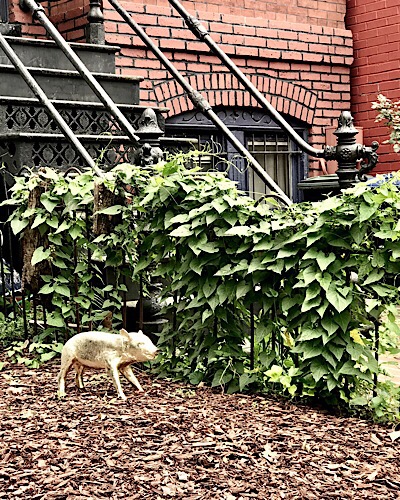
    I think it highly unlikely that the neighbor who chose to decorate a front yard with a silver-painted pig and wood chips intended in any way to reference Vishnu in his incarnation as a boar. But as I’m caught up in learning about the animal chariots and incarnations of the 330 million these days, that is what came to mind for me.  

    There’s a story that Vishnu incarnated as a boar to kill a demon who could not be killed by man or god (similar to the story about Durga slaying Mahisha, the buffalo demon).

    When in anthropomorphic form, Varaha is often seen with Bhudevi (Earth goddess) and sometimes also Lakshmi. There she is again–Lakshmi–calling to me to remind me to act from my abundance (from there comes my capacity to slay demons).

  • | |

    What is Beauty? (and “Ankle Loop”)

    When I was meditating this morning, the last lines of Keats’ ‘Ode on A Grecian Urn’ welled up in my thoughts: “Beauty is truth, truth beauty, — that is all/ Ye know on earth, and all ye need to know.”  How odd, I thought, for this to appear, as if out of nowhere.  I have been contemplating this week on what it means to be refined, but not in the way of an aesthete.  Rather, as I have been concentrating on the Anusara alignment principle of “ankle loop,” I have been thinking about how deepening our practice with repeated exploration and study we are able to refine our understanding and the flow of energy within us so that we can be more connected to ourselves and each other.

    As I understand the essential structure of the Anusara principles, the “loops” are really tertiary principles.  The primary principles are those of “attitude, alignment, and action,” which are the principles of how we practice.  The secondary principles are the fundamental physical and energetic principles — “opening to grace, muscular energy, inner/expanding spiral, outer/contracting spiral, organic energy.”  The loops serve to refine the secondary principles.  Ankle loop, for example, which starts at the base of the shin bone, travels down the back of the heel and then back up through the arch, energizes the foot, lifts the arch, supports our stance and helps us focus muscular energy.  When we are feeling challenged finding as much muscular energy in our feet and legs as would be optimal for a full expression of the pose, we can use ankle loop to refine our understanding and practice of muscular energy in the legs.  Keeping in mind the primary principles of practice, though, the refinements should also always lead us towards the heart and not just get us into details.  Getting more sophisticated and refined, likewise should not lead us to disdain for that which is unrefined.

    Funny, then, that the aesthete’s call to beauty should arise in my meditation while I have been consciously thinking about refinement.  What does it mean to appreciate and study refinements, but still honor and delight in a novice’s full expression of “attitude, alignment, and action” as much as an impeccably aligned and skillful pose that does not reveal a yearning for spirit?  Beauty may be truth, and truth beauty, but what is “beauty?”

Leave a Reply

Your email address will not be published. Required fields are marked *

This site uses Akismet to reduce spam. Learn how your comment data is processed.