Samsara
Pale cherry blossoms
Give way to green. Now the crab-
apples darkly pink.
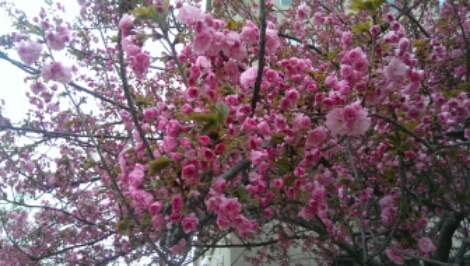
Pale cherry blossoms
Give way to green. Now the crab-
apples darkly pink.
I was grateful to be able to walk to my comfortable home with plenty of food and to notice the beauty, but still engage in discussion and action to address the current situation. I choose as my role models those who inspire me to think and work and engage more fully. What are the responsibilities that come with privilege–as much as one has (at this point I have more than most,whatever it took to be where I am)?
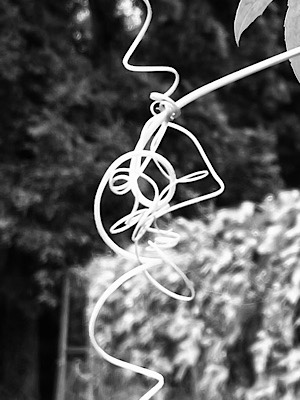
This will be my 20th season in my garden. I know that my back garden — where I grow my herbs, flowers, and vegetables — is easily 4-5 weeks earlier than the gardens of my friends’ in Potomac and Silver Spring and the outer suburbs. It is even almost that much earlier than my front garden. I have a brilliantly sunny, south-facing, protected back garden with a brick patio that is against an unpainted brick house and a densely shaded, north-facing front garden. Not only is the back garden sheltered from the wind by the house on one side and the fence on three sides, but the bricks retain enough heat to change the temperature by a a couple of degrees. I have a special micro-climate. My climbing rosebush (pictured in the header) is already in leaf.
What does this mean? While my friends in the suburbs or those with east/west facing houses are starting seedlings for kale and spinach indoors, I can put seeds into outdoor containers in the next week or two without compunction. The seedlings I would need to start (if I don’t instead choose to purchase them from the organic farmers at the market) are peppers and tomatoes for planting in mid-April. If I start with strong 8″-12″ plants in mid to late-April (depending on the 15-day forecast), I can have and have had for at least 10 of the past 20 years, cherry tomatoes in May and peppers in early June. My greens, obviously, bolt earlier. I’ve figured out that certain varieties of chard do better in these conditions, and that spinach and lettuce do better sheltered by the fence where they get afternoon shade, so that I can have them farther into the season.
This kind of knowing by combining general book and teaching knowledge with personal observation of my little space, is much like the yoga practice of svadyaya (self-knowledge), which is the fourth niyama of Patanjali’s yoga sutras. Svadyaya is literally study of the self through the scriptures. Implicit in that is the guidance of a teacher or guru. Ultimately, though, self-knowledge or awareness must be experiential. We make the effort to study and we listen to our teacher, but then we practice. We soften and open to who we (or our garden) truly are — another way of practicing and experiencing the Anusara principle of opening to grace — and then in the context of the teachings, accept who we are. As gardeners, that means accepting what zone we are in, how much shade, water, space, and sun we have. As yogins, it means accepting our strengths and our limitations. We can shift our zone by treating certain plants as indoor/outdoor or as annuals rather than perennials; we can enhance our water flow by storing it in rain barrels, but that is merely expanding the edge rather than making a complete change. We can expand the edge of our practice, but still need to accept the bodies with which we were born.
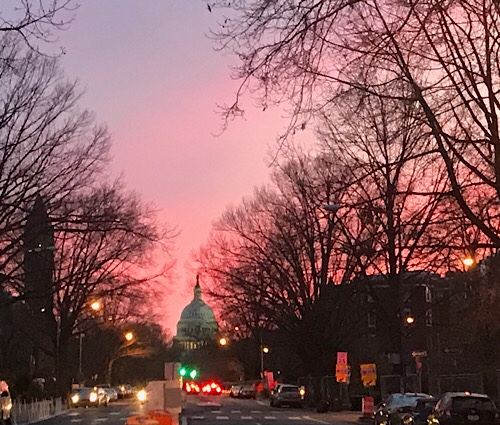
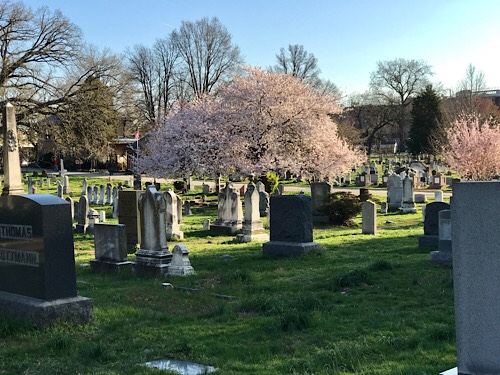
I have been walking earlier and earlier to be with those seeking communal isolation and not with those who simply have not yet managed to grasp that the severity of the situation also applies to them. This morning I was called to go to Congressional Cemetery and walk among the markers and spirits of the dead. I found it sparkling with light and new life.
My friend asked me tonight whether I’d gone over to the Supreme Court to see if there were any more heart-shaped clouds during the oral arguments today. I was occupied mostly by errands on my too brief lunch time walk (work was very busy) and didn’t get all the way over to the Supreme Court, but yes, there were more today when I was within a few blocks of the Court: