Art and Culture | Asana, Pranayama, and Yoga Practice | Community and Family | Food for the Mind (Yoga Philosophy, etc) | Photos | Quaker
Questions Around Town

I’m spending the weekend via Zoom with Michelle Johnson, for a “Skill in Action” retreat, where she is creating and holding the space for exploring how we individually and collectively can act to bring more communal justice, through anti-racist action, in our own lives, in the yoga community, and in society. She has been doing anti-racism work for 20 years, and has been practicing yoga and teaching since 2009. She published “Skill in Action,” in 2018. I read it several months ago. She said that she was flooded with orders the weekend after George Floyd was murdered.
What changed? Was it the confluence with the pandemic? Will we engage enough to make this an opportunity for lasting change or will those who are least impacted get weary or bored? What can would be allies do to help make it the former and not the latter?
I’m up late writing this after having spent a couple of hours dancing around and getting ready for tomorrow and contemplating and, of course, playing with Maitri.
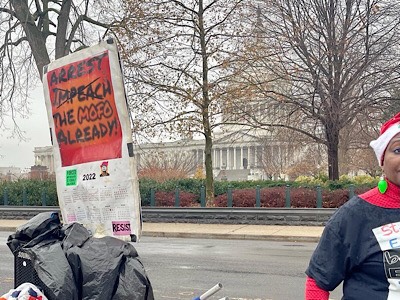
I went with a friend from volunteering at the youth garden yesterday morning to join with others to heighten awareness of the potential impact on the fabric of our fragile democracy of what the current Supreme Court decides in Moore v Harper, which was being argued.
We got to talking to one of the fellow demonstrators. I had pictures of N (for more from N, see @blacklivesmattermemorialfence), from a previous demonstration relevant to voting rights earlier in the year. After we confirmed the connection, N asked me if I was a lawyer for the government; it turns out N also remembered that I had given directions and ended up walking a few blocks together to the gathering near the Capitol for the one year anniversary of the January 6th insurrection.
We all talked about impact and whether it makes a difference if we only inspire a few people. I shared a story about one of the very few comments saying I had inspired being more politically active and outspoken in the yoga context. Maybe, I conjectured, it doesn’t matter if we only reach one person, because we don’t know who is that person and how they will be moved. N plans to make a t-shirt that says, “each one, reach one.”
To whom will you reach out? What moves you?
Earlier this week one of my long-time students emailed me before class to say that even though she had strained a muscle in her mid-back, she still intended to come to practice because she hoped it would make her feel better. “It even hurts when I laugh,” she added. I emailed her back saying that I would offer alignment instructions to help with her back, but I could not promise that we would not laugh (which, of course, she reported made her laugh). In fact, it was a class filled with much laughter, but applying the principles of alignment served to alleviate the pain the student had been experiencing.
Towards the end of the class, as we were getting ready to move into a seated forward bend, I asked my student what alignment principles she should apply to take care of her back in the pose. Demonstrating as she spoke, she said that she should spread her toes to activate “shins in;” take her inner thighs in, back, and apart to inner spiral her legs in order to widen her pelvic floor and enable curve in the lumbar spine, releasing some of the strain on her back; and then work outer spiral to engage and protect her back. “Perfect,” I said, “but what should you do before those actions?”
Another student jumped in, “open to grace.” Quite right, but how, I asked, would you apply “opening to grace” as a physical principle in this instance? That seemed a little like a trick question, so I explained how I use the action of “opening to grace” when I am working with an injury (obviously this applies all the time, but it especially applies both when working with an injury and when moving towards a more advanced pose than you have previously practiced.)
Opening to grace here means being patiently and exquisitely sensitive, moving slowly and mindfully enough to be able to tell from the beginning and throughout the entire cycle of entering into, reaching pinnacle (whatever that may be under the circumstances), and getting out of the pose whether the movements are serving to heal and expand before causing more pain and injury. Does any movement into the pose at all aggravate the injury? Does applying the principles gently make it better? Does applying them with fierce intensity help more? If we start with the strongest, we will have already gone past the place where we discover that resting or just a gentle attempt would have been healing or expanding, but any more would be aggravating. When we start with the gentle and sensitive and then move in deeper and stronger without losing the perfect sensitivity that is when true change can occur.
It never feels good to be injured, but because of the immediate motivation to get out of pain, injuries can be great teachers of just how much practicing with true sensitivity and awareness can enable us to expand heart and mind instead of just moving towards wilder poses for the sake of some idea that we are better yogis if we can do more poses.