Art and Culture | Asana, Pranayama, and Yoga Practice | Food for the Mind (Yoga Philosophy, etc) | Meditation
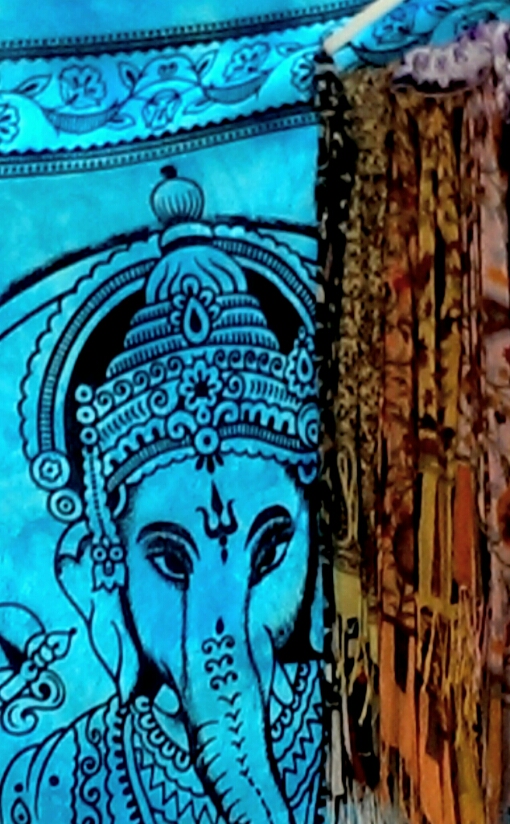
Jai Ganesha
Check out this link, and then, if it is something you want and care about for yourself and others, please call and/or write your elected officials. It’s not single payor (that’s what I believe would be best), but we should at least be able to offer something.
A raccoon at the
Night bus stop starts quite a cheer-
Ful conversation.

Peace and light, E — Posted with WordPress for BlackBerry.
 Last night another storm front passed us by with only a trace of rain, leaving us deeper in drought. The wind picked up, the temperature dropped, and the clouds scattered, leaving the sky scrubbed bright blue and the air fresh. Though this morning on my walk to work there was hardly a cloud in the sky, a rather menacing gray cloud hovered directly over the building where I work. Observing this odd cloud led me to ponder about how I often feel that I have my own personal cloud–everyone else has purpose in their lives and is worthy of love, but not me (this is a bit of an exaggeration, but you get the idea).
The reality is that all of us get such feelings to a greater or lesser degree some of the time. It can be a helpful step in clearing away feelings of unworthiness to remember that it is part of the human condition. The tantric yogis say that there are three cloaks or malas (anava mala, mayiya mala, and karma mala) that result from the manifestation of diversity from the pure universal out of its own play. The sense of unworthiness we sometimes feel (anava mala) comes from forgetting that we are spirit, and anava mala– in whatever form it appears to manifest–is just because of the loneliness of not remembering our true self. When we experience or create conflict or unhappiness out of the illusion (maya) that separateness and distinction are the only state of all that is real then we are in thrall to mayiya mala. When we think we are completely in charge and responsible for everything we do and how it impacts the world, that is karma mala at work.
We practice to pierce through the clouding of our individual consciousness by the malas. By inviting ourselves to open to the luminous space of consciousness and to surrender to the very fullness of our being, we reduce the impact of the malas on how we conduct our lives. Our practice helps us to remember our worthiness so that we can be happier and freer and do our work and engage in our relationships with more love and light. It helps us remember the light in each being so we are naturally drawn to respond with more compassion and friendliness to everything on the planet. The grace of dissolving kriya mala is that when it is not obscuring our vision, we can engage fully on our path, but still accept that we are ultimately not in charge and do not know what the universe truly has in store.