Blossoms Around Town


Here’s an aerial view of the back garden on the equinox after I spent several hours cleaning, deadheading, repotting, mulching, etc. As you can see, the moss is ecstatic from having had the weight of the snow on it for several weeks. Coming up in quantities almost enough to pick are lettuce, spinach, cilantro, parsley, chives, onions, lemon balm (always have too much of that — if you’re local let me know if you want some). The first rosebud emerged sometime between Friday and Sunday. It is hard to believe that just a month ago, I was blogging about indoor gardening — how to find delight even when snowed under (scroll to the bottom of the linked post to compare pictures of the same view).
As you can see from comparing the two photos, things were still growing under the snow or getting ready to do so. That is what practice is like for me. Sometimes I feel completely snowed under by an injury or rush jobs at work or personal circumstances beyond my control. I keep practicing, but I don’t have the time or energy for long practices or full weekend workshops, when it is easy to get to a place of delight. Other times, things are less pressured, and I feel brimming over with health. Then practice feels wildly effulgent. For my garden to offer its full potential (as is true with my practice), I need to spend lots of time and effort in it for the next several weeks. I know that if I do so, I will be blessed with fullness.

Thanks to Cate Stillman for sharing these quick and easy tips for comforting, grounding, and realigning after sustaining trauma. Actually, I’m all for warm, tasty, moist one-pot meals and walking throughout the cool and cold season. Most of these tips would be of service for healthy and happy day to day living regardless–just add some fresh things from the garden or the farmer’s market and double or triple the walking time.
From late September through the first week when there either are two or more nights forecast to below 38F or one night below 35F, I assiduously watch the 15-day weather forecast to determine when to bring in my tropical plants (orchids, bromiliads, a night-blooming jasmine plant (now 8 years old), a bay tree in a 24 inch pot (now 12 years old)). I also bring in the lemon grass and lemon balm I have in containers so that they can be the perennials they would be in a warm climate; here, left outside, they are annuals.
When I first had a few orchids — over 10 years ago now — as soon as there was a hint of cold weather (below 45F) I rushed the plants inside, believing that if they were tropical, they needed to be inside. In one of the early years, the first night below 40F was in late September. The plants really suffered from a full seven months inside. I have since learned (by studying and personal observation) two things about my tropical plants. The first is that they are a lot happier outside than inside (when inside is not a properly humid, sunny greenhouse). The second is that they like cold weather as long as it is not near or below freezing. They especially like cold rains like we had the other weekend. The stress of a few weeks of nights in the 40sF, in fact, seem to help the orchids bloom. Now, by waiting until the last possible minute, and bringing them out as soon as it seems like the danger of last frost (for my backyard, which is very early) has passed, the orchids are outside at least seven months of the year.
Thinking about how the orchids flourish with the stress of some chill, but not too much, reminds me of what my teacher John Friend talks about in yoga practice of the difference between stress and distress. Some stress actually strengthens us. This is why one of the best ways to avoid or at least slow the process of osteoporous (according to the general medical literature to I’ve read) advocates weight-bearing exercise. Putting weight, i.e., stress, on our bones and muscles strengthens them. Too much, too fast, however, will injure our muscles and bones.
So, especially for those of us with injuries (prior or current) or physical challenges such as arthritis, it is optimal to exercise, to seek our edge, to put ourselves under stress, mindfully and intentionally. We need to be aware, though, of the subtlety of the edge between stress and distress so that we are strengthened not injured, just as exposing the orchids to some fall weather invites them to bloom, but actual freezing or near-freezing temperatures will harm or kill them.
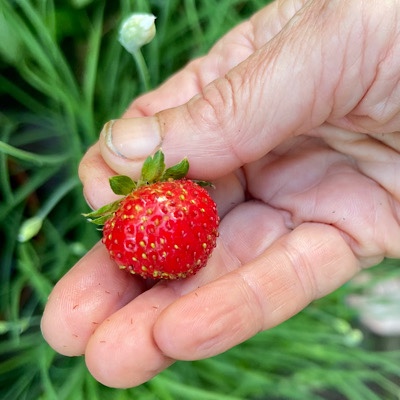
One perfect strawberry. With an abundance of garlic chives in the background.
Where are you placing your focus?