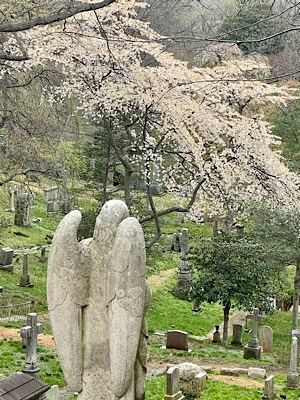
Angels Around Town
Sky was having a
heart-shaped clouds everywhere
you look kind of day.





The “shelter in place” signs in my building demarcate suites where designated groups of employees are supposed to gather in the event of a threat to human safety where it would be safer to hunker down in the building than to go out.
While I was sitting through a seemingly interminable, pointless, but only somewhat acrimonious meeting this morning, I was thinking how important it is to have a space within our own consciousness where it feels safe and peaceful even when we are in a situation where staying physically put is the most realistic alternative. This got me thinking about one of the powers (siddhis) that allegedly may arise from a steady, devoted, and long-term practice. That power is the ability to bi-locate–the power to be in two or more places at once.
I’ve long practiced with part of my goal being to cultivate the space of meditation as a way of making bearable the unavoidably painful, such as when confined to bed because of severe illness. In such a situation, though my experience is thankfully limited, going into meditation is a going to another space of consciousness, but does not require staying mentally engaged and present.
When in an unpleasant meeting or stuck in traffic or similar situations, the problem is that one needs to stay mentally and physically alert and present and cannot just go off into bliss.
Then, I think the power of bi-locating is what would serve best. It would enable being simultaneously present and functioning while also being in the blissful and peaceful state of meditation. The space we go to in meditation would indeed then be a “shelter in place.”

Peace and light, E — Posted with WordPress for BlackBerry.
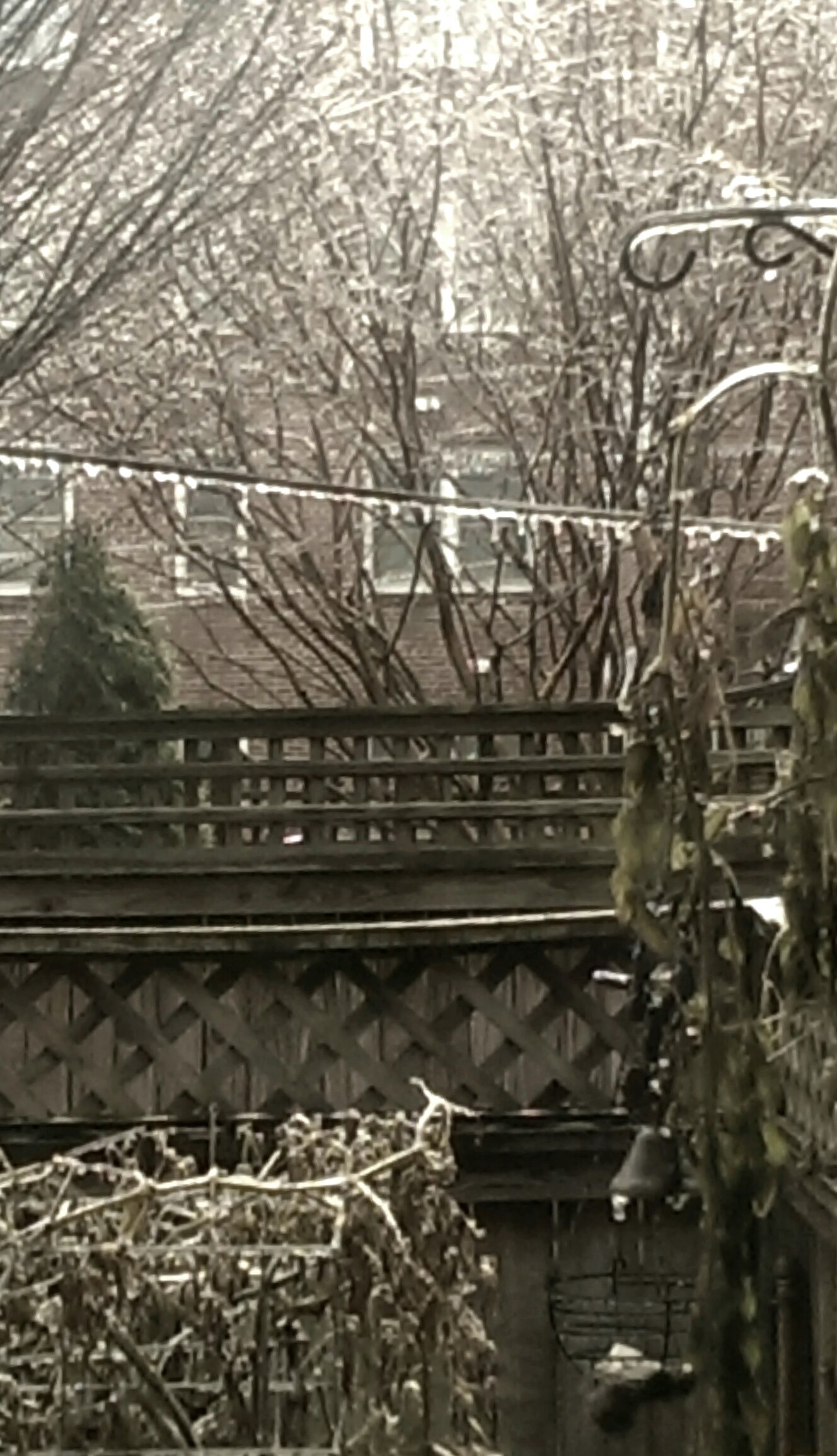
It is forecast to be nearly 60F tomorrow. Despite the arctic incursion and the ice, the kale may revive itself; it has happened in previous years.
Last night I went to see the revival of the Bernstein musical version of Voltaire’s Candide, now playing at the Shakespeare Theater’s Harmon Hall (discount tickets available), which was absolutely a delight — fantastic staging and direction, luxurious costuming, enthusiastic performances. Throughout his journey, which is beset with cruelty, hardship, natural disaster, and other mishaps wherever he goes, Candide sings of his tutor’s optimistic advice that “all’s for the best in this best of all possible worlds.” The application of this philosophy leads to some silly results, including the Monty Python-worthy lyric “it’s a great day for an auto da fe.”
I have a friend who, after telling me of various life challenges and griefs, inevitably signs off with the phrase “it’s all good,” though I am not sure she believes it. I thought of her repetition of the phrase “it’s all good,” while I was watching the musical. Later in Candide’s travels, he encounters a second philosopher scholar who (I’m paraphrasing loosely) contradicts the “it’s all for the best” philosophy of Candide’s tutor by telling Candide to just look around and he will know that things are not in fact always for the best. A fluffier version of the debate in the novel, as to whether things are all for the best when there is so much cruelty and devastation, is interwoven into the rest of the play.
I’ve never had a desire to wear the t-shirt proclaiming that “it’s all good.” I look around me, and I simply do not believe it. I do believe wholeheartedly, though, Voltaire’s premise that we have the responsibility to “cultivate our garden.” As my teachers John Friend and Paul Muller-Ortega espouse, we should “respond from the highest,” regardless of what we experience and encounter. By having our response make the best of all possible worlds from things that are not evidently for the best, we bring more light into the world, whatever is our world view. I can only hope that with steady practice of yoga and meditation, I can keep ever truer to these teachings when I am seriously challenged.