| | | |

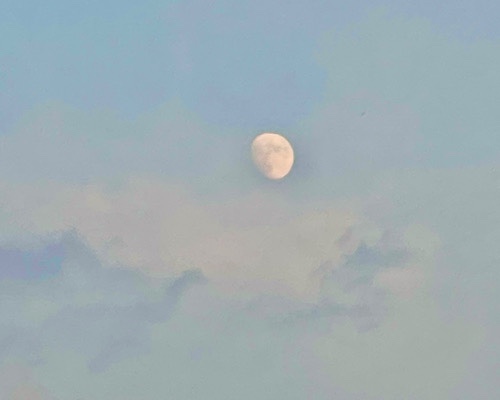
Waxing Moon/Hazy Sky

The haze is from the wild fires out west. What might you be able to forego—perhaps a plane or automobile trip—or a degree or two less cooling from any air conditioning you might use to help minimize your contribution to global climate change? Sometimes I have better answers for these questions than others and sometimes I am better at following through, as with any practice.

Similar Posts

  • | | | |

    “You Who Choose to Lead Must Follow,” Argentinian Tango, and the Dance of Shiva and Shakti

    On Friday night, Professor Douglas Brooks offered a satsang that was hosted by District Kula. One of the attendees, who said that she did no yoga, but taught Argentinian tango, wanted to know about what she had heard of yoga talking about the dance of masculine and feminine because that’s what tango is all about.

    Douglas gave a quick overview of the idea of the tattvas as a foundation for an answer to the tango dancer’s question. As part of this background, he discussed the numerological aspect of the tattvas, saying that Shiva and Shakti relate like this:  one is two becomes three becomes five. The two must separate, and the space between them makes three and teaches us the one.  Because of the spaces between, we do not have one to two to four, but two (one because inseparable) to three to five.  We know the one only when we know two, and the one is therefore part of three.   (“Lovely dance of numbers; that makes perfect sense,” I thought, having a happy geekfest in my own mind.  “I’ll enjoy pondering how that might be an explanation for there being five top tattvas and not six or four and wondering whether I had even begun finding an understanding, even though what Douglas was talking about is something I have been contemplating for years in various ways and contexts.)

    Douglas then led into a description of the inseparable, inextricably intertwined nature of Shiva and Shakti.  “It is like that in tango,” the dancer interjected at multiple points.  “The better the leader, the more he is listening to the follower, thus allowing the follower to be the leader.”  Each time Douglas refined his response, the dancer offered something else about her experience with tango.  “Right, when they are dancing well, the man takes on some of the characteristics of the feminine, and the woman that of the man.  The difference between them starts to dissolve into the dance itself.”  Her eyes lit up, and she bubbled up with speech, in her excitement at finding in the tantric philosophy what appeared to be an explanation of what she experiences in the tango.

    The tango dancer and the yoga texts assign specific roles and attributes to the masculine and the feminine, and we tend to fall into that tradition when we discuss the tantric philosophy.  As much as the traditional tantrika or tango dancer might say that the masculine and feminine (when embodied) take on/have characteristics of each other, they have assigned masculine/feminine roles to play, and they are still stuck in a paradigm that keeps real humans in assigned roles.  These assigned roles impact how male and female are permitted to act in society, regardless of any recognition that who is actually, rather than technically, in charge may be in flux on different levels.

    The paradigm of tango dancing kept Friday night’s discussion within the context of typical and rigid roles for male and female, but I do not think that is a required way for us to think of how to bring the tantric yoga philosophy into our lives.  When we think of the tattvas as abstract principles, we do not have to privilege in our lives or own thinking the traditional divide between male and female roles as the basis for understanding the play of opposites (though to be true to the text in its historical context we do).

    I believe that the dance of shiva and shakti is as much about the dance between the universal and multiplicitous individuality as it is about the specific play between masculine and feminine in assigned roles.  The one is two.  The two (one) separates into three; when the two separate we discover the one (two), and after that the three becomes five.  I remember a friend saying in our college days, “There are three of us in it:  there is me, there is my loved one, and then there is our relationship.”  To be in the world and relate fully, the tattvas (and dances with partners of either sex) teach us that two are inseparable by being in relationship.  By recognizing the appearance of separation, the dance of Shiva and Shakti tattvas shows us the relationship — the oneness.  Thus, all consciousness is one, but two, and then three, and yet still one.

    How this informs me, other than enjoyable thoughts in my head, is that when we try to be spaciously and openly aware in all of our relationships of this elemental play of individual identity, separability, and indivisible unity, we see the other in ourselves and ourselves in the other.   This helps much to inspire friendliness, understanding, and compassion.  It also helps bring understanding of the leader when we are following, which it makes it easier to follow with discrimination, but without judgment.  When it is our turn to lead, it helps us know that for those who might choose to or be required to follow us for some particular project, that to lead well we must listen to the followers.  As the the Grateful Dead taught me decades ago, “you who choose to lead must follow.”

  • | | | |

    Potage D’Ete Au Mid-Atlantic (and jivan mukti)

    potage Could not resist the french name.  More fun than summer local vegetable stew.  An alternative name could be:  how to make three okra and six beans into dinner for two.  Or maybe four.  When I was out in the garden this morning, I simply picked what needed to be picked.  Featured here:  three okra, six beans, one jalapeno, two ancho chiles (one partly dried on the plant), two large tomatoes (both of which are only partly viable), two ripe and one green (fell off while I was picking the ripe ones) roma tomatoes, one very small garlic clove, baby leeks, garlic chives, tarragon, parsley, dill, and herb fennel.  Serve over quinoa, couscous, rice, or pasta, and it is easily a meal for two.  Add some red beans or other dried beans, and it could be dinner for four.

    One of the things I like about eating from the garden is the necessity of being creative.  Cooking from a cook book, who wants an ingredient list this long?  I could also be disappointed that no one of my plants is giving me enough to create a dish out of mostly one or two ingredients.  If I were getting these ingredients from the store, I would get more okra or beans or peppers.   There is a great joy in finding a sense of abundance and sparked creativity and celebrating pleasure, art, fulfillment, delight, offerings with what we have been given, whether it is the food from our garden, our bodies, our talents, our families, or the time and place into which we were born.  In finding the highest sense of abundance and creativity within our limitations, we are truly experiencing the yoga concept of jivan mukti, living liberation.

  • | | |

    Best Possible Holiday Walkabout

    I may have a nagging cough from a cold that started over a week ago, and it might not have been the ideal of a walk in the woods with a beloved, but I had the best walkabout possible today.  The air was mild, and the rain held off until mid-afternoon, leaving plenty of time to get out and appreciate the day.  Enjoying that I did not need hat or gloves, I walked for a couple of hours around the neighborhood before I went to the Sunday jam to dance.  I picked up a few things that I needed, said hi to neighbors who were also out walking, and looked at trees and clouds and invited myself to be filled with gratitude for what I have.

    I was thinking about the exhortation to have the “best possible day.”  Before I started my walk, I got an email from a friend about setting a date for lunch, and she said that she’d had the best holiday possible.  I think it was in response to my wishing her such–the best holiday possible, that is.

    I’ve long stopped exhorting people to have a happy holiday or a merry christmas because I have no idea what might be going on with them (or, I do have an idea).  I have enough friends, neighbors, co-workers, and acquaintances who are facing serious challenges–illness, difficulties with work or difficulties getting work, kids stumbling to get through life, relationship complications, elder care navigations, loss of a loved one, or loneliness–that wishing a happy holiday might be kind of clueless.  And then there is the state of society and the world.

    Thus, I wish that we are able to recognize and experience what we have that is good (while working to make healthier and more life-enhancing choices/changes for the things that are not good that can be changed) and bring out the best in ourselves in navigating all of life–the best possible holiday, day, year, etc.

    best walk 1a best walk 1b best walk 1c best walk 1d best walk 1f best walk 1g


Leave a Reply

Your email address will not be published. Required fields are marked *

This site uses Akismet to reduce spam. Learn how your comment data is processed.