Signs Around Town


This morning I decided it was time to have a public “Rose Garden Yoga” page on Facebook, in addition to the page under my name.
Before I even figured out whether I had done it correctly, a couple of friends had hit the “like” button. I still do not know when and where it appeared so that would happen. After browsing around, I did figure out how to “share” with my friends that I had created the page and that brought in a few more. I have also added a widget to the welcome page of the blog/website, so people can “like” “Rose Garden Yoga.” (Please do).
Did I need to do this? Absolutely not. Do I find knowing my way around these mediums of expression useful? Yes, because they have become so important to how we communicate with each other across generations, the planet, and various social divides. Do I mind that getting it just right or perfectly current takes more time and skill than I have from just experimenting? Not really. When I want to do more, I spend the time to learn or hire someone to help. It is also sort of fun to just mess around and experiment and discover whether I can figure it out just by trusting that if I try enough different things and don’t get frustrated by not getting it “right” right away, I will end up either with something that serves well enough or will decide it is not that important and let go.
There is a specific sequence to the major Anusara alignment principles even though ultimately we are doing all of the alignment principles simultaneously. “Organic energy,” the action of reaching out and making offering is the fifth of the physical principles. We do not reach out until we have softened and listened (opened to grace), intentionally drawn in with nurturing, focused embrace (muscular energy), expanded with discrimination (inner or expanding spiral), and drawn in again with discrimination and awareness to concentrate the energy (contracting or outer spiral). We do, in fact, need to be aware and open, to be nurtured, and to study and expand with refinement, to enhance our ability to make offering and to serve in the most optimal way. So we take care of ourselves and draw inward as much as we reach out to keep ourselves in balance.
Once we have taken care of ourselves, though, it has been my experience that without reaching out, there is no true strength or meaning in either a yoga pose or in life. Organic energy as a physical principle is expanding from bone to muscle to skin, expanding outward from the midline, and reaching from the core to the periphery. How I experience organic energy at its most supporting is a true reaching out, an offering of the energy created and refined by the other practices.
What is the point of a self-embrace or personal enlightenment if it is not used to serve, to offer the love and wisdom cultivated by the practice? Organic energy is what changes yoga (on and off the mat) from being enjoyable “navel gazing” and being a source of power that helps us brighten and shift not only ourselves, but our relationships and all around us.
When a hurricane that is predicted to be perhaps the worst in 50 years for the East Coast shares the same name as one’s mother, news of the impending destruction is bound to bring up childhood memories.
I grew up with the song “Good Night Irene” as part of my childhood mythology. My parents met in Greenwich Village in the late 50s, which was a time when folk music was the thing. We all love songs about someone with our own name, so “Goodnight Irene” was one our mother taught us. If memory serves, we had recordings in the house by Leadbelly and the Weavers to which my older sister and I danced around the living room.
A search in You Tube reveals that it has been a popular song to cover for decades. Which is your favorite?
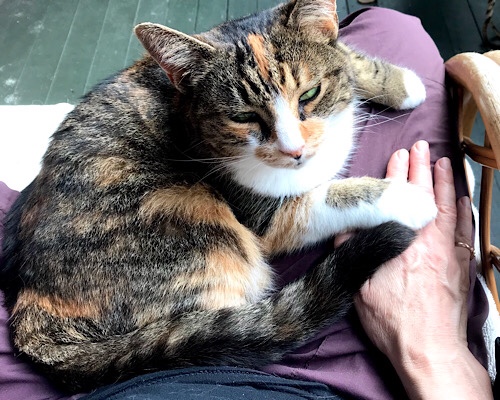
You wouldn’t know, from seeing Maitri enjoying the shade while the sun shines brightly on the curtain of beans and soon to come next wave of cherry tomatoes, what an extremely agitating work day I was having that started too early and was not as productive as I think would have been desirable.
Work day done, I prefer to remember the moments with Maitri and out in the garden.

When I think of the Anusara principle of calf loop, I think of playing with drinking straws as a child. I’d take the straw out of the glass and bend it back and forth. The straw would end up with a horizontal crease where it was bent — not quite a break — but the place where it bulged at the bend would prevent the straw from serving the purpose of enabling liquid to be drawn up through it. When our knees (or our elbows for that matter) are hyper-extended, I think it disrupts the energy flow from the periphery to the core, weakening the pose, and breaking the integrity of the alignment.
As one whose legs started out bowed (though less after over six solid years of working “shins in/thighs out”), my natural tendency is to hyper-extend. I find that using calf loop, I do not hyper-extend. Calf loop (also called “shin loop”) has us draw energy from the base of the shin, up the back of the lower leg, and loop it through the top of the shin and then back down the front of the leg. We wouldn’t ever start a pose thinking about calf loop, but in the flow of a pose, after the major principles are activated, including muscular energy, we can enhance muscular energy and the integrity of the alignment of the knees by focusing on calf loop. When I practice calf loop, I find that it lifts the calf muscle and draws it more firmly into the top of the shin, and moves the top of the shin forward. These actions do not bend the knee, but firm the muscles behind the lower leg, including the calf and the popliteus (which is the muscle behind the knee that flexes the knee) to the bone.
What is tricky — especially for those who tend to hyper-extend, is that getting the knee in proper alignment feels like bending the knee. If we have been out of alignment, changing our stance will feel strange and perhaps “not right” at first. The sweet subtlety of practice (whether trying to expand our ability to do poses, heal and injury, or live in better alignment overall) is learning what is true integrity in a pose and what is habit, what will serve and enhance and what does not.