Visit from a Crow


She was banished to the outskirts of town by the patriarchy, but the outskirts are nicer than the center of town these days (not actually sure whether the latter is true).
She is unassuming on the surface and secretly wild, and she is completely self-sufficient.
I just reread Marilyn French’s The Woman’s Room and it has me thinking about Kali.
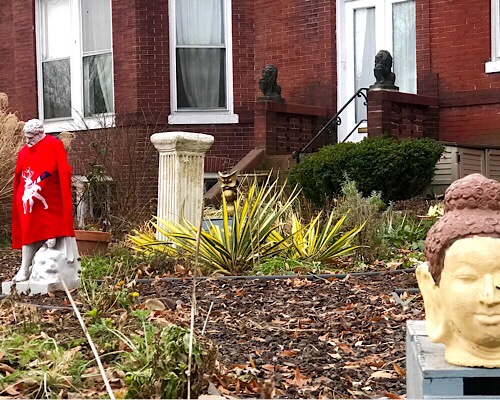
Photo taken in front of the Kali temple just outside of Chidambaram on January 1, 2014.
One of the most profound and essential teachings of the great yogis is to “watch the gap.” We are given the practice of watching the gap, the space, the pause, the turning point between the in breath and the out breath, the out breath and the in breath. In the gap, we are able to witness perfect fullness (purna) and perfect emptiness (sunyata). In minding the gap, we can experience perfect stillness and serenity. It is an extraordinary practice in its simplicity and in its gift of peace and repose.
Whether you have never heard of this practice, learned it at some point but have mostly forgotten about it, or just did it with your own practice, I invite you to take a few minutes on reading this: make your seat steady and as comfortable as possible, close your eyes, invite an intention of finding a still spaciousness in your heart. Draw your attention to the breath and start to notice the space (maybe almost instantaneous and unobservable, maybe a real pause) between the in and out breaths.
If you are moved, comment on your experience to share with each other. There is no one right reaction nor a wrong one. If it was challenging to sit still and focus, just be gentle and soften to how enjoyable it can be to do nothing other than watch the breath, like the sweet and easy restfulness of watching the movement of waves at the beach.
Peace and light, E — Posted with WordPress for BlackBerry.
One of the offerings in John Friend’s Anusara Teacher Training Manual, is the “four gates of speech,” which I believe comes from Buddhist practice. The four gates are:
1. Is it truthful?
2. Is it necessary to say?
3. Is it the appropriate time?
4. Is it a kind thing to say?
It is easy to see this application in terms of speaking with others, though not always easy to practice, especially in a group setting where the culture is to condemn and criticize.
A more subtle practice of the four gates is how we talk to and about ourselves. I am someone who was raised to have a very strong internal judging voice. Although with the steady practice of yoga affirmation, my tendency for self-judgment has eased, the propensity reasserts itself when I am stressed. I have taken to asking myself, when I hear the judging voice, does it pass the four gates of speech? I find it a challenging practice, but a necessary one. When we honor ourselves (we can honor ourselves and our own light and still know there are ways we would benefit from expanding or shifting), we will more easily honor, recognize, and affirm the light in others.