Down By the River
I get lots of emails asking me to engage in e-activism — write letters to Congress, write letters to corporate executives, write letters to the President, sign petitions — and, of course, requests for donations. The requests I get are from a wide range of public interest organizations, including environmental, women’s rights, peace, civil rights, worker’s rights, care for animals and other wildlife, organic food, good science, enhancing education, the list goes on. Sometimes I just hit the delete button. Sometimes I sign the petition. Sometimes I hit the send button on the form letter. Sometimes I edit the letter personally to make it a more powerful statement. Sometimes I give money. Sometimes I both write and give money. Sometimes I learn something that invites me to change how I consume or invest my money, and I try to make a shift.
I received an email today from the Rainforest Action Network asking me if I would make a pledge to help end mountain top removal. I power my electricity with 100% wind energy, now through Clean Currents, so I am not using coal-powered electricity myself at home. I sent RAN another donation; I really believe in what they do. I also agreed to do a blog post on why it is important to end mountaintop coal mining as part of my pledge. It’s utter and nearly permanent devastation is horrifying and wakens me to the repercussions of consumption without conscious knowledge of the impact. Seeing the pictures makes me think about everything I consume (and I am already an overthinker). I welcomed the invitation to pledge to spread the word.
In yoga, the concept of “sangha” or community carries with it the meaning that you become those with whom you keep company (so therefore keep good company). I subscribe to all these activist list serves and seek out those who are more engaged than am I, so that I will be inspired progressively to live with more consciousness. I thank RAN for inspiring me to extend the invitation to look more closely at how we can shift our energy consumption still to enjoy reasonable fruits of our technology, but not in a way that destroys the possibility of a good life for others in the present and for eons into the future.
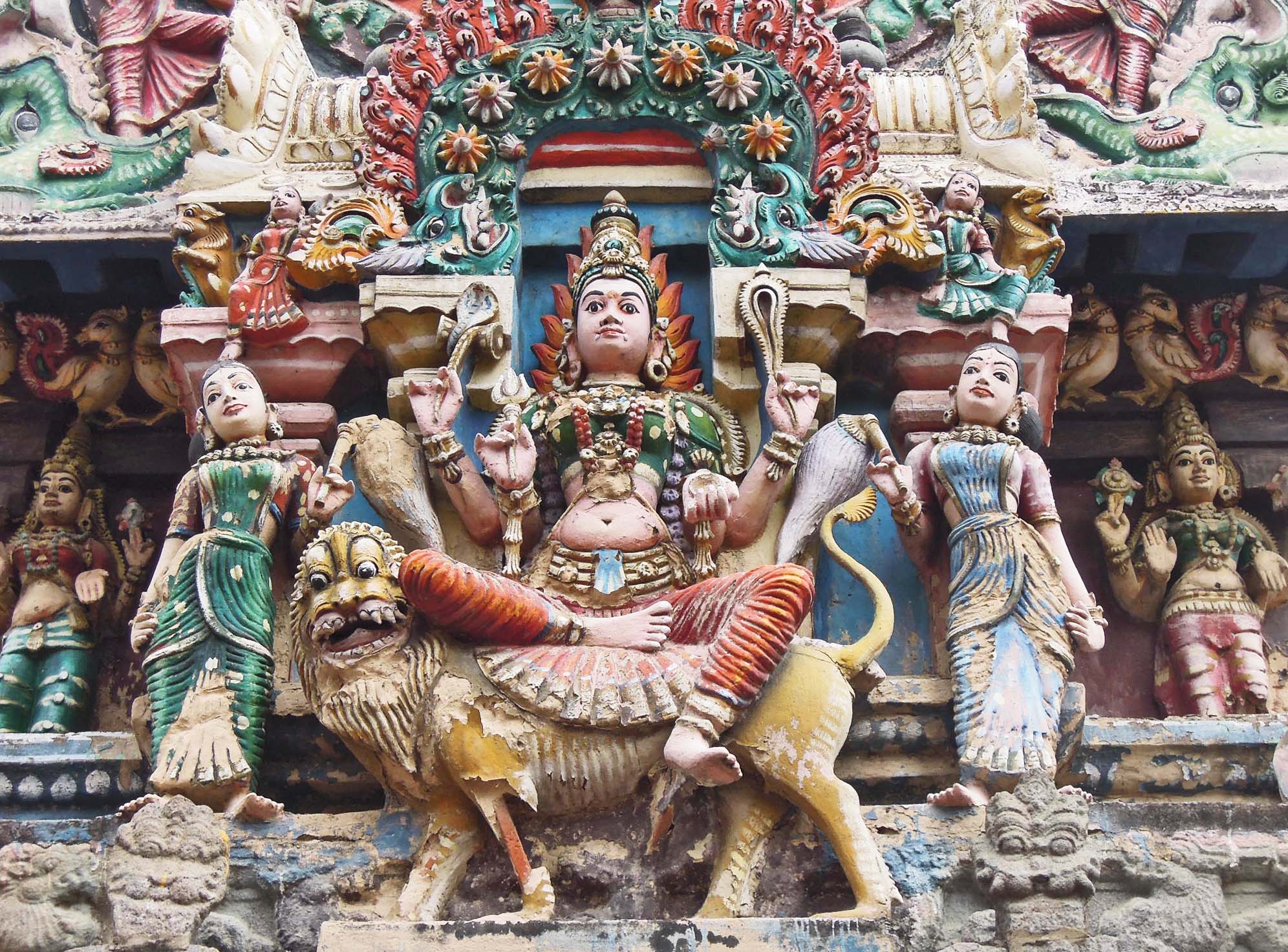
One of the most extraordinary things about the effulgent creativity and the omnipresent display of the pantheon in India is its unabashedly vulnerable nakedness about our deepest fears and desires (the ones we usually try so hard in the West to keep private).
One of the first things I did when I got home was to start several kinds of sprouts. Soaking beans overnight is, if you think about it, just a prelude to sprouting. I often sprout beans for a few days even if I plan to cook them. Once they have just sprouted (usually after two+three days), cooking time to tender is only 10-15 minutes. I had some sprouted chickpeas, a couple of potatoes in cold storage (aka the vegetable bin in my refrigerator). Today was the first day I was really able to get into the garden since my return. In addition to carrots, I was able to pull a substantial quantity of various greens: kale, chard, curly endive.
The stew: saute in olive oil (or a mix of olive oil and butter), minced onion and garlic, diced celery and carrot until translucent. Add to pot peeled and cubed potato and sprouted chickpeas (if using only soaked chickpeas, cooking time will be 3-4 times as long; or you could use already cooked chickpeas) and stir to coat with cooking oil. Add a couple of dried hot chilis (optional) and some sprigs of rosemary and oregano (fresh is best). Cover with vegetable stock or water and cook until chickpeas and vegetables are tender. In a pressure cooker this took about 10 minutes. Chop whatever fresh greens you have on hand (anything, but collards; if all you have are collards, kidney or pinto beans would work better than chickpeas). Add the greens just before serving and cook only long enough to wilt greens. Season with salt and black pepper to taste. I used rind from a spanish rosemary-crusted goat cheese when cooking. This would be optional, but if you want just a hint of cheese flavor, cooking with the rind of a hard cheese is very nice.
Ah, it is good to be home.

Peace and light, E — Posted with WordPress for BlackBerry.
A samskara is generally defined as an impression left in us by a past action or experience. I found myself thinking about the process of samskara yesterday, when I went with long time friends of my family to watch their son taking class at the summer program at the Kirov Academy of Ballet.
I have not watched a ballet class (except on the occasional film) since I was actively studying ballet as a teenager and young adult. I have long been conscious of how ballet imprinted my body image and way of looking at myself, but have not found a space before where I was able to look at this aspect of my history with fresh eyes.
What was different yesterday, was that I was observing with openness. I was sitting with people I have known all my life, sharing their warmth, love, and parental pride for their son, rather than concentrating on my own history. It brought back memories, but not in the same way that sitting by myself or with a girlfriend, watching a documentary has done.
In this open state of reflection, I witnessed something that I knew at some level, but had not given much thought to before: how much having taken thousands of hours of ballet class has informed the way I teach. My tendency in my own practice and in my teaching to see the details of alignment and to try asanas repeatedly until it seems that I or my students have experienced the alignment in the most optimal way for the day is straight out of my experience in ballet class.
Softening and witnessing instead of feeling or judging from past experience gives the possibility of shifting from samskaras, even ones that are very deeply etched into body and mind. Being with my friends yesterday, of course, gave me the joy of seeing the spectacular dancing of these young men and the delight of connection. It also gave me the unexpected gift of a moment of understanding how the Anusara principle of “opening to grace” allows us to shift. When we are open, nonjudging witness consciousness (an aspect of “opening to grace”), that is when we have the possibility with each thing we repeat, to experience it new without being bound by our samskaras.